Category: Following Christ
-
Forgiven, or Transformed to Righteousness?

For centuries, the traditional, Christian interpretation of Jesus’ death has been that it was an atonement for the sins of those who would choose to “believe” and follow Him. This scenario portrayed a kind of cosmic cleansing for those who believed, though no one told us what that meant. A common assumption is that having one’s sins atoned for/forgiven is having them excused. For the record, not everyone completely bought the cosmic cleansing story, citing texts (e.g. Luke) that didn’t completely embrace the sacrificial atonement theme.
-
The Letters of James and Paul — Different?

There is an undercurrent of opinion amongst scholars of the early Church and Bible students that James, the brother of Jesus, and Paul the Apostle proclaimed two different gospels – that the book of James contains an authentic look into 1st century Jewish Christianity and what his brother, Jesus, taught, while Paul’s epistles lay out a completely different “religion”. Some of these also believe that, since Paul wrote first, that aspects of his letters were borrowed by the Gospel writers, thus propagating the Paul version of Christianity throughout nearly the entire New Testament. Is this viewpoint correct?
-
Paul’s Real Gospel

When you hear a respected biblical scholar reinforcing with conviction what you’ve been learning – and teaching – for the last ten or twenty years, it’s a big deal, not to mention quite the affirmation. Such was my case in coming across a lecture by Dr. Jason Staples (one of my favorite New Testament scholars) in 2024 entitled “Salvation by Moral Transformation: What Paul Really Meant by Grace”. Not to be too dramatic but Staples’ insights into Paul’s real message will be at least as explosive within the traditionalist community as was “The New Perspective on Paul”[i] of Messrs. NT…
-
Did Jesus Say He Was YHWH?

In a recent video interview, Dr. Jason Staples presented the outlines of his argument that lexically, Jesus referred to Himself as YHWH in both Luke and Matthew. Now, if you’re comfortable with the whole “son of God” characterization, this may be a bit jarring
-
What Did the “Law of Moses” Mean To…?

This post presents a three-part series looking at what the term “Law of Moses” (and similar) meant to different people at different times in the Bible; 1) The Israelites, at various points in their history, 2) Jesus (in His many interactions with others involving His understanding of its meaning), and 3) Paul, who infamously dismissed “works of the law” as valid for justification of his Jewish brethren.
-
How Jesus Taught
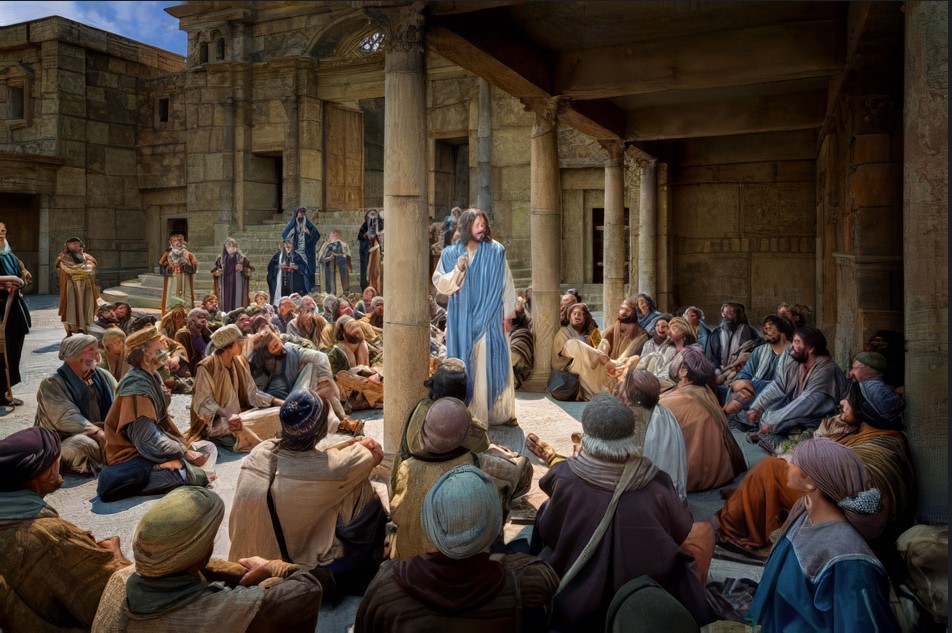
When we read Jesus teaching in the New Testament, we know instinctively that He is speaking and teaching differently than we do today in the modern West. How is it different? What influenced His teaching “style” that we have become so familiar with over the years, but remains so distinctively “foreign” to our modern, Western ears. That’s what we’ll dig into and explain.
-
Make Man In Our Image

What does “Let us make man in our image, after our likeness” (Gen 1:26) mean about us? And, what does it mean that God gives man “dominion” over the living things in His Creation? And, what on earth does this have to do with prohibiting them from worshipping idols? Let’s find out.
-
Developing Spiritual Fitness

Most of us think about our spiritual lives (when we think of them at all) as cerebral, passive things: things that just are, likely supported by some “quiet time”, perhaps some Bible reading, and prayer. However, our spiritual strength is only truly developed when, like a muscle in our body, it is stressed, and stressed repeatedly.
-
Interpreting the New Covenant

There is substantial controversy surrounding the proper interpretation of the announcement of a New Covenant between God and Israel and Judah (Je 31:31-34, Ezk 36:24-28). Both the Jewish and Christian interpreters spin its interpretation to suit their theological views, leaving no consensus. Let’s see if by working through the texts we can discover the truth.
-
New Life in the Kingdom of God
In the second three chapters of Ephesians, Paul casts his revolutionized view of human life and interrelationships that, as much as any portion of his epistles, brings into sharp focus the life transformation that followers of Christ should both expect and strive for.
-
A Call to a Radical Christian Revolution

The premise of this note is that in order to rescue this civilization, Christ Himself is going to have to “appear” in the world to demonstrate to its inhabitants that He is the way, the truth, and the life. And, since we Christians are the members of His body on earth, that job falls to us.
-
Love Your Neighbor as Yourself

Most will recognize this title as one of the most famous admonitions of Jesus of Nazareth. But most of us don’t have much experience in fulfilling it. How can we turn this around?
-
The Obedience of Faith

In this note we’ll look at this imperative of obedience to Christ as portrayed in the Bible, and uncover some insight into what the Bible means by “obedience” and “believe”.
-
Recovering the Gospel – II

Here I want to look at, to the degree we can, how Jesus Himself thought about the Gospel He was bringing. What did He think the Gospel was that He was bringing, and, more importantly for our present situation, how did He see it being enacted?
-
Recovering the Gospel – I
When you hear the term “Gospel”, what story or message comes to mind? When you hear the statement “Believe and be saved”, what does “believe” mean to you? And when you read: “For by grace you have been saved through faith”, what is your understanding of what “faith” looks like?
-
Biblical Love

In the Bible the people of God are commanded to love Him (Deut 6:5, 11:13, 30:6, Mt 22:37) and love their neighbors (Lev 19:34, Mt 22:39-40), whether those neighbors are love-able or not. But what is Biblical love? And how do we get it, and give it away[i]?
-
The Parables of the Treasure and Pearl

What did Jesus intend for His audience to understand from these similes?
-
Living Christ

This note focuses on the sincere Christian desiring to live the life he has been called to live in Christ — to live your life as Christ would live it if He was you.
-
Hearing the Good News
Most modern western Christians miss what the Bible has to say about its good news – the Gospel of Christ. It’s right there in black and white. But somehow they miss it – read right past it. How does this happen?
-
The Economy of God

God’s economy is not a traditional economy but it does have some characteristics in common with them. Both are composed of a series of “transactions” – interactions between “supplier” and “acquirer”. However, this is largely where the analogy ends. The economy of God doesn’t have a measure of value that you can denominate in quantitative units. It also isn’t constrained by a finite amount of value. Its source of value is God Himself, whose resources are inexhaustible.
-
Being a Disciple
Not many self-proclaimed Christians these days would claim the mantle of “Disciple”. They think those were the twelve guys who followed Jesus around (or were they Apostles?). Most have no idea what the term means and what is, therefore, involved in actually becoming one.
-
God’s Calling to Himself

When you read something in the Bible, perhaps for the umpteenth time, but suddenly it communicates something new to you, you pay attention. Such was the case when I ran across (on my way to researching a completely different topic) these verses in Hebrews 3:7-8:
-
Perceiving God

Christians are taught to “know” and love God. And for some, their experience in the faith leads them to moments of perceiving God with them. Here I’m not talking about some strange incursion into your life by some spirit-like presence, perhaps in response to some crisis or loss in your life. The web is full of such event-induced testimonies, and, no doubt some are true, and some are even God. No, I’m referring to times typically of quiet reflection in which you sense the reality of God with you. These episodes are far more intense and immediate than the Spirit-filled…
-
Seek First the Kingdom of God

Not all Christians experience the same quality of spiritual life. For some, their lives are joyful, full of confidence, full of assurance of their acceptance and eventual reward, and full to overflowing with the Spirit of God, to the point that they feel compelled to give it away to those around them. For others, life is more measured, perhaps a bit more stressful, containing more concern, at least to a degree, for some of the things in their lives, resulting in worry. They are somewhat discouraged by the lack of spiritual “fruit” in their lives. They want to love, and…
-
The Grace of God

The grace of God is widely misunderstood by Christians today. I misunderstood it for decades, to my humiliation. So I can easily understand why and how others can be misled. In searching for a definition, the one that I feel best describes its efficacy is provided by Dallas Willard: “Grace is the action of God in our lives to accomplish what we cannot do on our own.”
-
The Christian Message and Its Story of God

So what is this Christian message, and why, for growing numbers of people today, has it been either ignored or judged irrelevant?