
Introduction
“Righteousness” to Israel came to mean being acceptable to God. Most know that the Ten Commandments given by God to Israel at Sinai served as the foundation for Israel’s idea of righteousness. The evolution of Israel’s received understanding of their position vis-à-vis the status of “righteous” to God was dependent on their progressive revelation by God of His will for therm. And, they had to fight through many false declarations intent on obscuring the truth to benefit men.
While the Decalogue remained the bedrock of Israel’s moral imperative, their view did not remain static but developed through their history. Our purpose here is to see how their understanding evolved over time and what we can learn from that evolution. And, we will ask: If the Bible (and extra-Biblical sources) articulate the requirements of God’s definition of our righteousness, how are we to meet those requirements?
What Was Righteousness to the Israelites?
From the outset in the Garden, moral behavior as defined in the Bible was behavior that obeyed God’s instructions. The covenant God established with the Hebrews at Sinai was predicated on their living obediently to His instructions. The underlying idea was that as long as the people were obedient to God’s instructions, He would “be your God” (and so sustain and protect them). Failing to live obediently would cause violation of God’s covenant and bring His judgment of corrective discipline on them.
Interestingly, after Noah and later Abraham, faithfulness to God seems to fade out of the landscape of righteousness (though it was its basis). Faithfulness, while it includes obedience, involves commitment to the One to whom you are faithful, whereas obedience to rules – which one might characterize as “slavish”, is just that – non-relational rule-following. Being faithful to YHVH meant honoring YHVH above oneself — as your King; your God.
Deuteronomy contains a few verses that we might call encouraging of commitment to YHWH, such as Dt 10:12-13, Dt 11:1, 13, 22, Dt 13:4, as well as brief encouragement in Ps 31:23 and 37:3. But, we don’t see a renewal of emphasis on faithfulness language[i] (Hab 2:4 notwithstanding) until Jesus’s ministry.
So, to the early Hebrews-now-Israelites, living obediently to God’s moral and ethical instructions was by no means a way to strive for personal virtue. It was simply their mandate if they wanted their lives and well-being to be sustained. It was “normative” for maintaining their status of “righteous” before God. It was not aspirational (i.e. seeking for personal virtue, holiness, or spirituality).
And since these were God’s instructions, adhering to them was seen as demonstrating the Israelite’s holiness (Lev 11:44-45) – the fact that one was owned (Lev 25:55) and possessed (Dt 7:6) by God and so was set apart for Him from the surrounding world. This was Israel’s opening perception of their lives, established at Sinai, as God’s covenant people. They were to be holy to Him by not engaging in the kind of immorality and unethical behavior seen in their neighboring peoples. This prescription for being “set apart” (Ps 4:3) was the foundation of God’s covenant with them.
Traits of Moral Worldview
There are certain properties of a moral worldview, as represented by Israel’s moral framework, that can be evaluated to help us follow how that worldview changed over time. They include:
- What was the source of instruction?
- What was the goal of the instructions?
- What was the people’s understanding of the benefit to them of obeying the instructions?
- External vs Internal – Was Israel instructed to obey external instructions or encouraged to develop internal attitudes “of the heart”?
- Moral or Ethical/Social or Ritual – What type of behavior did the instructions require?
- Love of… — What, or who, were they instructed to “love”?
- Who is the object of the commanded moral or ethical treatment?
- Is one expected to use his initiative to extend “good” to others?
We’ll answer these questions about the stages of Israel’s moral framework.
The Sources
The Decalogue
The Decalogue – the Ten Commandments – was the core set of moral and ethical instructions given to the Israelites at Sinai, and repeated at Moab by God via Moses.
There are different versions of this list – Exodus 20, Deuteronomy 5, even Ex 34:14-18[ii] (known as the “J” Decalogue). The version I favor, mainly because I believe it predates these others, is contained in a document found in 1878 in a cave in Jordan (ancient Moab) that has been dubbed the “Shapira Scroll”, and more recently the “Moses Scroll” (MS) by my teacher and friend, Ross K. Nichols.
Click on this link (Ten Words as Torah) to open a table comparing the MS, Ex 20, and Dt 5 versions of the Sinai/Moab instructions.
The instructions that we’re told God gave Moses for Israel at Sinai are those that He wrote on two tablets of stone. However, the priestly author of Exodus 20-23 then immediately goes on to recite (in God’s voice, as if He was continuing to speak to Moses – on the mountain?) numerous other instructions covering a wide range of topics, many having to do with the later sacrificial system. It is this larger corpus that, largely due to its literary context (God presumably talking to Moses), became known as “the Law of Moses”. Interestingly, God doesn’t instruct Moses to inscribe these other instructions on stone tablets. Just the Ten Words. That’s curious.
Now, how many words can you inscribe on two stone tablets that a man can carry? The approximately 30,000 words of Deuteronomy? No. We’re looking at a much smaller text. Something about the size of the Ten Words – 174 Hebrew words (from Ex 20:2-17).
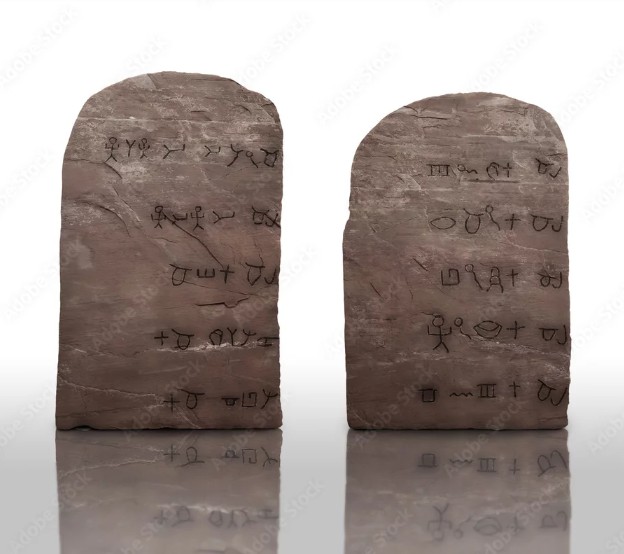
By the time we get to Ezra in, say, the 4th century BC, the number of words in “the Law of Moses” has grown. We’re told in Nehemiah’s (8:3) description that Ezra read it to the people of Jerusalem “from early morning to midday”. At 130 words/minute, reading our canonical Deuteronomy’s 30,000 words would take something less than 4 hours, so it’s a reasonable guess for what passed for “the law of Moses” in the 4th century[iii]. What he could not have been reading is our canonical Pentateuch since its 162,870 words would require some 20 hours to read.
If we see Deuteronomy as roughly what was perceived as God’s covenant with Israel in the 4th century, we see it was written in the form of a late second-millennium Hittite suzerainty treaty. It’s treaty outline looks like:
- What God has done for them beforehand (Exodus, sustainment in the wilderness, etc.) Dt 1:6-4:49
- God’s general stipulations on Israel (e.g. the Decalogue, the Shema, God’s character, etc.) Dt. 5-11
- Detailed Stipulations (a recapitulation [actually, an insertion]) of instructions supposedly given to Moses by YHWH at Horeb and Moab: Dt. 12-26
- Blessing and Curses – Dt 27-28
- Witnesses: Dt 4:26; 30:19; 31:19; 32
So here we have God making His covenantal case to Israel: “I saved you from slavery in Egypt to freedom. In exchange for that, you will follow these rules I’m giving you. If you do, you’ll be blessed. If you don’t, you’ll be cursed.”
In view of the debatable provenance of Dt 12-26 (the so-called Law Code), we have the Decalogue as the core of the covenant requirements God placed on His people.
Now, I prefer the MS to the canonical versions primarily because I suspect it is older and therefore closer to the original than the others. But it also shows a deeper level of moral/ethical insight than the others. For example, while the canonical commandments say “You shall not murder”, the equivalent MS instruction reads:
“You shall not kill the soul of your brother”
emphasizing the subject’s relationship to the other and encompassing a broader range of damaging offenses to the other than simply his murder.
The last of the MS’s instructions isn’t found in the canonical lists. It reads:
“You shall not hate your brother in your heart.”
the companion blessing for doing so being: “Blessed is the man who loves his neighbor”. (This instruction actually appears, as we will see, in Lev 19:17.)
Source
God’s written instructions to Moses (possibly the Moses Scroll?)
Goal of the Instructions
Define the requirements for living within God’s covenant
People’s Perceived Benefit
Adhering to God’s law qualifies them to remain in God’s presence/camp and continue to receive His blessings and protection.
External vs Internal (Heart)
The Decalogue is an external list of “do’s” and “don’ts”. While its instructions may require personal effort/change, such effort/change isn’t explicitly demanded.
Moral or Ethical/Social or Ritual
Combination of moral and ethical/social.
Who Is to be Loved?
God, indirectly. (Within the context of the Moses Scroll and Deuteronomy, the Shema commanding love of God is adjacent to the Decalogue. And with the MS, again, the 10th command’s blessing commends love of neighbor.)
Who Is the Object of the Commanded Relational Behavior
While not explicit, it appears to be the Israelite’s kinsmen.
Is One Expected to Use His Initiative to Extend “Good” to Others?
Not explicitly. But the MS commands leave room for more expansive interpretation.
Leviticus 19
Leviticus 19 doesn’t restate the Decalogue, per se. It attempts to recast its commands within a framework defining how the Israelite is to be holy (set apart for YHVH) in his daily life. It includes later Levitical rules that introduce the ideas of a) ritual and physical purity as aspects of this holiness, and b) atoning for transgressions of the rules through offering sacrifices and related rituals.
The author seems to get his Inspiration from Lev 19:2
2“Speak to all the congregation of the people of Israel and say to them, You shall be holy, for I the LORD your God am holy”.
The remainder of the chapter is the author’s interpretation of how this is to be done – how to be holy, in imitation of God (Imitatio Dei) who is holy[iv]. This admonition is a characteristic of Leviticus’s “Holiness Code”, its chapters 17-26. These chapters include an eclectic mixture of prescriptions for holiness, both moral/ethical and ritual obedience (e.g. Love neighbor (v18); don’t eat flesh with blood in it (v26)). The author of this Holiness Code seems to underscore that every aspect of the Israelite’s life (agricultural, moral, social, ritual) is to be holistically holy, in conformance with his edicts.
The author’s idea of holiness (set-apartness) features ritual purity and separation from impurity. Things deemed unclean (2932. טֻמְאָה ṭum’āh) could be physically unclean (e.g. corpses), ritually unclean (e.g., women during their menstrual period), or spiritually unclean (i.e., after having transgressed one of many Torah-prescribed rules). The authors of the Torah’s “P” material seemed to have had no problem equating physical impurity with some kind of offense to God[v]. This, it seems, is because for the Sinai Israelites, their physical proximity to God in His sanctuary, and the ritual purity that proximity required, seemed on a par with spiritual purity in maintaining their holiness, and so suitability of their camp to host God’s presence

It could be argued that for second Temple Judaism, ritual purity as defined by the Torah dominated moral and ethical probity in importance, leading to a more legalistic and therefore less personal-responsibility-based system.
This view of purity/holiness fits nicely with Israel’s foundational identity as God’s chosen people. The Israelite view seems to have been that Israel maintained its corporate righteousness so long as its people maintained their fidelity to the rules that were unique to them and so set them apart – their Torah.
It’s interesting to note that there were no Torah rules against sinful thoughts or intentions that resulted in a ritual remedy. For example, Lev 19:17’s instruction to not hate one’s brother in your heart carries with it no prescribed penalty for not doing so. Nor is there a penalty presented for not loving one’s neighbor (v18)[vi][xviii].
The object of regard in Lev 19:17 is one’s “brother” — 251. אָח ‘āḥ, which has the meaning of one having the same parents or same ancestors (i.e. one of your tribe). It can also mean a close friend outside of one’s physical family, as in the case of Jonathon to David (2 Sam 1:26). The meaning of this admonition (to “not hate” in one’s heart) is to implore its readers to verbally work out differences with one another, rather than harbor resentment in your heart for him.
In the famous following verse (v18b), the word rendered “neighbor” is 7453. רֵעַ rēa`, רֵיעַ rēya`, whose meaning is not restricted to a family or tribe member, at least in the abstract. Abstractly it represents simply another person. However, v18a sets the context of “the sons of your own people”. So, it seems the Levitical author isn’t ready to invoke his moral code in dealings with everyone, but rather to direct the reader’s focus toward his fellow Israelites.
However, love of neighbor in any context in the exilic time of Leviticus was quite revolutionary – essentially unprecedented (except for our theoretically earlier MS). However, the concept likely bore little resemblance to our modern idea of the term[vii]. Later, the idea was developed and elaborated in various writings; The Dead Sea Scrolls (Manual of Discipline, Damascus Document), the Apocrypha (Maccabean literature – e.g., Tobit 4:15) and Pseudepigrapha, i.e. The Book of Jubilees (v17 echoes – 7:20, 20:2, 36:4,8)[viii],[ix], the Testimonies of The Twelve Prophets (that we will look at in greater detail below), and, of course, Jesus’s restatement and elaboration in the Gospels.
However, our Apocryphal and Pseudepigraphal sources never actually restate Lev 19:18. They do, without question, extend the Torah’s ethical framework to include right treatment of “neighbors”/others by encouraging behaviors of mercy, kindness, justice, absence of hate and vengeance, and “doing good” to them. But they stop short of admonishing “love” of the other.
The idea of “neighbor” (either Heb 7453. רֵעַ rēa`, רֵיעַ rēya` [v18b] or 5997. עָמִית `āmiyṯ [v17]) was mainly kinsman, Israelite. But it seems that the command was extended to include resident aliens[x], i.e. those foreigners who had met the requirements of living among Israelites. We can infer this because those who had not met those requirements were still identified as foreigners – sojourners – and are separately addressed. This command was not applicable to all foreigners (i.e. pagans living apart from Israel), but restricted to this very well-defined subset of resident aliens. This makes sense since the Torah was the instructions to the Israelites in how to live together in the land God was giving them.
So, it seems Leviticus 19 is the canonical source of this most powerful instruction (but perhaps not its original source). The Moses Scroll, which may predate Leviticus by hundreds of years, contains the same instruction in its 10th blessing[xi]:
“Blessed is the man who loves his neighbor.”
But, Lev 19 also prescribes moral atrocities, introduced by its Levitical authors. For example, if you have sex with another man’s slave girl, you nor she are put to death, but you owe the priests a ram (v21)! (Try to imagine a God that would stipulate this. Now, try to imagine a [male] priest that would prescribe something like this. See the problem?)
Structurally the order of its instructions seems quite random. But for several of the instructions it demonstrates a pattern of stating them initially (v1-18) followed by, for some, a repetition and expansion later in the scroll (v30-36). This later expansion demonstrates characteristics of later Midrashic interpretation such as is found in Qumran scrolls, and later rabbinic writings.
Source
God’s written instruction to Moses plus priestly ritual requirements and Midrashic extensions
Goal of the Instructions
Define the requirements for living within God’s covenant plus a bit of how to be rightly motivated with respect to others. The author’s intention is a comprehensive rulebook for living founded on imitating the holy God.
People’s Perceived Benefit
Preserve one’s identity as one of God’s covenant people, including maintaining ritual purity through obeying the priestly ritual laws.
External vs Internal (Heart)
Primarily external, despite calling for some behaviors requiring heart change (i.e., not hating your brother in your heart: love of your neighbor).
Moral or Ethical/Social or Ritual
Combination of moral, ethical/social and ritual.
Who Is to be Loved?
Not hating brother; love neighbor, stranger/sojourner.
Who Is the Object of the Commanded Relational Behavior
Countrymen (which includes resident aliens).
Is One Expected to Use His Initiative to Extend “Good” to Others?
Yes. Leaving edges of fields to the poor; “loving” of neighbor which implies motives for his good; rebuking neighbor for wrong he may have (unknowingly) done, thus correcting him; treating the “stranger” as one of your clan.
The Testaments of the Twelve Patriarchs (T12P)
The Testaments of the Twelve Patriarchs occupies a pivotal place in the evolution of Israel’s understanding of righteousness, standing between the holiness ethic of the Torah/Tabernacle and the intensified interior moral vision of early Jewish and Christian teaching. Cast as the deathbed speeches of Jacob’s sons, this pseudepigrapha reframes tribal memory as moral pedagogy: sin is analyzed as a distortion of the heart, virtue as the alignment of desire with God’s purposes, and righteousness as living out justice, compassion, purity, and self‑mastery. Its vivid contrasts between the “spirits” of truth and deceit, its insistence on repentance as moral transformation, and its expectation of a future age shaped by ethical renewal all reveal a Judaism in which righteousness is no longer merely covenantal compliance but an inner disposition that shapes the whole person.
What is truly groundbreaking is the T12P’s reformulation of holiness from separation (e.g., the Essenes) to generous self-giving. In this way, the Testaments serve as a crucial bridge between the Torah’s external commands and the later emphasis on interiorized, eschatologically charged righteousness found in Jesus’ teaching.
Where do we see this ethical introspection, not merely legal obedience in the T12P? It is characteristic of each of the son’s testimonies that he reflects introspectively on what he did wrong in his life from which he learned, and is now passing on, how he should have acted. Often these moral dichotomies are characterized as “light” vs “darkness”.
A signature of the T12P seems to be its recognition that there are good people and bad people who all incur the same challenges. So rather than judging which is which, it is better to simply treat all alike with love, mercy and patience. The familiar “brother”/”neighbor” grammar begins to fade in deference to the more generic “all men”. As such, it points directly toward the forthcoming teachings of Jesus.
Each Testimony has the following outline:
- Autobiographical confession
- Moral instruction (anger, lust, envy, pride, greed, etc.) as well as confessions
- Warnings about the future sins of the tribe
- Messianic or eschatological prophecy
- Final exhortation to keep the Law
Several of these “moral instructions” extend into “internal”-motivated good – behaviors that require taking personal initiative:
“Have compassion, my children, upon every man with mercy…”
“Do good to all men with a good heart.”
“feed the hungry, clothe the naked, visit the sick, help the distressed” (see Is 58:6-10[xii])
love one another sincerely “Do good to all men, not only to the good but also to the evil.”
“Bless those who curse you.”, “Pray for those who persecute you.”, “If anyone seeks to harm you, do good to him.” (see Pr 25:21-22, Ex 23:4-5)
“Show mercy to the poor.”, “Give to the needy with a good heart.” (See Dt. 15:7-10 [referring to a “brother”], Pr 22:9)
“Do not repay evil for evil.”, “Overcome evil with good.” (In addition to the previous citations see also Pr 20:22 and Pr 24:17-18)
“Give to the needy with a cheerful heart.”, “Do good to the poor and weak.”
“Do good, my children, and you will be blessed.”, “Be kind and merciful to one another.”
“Love one another from the heart.”, “Do good to one another.”, “If a man sins against you, forgive him and do him good.
“The good man has compassion on all.”, “He shows mercy to all men.”, “Do good, my children, to every man.” (In addition to the previous citations, see also Pr 14:21, Pr 19:17)
Notice: these concepts of Israelite morality are from the late second Temple period preceding John the Baptist and Jesus! What we can conclude from this sample is that the concept of a moral/ethical, righteous life for at least the sect of Israelites of whom the author of the T12P was a member, was significantly more developed in the sense of personal initiative in ethical virtues than had been the case earlier, say up to the early post-exilic period, or at the authorship of the Moses Scroll.
What they seem to simply portray is a progression of the cultural understanding of “righteousness” in Israel, though perhaps only that of a small fraction of cultic functionaries, from a pattern of dutiful adherence to external “instructions” of God, to something far more dependent on the internal conviction of its citizens toward a kind of generic compassion to one’s neighbors. This change is profound. The key event separating these approaches to righteous living seems to have been the Babylonian destruction and exile.
Babylon’s Wake-Up Call
Did that cataclysm spur this deeper moral introspection?
Wiles[xiii] points out that gradually over time, admonitions began to appear in the Wisdom Literature to get along with, even “love” one’s enemy. Previously, the dealing between two men who each perceived the other as an enemy was handled by the law simply in terms of law court “judgments” and “settlements”. But now this law-defined relationship, for whatever reasons, became seen as counter-productive, and not just for those involved but for their society as a whole.
So, the preferred approach grew to become working things out personally with your neighbor, enemy or not.
We see this sentiment first presented in in Lev 19:17:
17 “You shall not hate your brother in your heart, but you shall reason frankly with your neighbor, lest you incur sin because of him.
Negotiating differences was prioritized over taking legal action or, God forbid, some type of violence. This, by itself, was a monumental advance in cultural ethics.
While speculative, it seems perfectly reasonable that following the destruction of Jerusalem and its exile to Babylon, the thought leaders in Israel found the need to step back from their historical assumptions about “righteousness”, and ask why it was God had inflicted this cataclysmic judgment on them, and how they should reform to preclude it from happening again.
Changes
Two major changes seem to have occurred following the Babylonian return with both leading, hopefully, to eliminating the possibility of another Babylon-style disaster.
The first involved building evermore detailed and precise rules to be followed by the people so that if followed, it would be virtually impossible to violate one of the Torah’s instructions. This practice by the religious elite was known as Asu S’Yag Latorah, or “fencing the Torah”. This was reform by legislation.
The second, however, was our progression away from this purely mechanical religiosity toward more broadly institutionalizing a morality and ethics based on an inner reform of the heart. More and more in the late second Temple period we read (in both biblical and extra-biblical material) admonitions calling for a kind of compassionate regard for others and esteeming them as yourself (if not above yourself).
Source
2nd century BC – 1st century AD pseudepigraphal testimonies of the Twelve Patriarchs (with ties to ideas found in the DSS)
Goal of the Instructions
Obedience to God plus adopting behaviors that a) avoid sin/trouble, and b) that forewarn their progeny of impending judgment ultimately for their disobedience.
People’s Perceived Benefit
Live life faithfully and not incur God’s judgment (especially His end-of-the-age warnings) for not doing so. Avoid practices that might lead you to become unfaithful.
External vs Internal (Heart)
Mostly external but with many admonitions to live virtuously (in the “Spirit of Truth”) which imply a certain internal attitude of the heart change.
Moral or Ethical/Social or Ritual
Emphasis on moral and social/ethical.
Who Is to be Loved?
Brother (Levi 6:9, Simeon 4:7,Gad 6:1) the LORD and your brother (Issachar 5:2), one another (Zebulon 8:5, Gad 6:2-3), LORD and one another (Dan 5:2,Gad 7:7, Joseph 17:2), neighbor (Gad 4:2, Ben 3:3,5) LORD (Gad 5:2, Ben 3:1)
Who Is the Object of the Commanded Relational Behavior
Not explicit but assumedly one’s countrymen. The admonitions are primarily directed at the patriarch’s progeny.
Is One Expected to Use His Initiative to Extend “Good” to Others?
Yes. Ben 4:3, 5:2, Reu 4:1, Lev 13:9, Naph 8:8, etc.
Jesus’s Teachings – The Sermon on the Mount (SOTM)
When we arrive at Jesus and the New Testament, Israel’s “righteousness narrative” takes a significant turn. It’s not that requirements of the righteous life dramatically change (though those changes are not insignificant). Rather, it is Jesus’s emphasis insisting that the one seeking righteousness had to repent (Mt 4:17) (3340. μετανοέω metanoéō — to change one’s thinking/mind: Heb 7725. שׁוּב šûḇ: A verb meaning to turn, to return, to go back, to change).
This concept is what some now (and then) perceived as “apologize for” or “feel sorry about”. These are corruptions of the true meaning of the term.
Jesus is calling the people to change the way they think about people and their God, and act in accordance with that renewed understanding.
Why should they change? Because, Jesus says, “the Kingdom of God/Heaven is at hand.” In other words, at last God has stepped in to spread His Kingdom on earth, in the midst of His people. Symbolically, God is providing for His people to return to the Eden Garden to live with Him.
There were no such contextual predicates when the Mosaic law was given. There, as we’ve seen, the premise was that the people would be faithful to YHVH because He had saved them from lives of slavery – a kind of quid-pro-quo. Now, God did implore the people to “be holy, as I am holy”; to be a “nation of priests”, assumedly mediating between YHVH and the people of the nations. However, neither of those charters was ever realized. Israel, as a practical matter, never became the Kingdom of God – the one God sought.
But how were they to change their thinking?
Jesus wastes no time in segueing into the Beatitudes (Mt 5:2-11). Each image presented there illuminates a characteristic of those who have “changed their thinking”. And for these, Jesus says that they are “Blessed” (Gk 3107. μακάριος makários, which means (unlike its common definition of “happy”) that this makários is from God, not the result of some random good fortune). All of these images are of conditions of the citizens of the Kingdom of God, that Jesus told us in Mt 4:17 had come to earth from God.
So, with this definition we see that those in the Kingdom are those gifted of God’s character – His Spirit.
This is fundamentally different than the moral/ethical framework that preceded it. In the previous editions we have looked at, the people were instructed to behave (and later to think and be motivated) with increasing piety and lived-out care for others, be they brothers, neighbors, sojourners, or … enemies.
But, the people were on their own to change themselves to live in this way. And, a few actually may have with some success.
As Jesus continues with His SOTM, as if to make perfectly clear to His audience just how difficult it would be for them to act in such a way as to be labelled “righteous”, He gets into His “You have heard it said…But I say to you” statements. Here He addresses a series of instructions that His audience would have grown up hearing. And for each, He raises the bar (indicated by “->” in the following list) quite dramatically. They include:
- Don’t murder -> Don’t be angry with your brother but reconcile with him promptly
- Don’t commit adultery -> Don’t look at a woman with lustful intent (i.e. with the intent to have sex with her). It’s better that you destroy your eye or hand if it leads you to sin.
- Give a certificate of divorce to your wife -> Don’t divorce. You cause your wife to commit adultery (as she remains married to you in God’s eyes), as does the one marrying the divorcee.
- Don’t swear falsely -> “Let what you say be simply yes or no.” (i.e. nobody lies in the Kingdom of God).
- Eye for an eye and a tooth for a tooth -> Don’t engage in petty disputes with the one who is evil[xiv].
- Love your neighbor and hate your enemy -> Love your enemies, pray for your persecutors. God dispenses blessings (e.g. sun, rain) on both the evil and on the good. If you only love those who love you, what reward do you have?
- Don’t dispense charity publicly (i.e. to be seen).
And finally in this section, Jesus caps His instructions with the Lord’s Prayer which, strikingly, implores God for His “kingdom come” and His “will be done on earth as it is in heaven.” This is Jesus once again announcing the immanence of God’s Kingdom, the “place” where people live as Jesus has been outlining, if they have simply “turned/changed” away from their past lives and to the life God desires them to live. People don’t simply move-in to this Kingdom. They repent of not being in it and seek God’s transformed life into it (Mt 6:33).
All of this “Kingdom of God” characterization is designed to shock Jesus’s audience (IMHO) into a kind of sober realization that there is no possible way for them to take up residence within it by and of themselves[xv]. Jesus’s SOTM extensions of the Decalogue were designed to underscore this inability of humanity to fulfill God’s covenant with Israel. However, His sermon is designed as much to offer them hope that God will bless them through His transformation of them to enable them to enter it, as to convict them that they are helpless to make such sweeping changes in their own hearts.
And this is the primary raising of the stakes Jesus was here to present as a kind of ultimatum, a sober reality check for the people, heralding (along with John the Baptist) the immanence of God ‘s New Covenant promises that were literally just days away[xvi].
Source
God’s written instructions to Moses plus Jesus’s interpretations and extensions.
Goal of the Instructions
Make people aware that now, as a result of Jesus’s coming, they actually can be obedient to God and live in His will (not just His covenant Torah) when they submit to God and enter His Kingdom.
People’s Perceived Benefit
Become an adopted child of God and citizen of the Kingdom over which He reigns.
External vs Internal (Heart)
At its root, Jesus’s message is 100% about heart change so that one can live within God’s will. The Gospel is about internal (heart) transformation).
Moral or Ethical/Social or Ritual
Emphasis on transformation to enable moral, social/ethical and spiritual. (NO ritual)
Who Is to be Loved?
Neighbor, enemies.
Who Is the Object of the Commanded Relational Behavior
God, and neighbor as yourself. Enemies (Mt 5:44). Jesus Himself by keeping His commandments (Jn 14:15). One another as Jesus loved you (Jn 15:12,17).
Is One Expected to Use His Initiative to Extend “Good” to Others?
Yes, in the acts of Jesus: healing, feeding, forgiving and in the Beatitudes: don’t retaliate (Mt 5:39-40); Go the second mile (Mt 5:41); love enemies (Mt 5:44, 48); lend without expecting payback (Lk 6:34).
A Note On Israel’s Ancient Near Eastern Cultural Foundation
Israel did not operate at any point in the period encompassed by the Hebrew Bible as a society built on interpersonal relationship, our current Western standard. Rather, Israel’s was an honor/shame-based culture. Its people sought the preservation and enhancement of their status – their cultural position – and by so-doing, the preservation of the order of their culture.
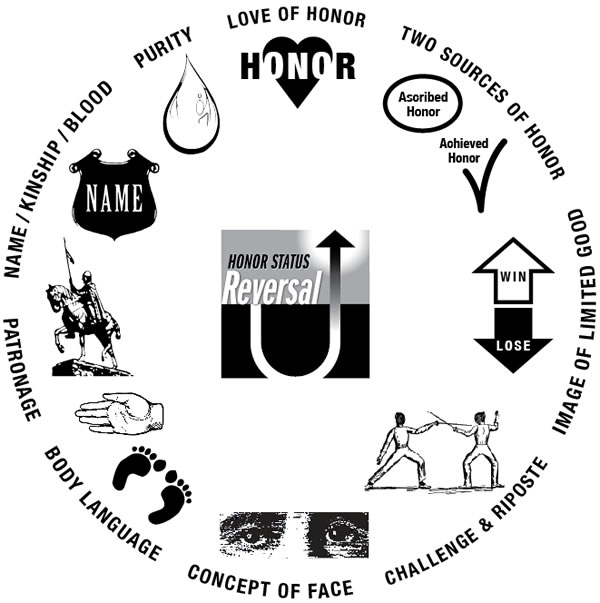
You may not have noticed, but in the Hebrew Bible we never find anyone, having committed some offense against another, apologizing for that offense. The word for “apologize” (לְהִתְנַצֵל) does not occur in the Hebrew Bible. Rather, what we find is the one having committed the offense later seeking to publicly promote the position of the one offended, thereby making amends
Take the story of Jacob and Esau for example. Jacob, the younger of the twins, famously deceives his father into conferring on him the blessing intended for the older Esau, having already enticed Esau into voluntarily giving up his firstborn birthright for a bowl of stew. Esau’s standing had been attacked, and so he had animosity for Jacob.
Over twenty years later, the two men and their now-substantial families meet again with Jacob expecting his brother (quite rightly) to attack him to restore justice (order). However, what happens is Jacob warmly greets, and publicly assumes a position of subservience to, his brother, sending him gifts, bowing to him seven times, and generally humbling himself before him. In response, Esau impulsively kisses his apparently contrite brother. Relationship restored.
Jacob never admitted his offenses against his brother, let alone apologized for them. Rather, he esteemed his brother publicly and so restored Esau’s status/honor within his society, and by doing so restored the order of the society that he had disrupted through his deceit.
The Bible has many such examples. In Joseph’s story he isn’t restored to his former position/status by his brothers that attacked his status. Rather, he is elevated far above his brother’s status as an outcome of their offense – a kind of Biblical Karma. Adam and Eve never apologize for their offense (not that they were offered the opportunity to do so) and end up permanently losing their favored position. The Prodigal Son voluntarily abandons his position within the order of his father’s family – an offense against his father and the natural order – but is nevertheless restored/redeemed by his father to his former status upon his return.
Did Esau forgive his brother? His kiss would seem to indicate something like an attitude of forgiveness, but the word itself is never used in describing Esau’s reaction. In fact, the words “forgive”/”forgiveness” are never attributed to any person in any situation in the Hebrew Bible. Those words are used only of God. Maybe Esau’s sentiment was simple gratitude?
In This Culture, What Might “Love” Have Meant to Israelites Hearing Lev 19:18?
In such a societal environment, therefore, it is hard to know how to interpret the admonition of Lev 18 (and later uses of the term) to “love” one’s neighbor. The word is 157. אָהַב ‘āhaḇ:
A verb meaning to love. The semantic range of the verb includes loving or liking objects and things such as bribes (Isa 1:23); wisdom (Pr 4:6); wine (Pr 21:17); peace, truth (Zec 8:19); or tasty food (Ge 27:4,9,14). The word also conveys love for other people (Ge 29:32; Ru 4:15; 1Ki 11:1); love for God (Ex 20:6; Ps 116:1); and also God’s love of people (Dt 4:37; 1Ki 10:9; Ho 3:1).
It seems a fitting interpretation, with respect to its use within ancient Israel’s honor/shame culture, might be “to esteem” (3365. יָקַר yāqar:) the other person.
A verb meaning to esteem, to be valuable, to be costly. It has the basic idea of being highly valuable, worthy; it indicates a high evaluation put upon someone or something (1Sa 18:30; Zec 11:13).
In any event, it seems it did not have the meaning we moderns think of today, perhaps until Jesus.
The Vector from Old Covenant to New
God was teaching us that being faithful to Him required a lot more than being compliant with the Decalogue (which virtually no one did anyway[xvii]).
Leviticus 19 is holiness expanded beyond the foundational Decalogue into a comprehensive social ethic, while the Testaments of the Twelve Patriarchs are apocalyptic moral-wisdom texts urging interior purification as preparation for Israel’s eschatological restoration—together forming the bridge between covenantal halakha and Jesus’ kingdom‑transformation ethic.
Through the evolution of the moral worldview of Israel, God was shaping the understanding of His people that simple covenant obedience was not what He was after in His children. He was looking for people who were radically transformed to devotion and faithfulness to Him.
As we have seen, Israel as a people gradually moved in the direction of esteem for the attitudes of the heart that result from inner transformation. Leviticus emphasizes ritual distinctiveness while the T12P and Jesus emphasize interior distinctiveness.
Along the way, Israelites were called by their religious leaders to feed their hungry enemy (Pr 25:21-22) and bless him (Jos 18). What we sadly don’t find are reports of people actually acting in accord with these ideals. It seems that they (as a people) were just not in a position to give God lives obedient to these ideals, as most of us still aren’t today. For that we would need God’s help – His New Covenant.
Conclusions
Following God’s rules was always the bedrock of Israel’s conception of righteousness. Adhering to the rules given to the “Israelites” meant “Jewishness keeping”, and so maintaining one’s position within the covenant people, and so, a party to that covenant.
Gradually, “internal” moral imperatives began to enter into their concept of righteous behavior, starting with “love of neighbor” and not hating your brother “in your heart” (Lev 19:17).
By the time of the T12P’s writing, personal initiative in doing “good” was an expected basis of proper moral and ethical behavior (as also documented by the DSS).
But it seems that the imperative to behave in accordance with the Mosaic covenant, and the (later) Torah’s prescriptions for atonement took precedence over attitudes of the heart despite their later (1st-2nd century BC) forays into not just being obedient, but to being proactively “good”.
Sects of the later Israelites responded to this perceived imperative to unilaterally redefine their “holiness”. This imperative included not only moral extensions (i.e., unilaterally doing good to others), but ritual extensions (i.e., as with the Essenes, removing themselves from proximity to the perceived corruption of the Temple Cult to the wilderness, defining their own criteria of purity and their own diet, etc.)
For a tabular summary of the distinctions in the phases of the progression of Israel’s moral worldview, click on this text.
| Topic | Decalogue | Lev 19 | T12P | Jesus – SOTM |
| Source | God’s written instructions to Moses (Moses Scroll?) | God’s written instruction to Moses + priestly interpretation and midrashic extension | 2nd century BC – 1st century AD pseudepigraphal testimonies of the Twelve Patriarchs (with ties to ideas found in the DSS) | God’s written instructions to Moses plus Jesus’s interpretation. |
| Goal of the instructions | Define the requirements for living within God’s covenant. | Define the requirements for living within God’s covenant plus a bit of how to think rightly about others. | Obedience to God plus adopting behaviors that a) avoid sin/trouble, and b) that forewarn their progeny of impending judgment ultimately for their disobedience. | Make people aware that now, as a result of Jesus’s coming, they actually can be obedient to God and live in His will (not just His covenant Torah) when turn and enter His Kingdom. |
| People’s Perceived Benefit | Qualify to remain in God’s presence/camp and continue to receive His blessings and protection. | Preserve one’s identity as one of God’s covenant people, including maintaining ritual purity through obeying the priestly ritual laws. | Live life faithfully and not incur God’s judgment (especially His end-of-the-age warnings) for not doing so. Avoid practices that might lead you to become unfaithful. | Become an adopted child of God and citizen of the Kingdom over which He reigns. |
| External vs Internal (Heart) | External – list of do’s and dont’s. None demand a changed heart, only obedience (e.g., honor of father and mother). | External, despite calling for some behaviors requiring heart change (i.e., not hating your brother in your heart: love of your neighbor). | Mostly external but with many admonitions to live virtuously (in the “Spirit of Truth”) which imply a certain internal attitude of the heart change. | At its root, Jesus’s message is 100% about heart change so that one can live within God’s will. The Gospel is about internal (heart) transformation). |
| Moral or Ethical/Social or Ritual | Combination of moral and ethical/social | Combination of moral, ethical/social and ritual | Emphasis on moral and social/ethical | Emphasis on transformation to enable moral, social/ethical and spiritual. (NO ritual) |
| Love of… | God, indirectly (Dt 5:10″…those who love me and keep my commandments). However, the MS’s 10th command’s blessing specifies “neighbor”. | Not hating brother; love neighbor, stranger/sojourner. | Brother (Levi 6:9, Simeon 4:7,Gad 6:1) the LORD and your brother (Issachar 5:2), one another (Zebulon 8:5, Gad 6:2-3), LORD and one another (Dan 5:2,Gad 7:7, Joseph 17:2), neighbor (Gad 4:2, Ben 3:3,5) LORD (Gad 5:2, Ben 3:1) | God, and neighbor as yourself. Enemies (Mt 5:44). Jesus Himself by keeping His commandments (Jn 14:15). One another as Jesus loved you (Jn 15:12,17). |
| Who is the object of the commanded moral or ethical treatment | Kinsmen | Countrymen (which includes resident aliens) | Not explicit but assumedly one’s countrymen. The admonitions are primarily directed at the patriarch’s progeny. | All people, including one’s enemies. |
| Is one expected to use his initiative to extend “good” to others? | Not directly. But the MS commands leave room for more expansive interpretation | Yes. Leaving edges of fields to the poor; “loving” of neighbor which implies motives for his good; rebuking neighbor for wrong he may have (unknowingly) done, thus correcting him; treating the “stranger” as one of your clan. | Yes. Ben 4:3, 5:2, Reu 4:1, Lev 13:9, Naph 8:8, etc. | Yes, in the acts of Jesus: healing, feeding, forgiving and in the Beatitudes: don’t retaliate (Mt 5:39, Mt 5:40); Go the second mile (Mt 5:41); love enemies (Mt 5:44, 48); lend without expecting payback (Lk 6:34) |
and for an overall summary and goals of the various stages of Israel’s moral development, click here.
| Stage | Ground of Morality | Focus | Goal |
| Decalogue | God’s past deliverance | External obedience | Covenant fidelity |
| Leviticus 19 | God’s holy character | Whole life holiness | Reflect God’s nature |
| T12P | Eschatological expectation | Purity, motives, vigilance | Prepare for the coming age |
| Sermon on the Mount | Kingdom breaking in now | Interior transformation | Enter God’s Kingdom and embody His generous love |
All of this change in thinking permeated to some degree into the Israelites’ consciousness prior to Jesus, setting the stage for His revolutionary reformulation of all they previously understood about moral standards and behavior (i.e., “righteous” living), and reliance on their God. No longer would they be excused for unrighteousness since that was precisely what their God was offering to transform them from by His Spirit.
[i] The vast majority of the Hebrew Bible’s “faith” and “faithfulness” language is referring to God’s, not the people’s toward God.
[ii] In The Evolution of the Religion of Israel, by George Aaron Barton, the author proposes that these Exodus verses, being more ancient as the instructions all would apply to a nomadic people, do not presume their involvement in established agriculture, and are presented in ten simple sentences easy to remember.
[iii] Note: This reading duration implies that Deuteronomy’s “Law Code” (ch 12-26) must have been a part of “the Law of Moses” at Ezra’s reading. Had it not been – had “the Law of Moses” then consisted of just the Moses Scroll (and its 3,450 words), Ezra’s reading time would have been only half an hour.
[iv] There are two puzzling exceptions where, strangely, sacrificial instructions are included (v5-8, and v21-22). Scholars have puzzled over this apparent anomaly for decades. For more on this see The Relationship Between Sacrificial Laws and Other Laws in Leviticus 19 by Jacob Marx.
[v] Feder, Yitzhaq, The Wilderness Camp Paradigm in the Holiness Source and the Temple Scroll:From Purity Laws to Cult Politics, Journal of Ancient Judaism 5 (2014), Dead Sea Discoveries 18, Brill, 2011
[vi] The Moses Scroll, however, presents each of its commandments paired with both a blessing for doing it and a curse for not doing it. This simplicity and elegance is another argument, in my opinion, for its authenticity.
[vii] Rugh, Corey D., Paul’s Use of Leviticus 19:18:A Comparative Analysis with Select Second Temple Jewish Texts, Liberty School of Divinity, 2020. This reference speculates, believably IMHO, that the concept of “love” in Leviticus 18, according to Andrew Malamat, meant something like “to be of use to,” “to be beneficial to,” or “to assist or help.”
[viii] Livneh, Atar, “Love Your Fellow as Yourself”: The Interpretation of Leviticus 19:17-18 in the Book of Jubilees”
[ix] Ibid, p175. It is interesting that this source points out that the Jubilees author(s) saw the moral/ethical behaviors they described as intra-Israel; i.e., not generally applicable to other populations.
[x] Kaminsky, Joel S., Loving One’s (Israelite) Neighbor: Election and Commandment in Leviticus 19, Smith ScholarWorks, 1-1-2008
[xi] The Shapira Scroll Ten Words, Blessings, and Curses – A Pilgrim’s Search
[xii] Trito-Isaiah is thought to have been authored following the return from Babylon, so late 6th-early 5th centuries BC. This would position it chronologically in the middle between the Levitical Torah and the T12P. This helps us locate the point in Israel’s history where this “inner righteousness” began to appear as a cultural credential.
[xiii] Wiles, John Keating, The “Enemy” in Israelite Wisdom Literature, Southern Baptist Theological Seminary, 1982
[xiv] Note: Jesus is not saying not to resist evil, even forcefully. Here He’s talking about getting drawn into petty situations in which you react with some retribution against the evil one. Such “tit-for-tat” interactions, Jesus seems to be counseling, achieve nothing other than to disturb your peace and the peace of those around you.
[xv]The difficulty Jesus’s instructions present in practice have been argued over in the Church from its earliest days. For a general historical survey, see: Powell, Mark Allan, Theological Interpretation of the Sermon on the Mount, Supplement to “Introducing the New Testament, 2nd ed., © 2018.
[xvi] In this BibleProject Podcast, Tim Mackie makes exactly this point that the SOTM message inextricably points to the New Covenant prophecies of Jeremiah and Ezekiel (among others).
[xvii] It is quite sobering, indeed, to recognize that the engine of the US economy – personal consumption – is built on covetousness. Of course, the consumer goods marketing industry and its incessant TV and online commercials encourages our “sin”. But, nevertheless, it is, in fact, biblical sin though as American as Apple Pie.
[xviii] In the Hebrew Bible the idea of internal motivation to good or evil is identified with the term “heart” (לֵב / לֵבָב — lev/levav) as a reference not to the physical organ but to the inner character of a person. It wasn’t until the Rabbinic era that the idea of “moral intention” was even separately labelled as kavanah.
