
Introduction
When you hear a respected biblical scholar reinforcing with conviction what you’ve been learning – and teaching – for the last ten or twenty years, it’s a big deal, not to mention quite the affirmation.
Such was my case in coming across a lecture by Dr. Jason Staples (one of my favorite New Testament scholars) in 2024 entitled “Salvation by Moral Transformation: What Paul Really Meant by Grace”.
Not to be too dramatic but Staples’ insights into Paul’s real message will be at least as explosive within the traditionalist community as was “The New Perspective on Paul”[i] of Messrs. NT Wright, James (“Jimmy”) Dunn, and E.P. Sanders a few decades ago. As Staples notes: “The Apostle Paul may be the single most misread and misunderstood writer in history.” Buckle up.
Background
Beginning with the 16th century Reformation, the interpretation of what Paul was proclaiming in his epistles was co-opted by Martin Luther who saw in it his deliverance from ritual following and spiritual striving. I’ve written a bit explaining Luther’s epiphany of Paul’s message in “Being a Disciple”[ii]. Luther’s interpretation he read (Rom1:16-17) as relieving him of the guilt of inadequacy he had suffered under, and his doubt that he could ever be worthy. For Luther, Paul’s “through grace by faith” statement (Eph 2:8) unshackled him from his anguish of never living up to the standard he perceived necessary for acceptance by God. He realized his monastic holiness vocation would never have succeeded in creating righteousness in him, and now he saw God that didn’t require holiness of him. His purpose became not to keep his light of Christ locked up in a monastery but to spread it to his community.
This message resonated with many others operating under the hegemony of the Catholic Church and caused his interpretation (that all he needed had already been provided by God’s grace through Christ) to spread like wildfire. Ephesians 2:8 was his touchstone. The whole Reformed Church movement grew out of his misunderstanding.
And, his interpretation was right, as far as he took it (justification). However, he failed to read closely the rest of what Paul said. His error was the fundamental interpretive error that equated salvation as an end in itself at one’s death, rather than as the pathway to a faithful, obedient life conforming with God’s will. This is what we’ll unpack in the following.
The Dichotomy In a Nutshell
In the traditional (Reformed) reading of Paul, the message is: “Believe Jesus, and confess that He rose from the dead, and go to heaven when you die” (for which they commonly invoke 2 Cor 5:8, as justification).

In the deeper reading of Paul that Staples has applied, the message is: “Everybody sins. Everyone is going to be judged by God on the “last day” for how he has lived his life (Rom 1:18-21, Ro 2:6-11, 2 Cor 5:11, Gal 6:7-8, 1 Cor 6:8-11). To be saved (from a life of sin and the penalties of God’s judgment on the last day including death), believe God and His Son, repent of your old life apart from Him and receive the gift of His new life in God’s Spirit so that you can represent Him on earth.”
Comparative Points of Emphasis in the Two Views
Atonement
The traditionalist view places heavy emphasis on the atoning character of Jesus’ death in removing our sins (“forgiving”, “expiating”, “covering”, etc.), while Paul doesn’t spend much time on God’s “forgiveness” of our sin, mentioning it only in Eph 1:7, Col 1:14, Col 2:13, and Col 3:13.
But Staples points out that atonement for sins is something the Israelites always had. It was the sole rationale for their entire Temple Cult system, the single most significant feature of the Judaism of Paul’s day.
He cites E.P. Sanders (from the author’s Paul and Palestinian Judaism p 157):
“[in the Torah] God has appointed means of atonement for every transgression except the intention to reject God and his covenant. … No matter how numerous a man’s transgressions, God has provided for their forgiveness, as long as he indicates his intention to remain in the covenant by repenting and doing other appropriate acts of atonement.”
The following verses reinforce this point:
Lev 4:35 35… Thus the priest shall make atonement on your behalf for the sin that you have committed, and you shall be forgiven.
Nu 15:25 25 And the priest shall make atonement for all the congregation of the people of Israel, and they shall be forgiven, because it was a mistake, and they have brought their offering, a food offering to the LORD, and their sin offering before the LORD for their mistake.
Staples also notes that the verses warning of God’s “last day” judgment (see above) were all written to Christians in Paul’s churches. So, how one conducts his life apparently makes a difference to God, even for those who have trusted themselves to Christ, and in so doing had their sins forgiven (this is a vastly misunderstood aspect of the Christian message). Now we’re starting to put a little distance between the traditional understanding of salvation, and Paul’s.
The Indwelling of the Holy Spirit
Traditional readings of Paul, for whatever historical, political, or theological reasons, seem to essentially skip over the doctrine of being “born again” (Jn 3:3) into a new life from God, through the indwelling in the believer of God’s Spirit. It is very strange that even many Evangelicals (for whom the appellation “Born Again Christian” was invented), seem mostly uninterested in this most glorious of realities.
Staples (rightly, in my opinion) points out that to Paul, this is what “salvation” was all about! He says that Paul’s gospel was that “Jesus came, suffered, died and rose in order to give us the freedom to live as God intends us to live, through the indwelling of His Spirit”[iii]. To Paul, salvation wasn’t some declaration of a future promise, but rather an experiential reality for he and his churches.
This is the key point of disagreement (or at least difference of emphasis) between the traditional and the “New Covenant” [iv] reading of Paul that Staples reveals to us.
The traditionalist says that belief in Christ as God’s Son is the sole credential one needs to avoid going to Hell when he dies. The New Covenant[v] reading of Paul says that our salvation is to something (not just from sin and death) – to the ability to live our lives as God intends them to be lived through the empowerment of His indwelt Spirit.
Repentance
The traditional view of Paul’s message on the need for “repentance” seems to be uttering a confession of “being sorry” for sin in our lives. (In fact, I have heard Calvinists reject the need for any kind of repentance. You know, “If you’re chosen, you’re chosen!”) There’s little, if any, elaboration as to what the nature of that action is, or its effect on the subject taking the action – what repentance “looks like”.
With this new reading of Paul articulated by Staples, the depth and breadth of the action of repentance is brought into somewhat clearer focus. For openers, the Greek translated repent/repentance is:
This definition is quite tepid. But as its dictionary discussion goes on to explain, its common usage in the NT is as an action of turning away from one’s previous way of living, and a turning toward God and His prescription for living (i.e. love of God; love of neighbor as yourself). Though some passages imply that being able to repent is itself a gift of God, others merely treat it as an imperative (in Rom 2:4 it is in imperative mood, implying an act of human will for those “called” to it).
Other passages treat it as an implied corollary of expressing faith in God/Christ. The idea is that if a person has committed to following Christ and living as God wills him to live, he has implicitly rejected his prior, out-of-covenant life. The two modes of life are incompatible. So faith/commitment to God and repentance are two sides of the same coin. The bottom line is it is a conscious turning from one’s old mode of living with the expectation (and assurance) of turning to a new, God-focused way of living.[vi]
Romans 2
(Click to see the Romans 2 text in a drop-down.)
1Therefore you have no excuse, O man, every one of you who judges. For in passing judgment on another you condemn yourself, because you, the judge, practice the very same things. 2We know that the judgment of God rightly falls on those who practice such things. 3Do you suppose, O man—you who judge those who practice such things and yet do them yourself—that you will escape the judgment of God? 4Or do you presume on the riches of his kindness and forbearance and patience, not knowing that God’s kindness is meant to lead you to repentance? 5But because of your hard and impenitent heart you are storing up wrath for yourself on the day of wrath when God’s righteous judgment will be revealed.
6 He will render to each one according to his works: 7to those who by patience in well-doing seek for glory and honor and immortality, he will give eternal life; 8but for those who are self-seeking and do not obey the truth, but obey unrighteousness, there will be wrath and fury. 9There will be tribulation and distress for every human being who does evil, the Jew first and also the Greek, 10but glory and honor and peace for everyone who does good, the Jew first and also the Greek. 11For God shows no partiality.
12For all who have sinned without the law will also perish without the law, and all who have sinned under the law will be judged by the law. 13For it is not the hearers of the law who are righteous before God, but the doers of the law who will be justified. 14For when Gentiles, who do not have the law, by nature do what the law requires, they are a law to themselves, even though they do not have the law. 15They show that the work of the law is written on their hearts, while their conscience also bears witness, and their conflicting thoughts accuse or even excuse them 16 on that day when, according to my gospel, God judges the secrets of men by Christ Jesus.
17But if you call yourself a Jew and rely on the law and boast in God 18and know his will and approve what is excellent, because you are instructed from the law; 19and if you are sure that you yourself are a guide to the blind, a light to those who are in darkness, 20an instructor of the foolish, a teacher of children, having in the law the embodiment of knowledge and truth— 21 you then who teach others, do you not teach yourself? While you preach against stealing, do you steal? 22You who say that one must not commit adultery, do you commit adultery? You who abhor idols, do you rob temples? 23You who boast in the law dishonor God by breaking the law. 24For, as it is written, “The name of God is blasphemed among the Gentiles because of you.”
25For circumcision indeed is of value if you obey the law, but if you break the law, your circumcision becomes uncircumcision. 26So, if a man who is uncircumcised keeps the precepts of the law, will not his uncircumcision be regarded as circumcision? 27Then he who is physically uncircumcised but keeps the law will condemn you who have the written code and circumcision but break the law. 28For no one is a Jew who is merely one outwardly, nor is circumcision outward and physical. 29But a Jew is one inwardly, and circumcision is a matter of the heart, by the Spirit, not by the letter. His praise is not from man but from God.
Traditionalists don’t know quite what to make of Paul’s message in Romans 2. Many Christian New Testament scholars claim that Paul is describing a hypothetical strawman (much the same as their analysis of his Romans 7) because, well, in a few verses he’s going to be saying that we’re justified by His grace as a gift (Rom 3:24)!
Yet what he’s saying here is:
Ro 2:6-1 6 He will render to each one according to his works: 7to those who by patience in well-doing seek for glory and honor and immortality, he will give eternal life; 8but for those who are self-seeking and do not obey the truth, but obey unrighteousness, there will be wrath and fury. 9There will be tribulation and distress for every human being who does evil, the Jew first and also the Greek, 10but glory and honor and peace for everyone who does good, the Jew first and also the Greek. 11For God shows no partiality.
The unexamined issue in the traditionalist view of this text is, that Paul was speaking here about both Jews and Gentiles. And he says that some of these who “seek for glory and honor and immortality”, are granted “eternal life”. What Paul has been seeing in his churches is exactly this: Gentiles, who have become followers of Christ, seeking for glory and honor and immortality and so, in Paul’s estimation, having (received) eternal life. Of course, he says that the same outcome is available to his brethren Jews.
For those who read the word “justified” as a kind of shorthand for “saved from Hell” (and “eternal life” as the objective of “saved”) then there seems to be an intractable misunderstanding here. Why? Paul, in his own voice in Romans 2 and Romans 3, is saying seemingly contradictory things, at least according to conventional (traditional) and quite superficial interpretation[iv].
Paul’s Own Definition of His Gospel
Staples summarizes Paul’s explanation of what he called “my Gospel” in the following slide:
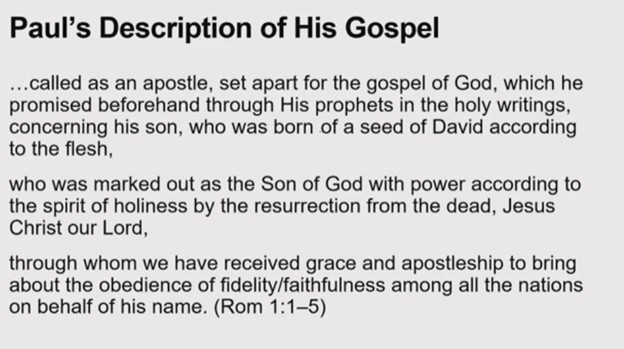
Paul doesn’t elaborate on which statements of “His prophets in the holy writings” he’s referring to, but we can imagine they likely included some big hitters like Is 11:1-10, Is 52:13-53:12, Dan 9:26, but no doubt others too. No other piece of data in Paul’s arsenal of scripture animates his gospel more profoundly than the fact of Jesus’ resurrection. This was the game-changer for Paul (as was, no doubt, his epiphany on the road to Damascus). People didn’t, and don’t, just resurrect themselves (whether in one form or another – it makes no difference.)
But it is likely that the experiential/empirical show-stopper for him was observing those in the Churches he had planted believing in his Gospel, and subsequently living in a distinctly God-honoring manner, having been fundamentally changed in character and heart through the indwelling of God’s Spirit, thereby bringing about “the obedience of faith” to Christ. In other words, voluntarily, desirously seeking to follow Christ in his model of giving, caring, sharing, and healing their fellow believers (and possibly their wider community, though we simply don’t have sufficient evidence of this).
Recounting Israel’s History With the Torah
Staples then dives into a summary of Paul’s view of the history of Israel, the chosen people, as represented in the following slides.
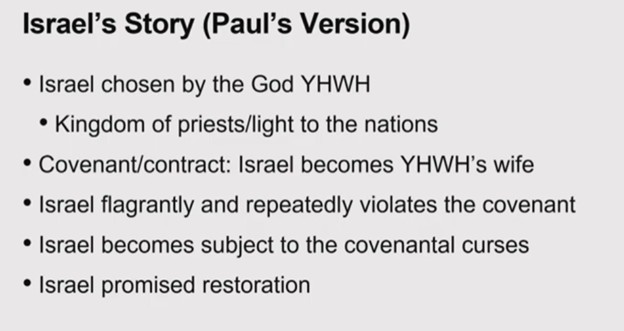
Israel was supposed to be for God a “kingdom of priests”/mediators between He and the nations (Gentiles). That never happened.
Israel played the unfaithful wife to YHWH’s faithful husband, the consequent of which, having violated God’s Covenants, was that Israel experienced the curses outlined in Dt 28:15-68, that God had made with them in covenant at Moab.
The Torah as Witness
Staples notes that the Torah in and of itself was never presented as the guarantor of Israel’s salvation or position in God. In fact, it is presented as just the opposite – the very basis of Israel’s condemnation, serving as a “witness” against them. Of course, Israel was given the choice to obey God’s covenant instructions (choose “life”), or, if not, incur His judgment.

God’s Promised Redemption
Nevertheless, despite this prophesied apostasy, God prophesies that He will call and bring Israel back to Himself (Dt 30:1-6, Is 56:7-8, Is 58:12, Is 60:18, etc.).

Here we get the first hint of God’s New Covenant solution (Dt 30:6). Salvation will come to Israel from outside of the Torah, in fact, from God Himself.

Paul’s Reading of the New Covenant
Staples reminds us that the Hebrew Bible’s message throughout is that the root cause of man’s separation from his God could not be solved by legislation (Torah) nor by simply the people’s attempts to be obedient.
The Torah, as Paul reminds us in Ro 7:22-23, wasn’t the problem. We were.
Paul makes his embracing of the New Covenant prophecies crystal clear when he, in 2 Cor 3:6, calls himself “a minister of a new covenant”. Within this covenant, Paul foresaw people becoming redeemed to God and so justified through being changed from sinful and disobedient to being doers of justice. This change is what he was seeing in his Churches among their Gentiles and Jews.
Why a New Covenant?
Staples spends some time making the case I have been trying to make for several years now elsewhere, and that is that God needed a covenant with humanity for which He took all of the responsibility simply because of humanity’s flawed nature. People don’t want a God, a Lord, or a King who imposes His standards on them. They want to do things their way. He notes Woody Allen’s[vii] quote as capturing this nature (in responding to criticism of his affair with his daughter-in-law):
“The heart wants what it wants. There’s no logic to those things. You met someone and you fall in love, and that’s that.”
He could have just as pointedly quoted Emily Dickenson (from a letter she wrote in 1862):
“The heart wants what it wants or else it does not care.”
He also notes James Madison’s observation[viii] during the work of forming the Federal Government:
“If men were angels, no government would be necessary.”
The overwhelming problem Paul’s New Covenant was here to solve was that our natural heart only very rarely wants the things God wants. We needed new hearts, with His “laws” written on them. And that’s what Paul was seeing among his churches. If the people had God’s Spirit living within them, they didn’t need a written Torah in order to follow Him in obedience. (This was the main point Paul was making in Romans 2 concerning Gentiles.)
Torah and Sin
As Paul surveys the state of his countrymen concerning the Torah, he has to explain the Torah’s purpose (since it obviously wasn’t to bring about heart change in God’s people). It was given to Israel by God (via Moses), so it must have had a purpose.
In Romans 3-6, Paul lays out, step by step, his logic of the purpose and efficacy of the Law, what it did and didn’t accomplish, and therefore why he sees faith in and devotion to God as the missing ingredient from Israel’s history:
- The law informed Israel of God’s will and their sin. It was good, despite it not being followed. Seeing oneself break God’s covenant “kills” according to Paul (2 Cor 3:6), and his testimony in much of Ro 7.
- Following the Law never justified anyone (Ro 3:20), never gave life (Gal 3:21). (This was not the Jew’s understanding. Following the daily practices of Judaism, thought the Jew, maintained his membership in the Israelite clan chosen by God, and so, he reasoned, justified to/by God.)
- Righteousness was always obtained by faithfully obeying God’s will (as exemplified by Abraham demonstrating faith/obedience in the Akedah before there was a Law.)
- Now God has justified those who (seek after/answer His call) through Christ’s sacrifice by God’s grace (making justification by God [being adopted as His child] available to Gentiles as well as Jews).
- Having been justified, even more will they be saved by His (Christ’s) life (Ro 5:8-10).
Saved by His life? Paul is writing probably 30 years after Christ’s crucifixion. How, then, are we to understand this statement? In what way was Christ’s life operating when Paul wrote these words? And might it be the source of the missing “faith in and devotion to God” Israel had not produced? We find out when we finally get into Romans 6-9.
Paul’s Explanation of Jesus’ Role and Authority
Staples points out Paul’s explanation of Christ’s authority based on His resurrection – His defeat of death.
Ga 3:13-14 13Christ redeemed us from the curse of the law by becoming a curse for us—for it is written, “Cursed is everyone who is hanged on a tree”— 14so that in Christ Jesus the blessing of Abraham might come to the Gentiles, so that we might receive the promised Spirit through faith.
Here Staples draws our attention to Paul’s interpretation of Christ’s authority. Paul opens his book with the statement (Ro 1:1-4):
1Paul, a servant of Christ Jesus, called to be an apostle, set apart for the gospel of God, 2which he promised beforehand through his prophets in the holy Scriptures, 3concerning his Son, who was descended from David according to the flesh 4and was declared to be the Son of God in power according to the Spirit of holiness by his resurrection from the dead, Jesus Christ our Lord,
Staples sees a fascinating continuity between Paul’s use of the term “resurrection” here (386. ἀνάστασις anástasis; gen. ana-stáseōs), and the raise/risen language of “his prophets” in the LXX.

Paul seems to conclude that the term “raise up”, having to do with the Messiah in the LXX, didn’t mean lifting up on a throne platform, but rather rising from the dead, the bedrock of Christ’s authority[ix].
So now we come to the heart of Paul’s Gospel (“my Gospel”) – the Spirit of God and His work of transformation.
The Work of the Spirit of God
Christ As the Effective Law
First, we need to see Jesus’ role in “sending” the Spirit (Jn 15:26):
26“But when the Helper comes, whom I will send to you from the Father, the Spirit of truth, who proceeds from the Father, he will bear witness about me.“
Paul understood that the Spirit, and His writing of God’s law on believers’ hearts, was the fulfillment of the Torah’s purpose. And, it was effective for Greeks as well as Jews. After all, as mentioned earlier, this is precisely what Paul had been seeing among his churches.

Here, the “just statute” seems to be the Shema – Dt 6:4-5 (“You shall love the LORD with all of your heart and with all of your mind and with all of your everything.”)
For Paul, Christ, in rising from the dead, accomplishes several things. First, through his human death he “died to the Law”, meaning both the obvious – dead people are not subject to the laws of men – and the symbolic, in that in His position “at the right hand of God” (whatever that may mean) as spirit, He has assumed divine power, no longer subject to the law. Having overcome fleshly death, He then can dispense to men access to His life through God’s Spirit.
The Gift
Paul characterizes this provision of the Spirit as God’s gift (charis), enabled by Christ’s death and resurrection (Ro 5:5-6). Staples then takes up the cultural context of gifts and gift-giving in the Ancient Near East (ANE). In that environment, gifts were a mechanism to establish social or political bonds between the giver and receiver. If you gave someone a gift, you established an unspoken obligation on the part of the receiver to reciprocate to you a gift of equal or greater value at some point in the future (a quid-pro-quo).
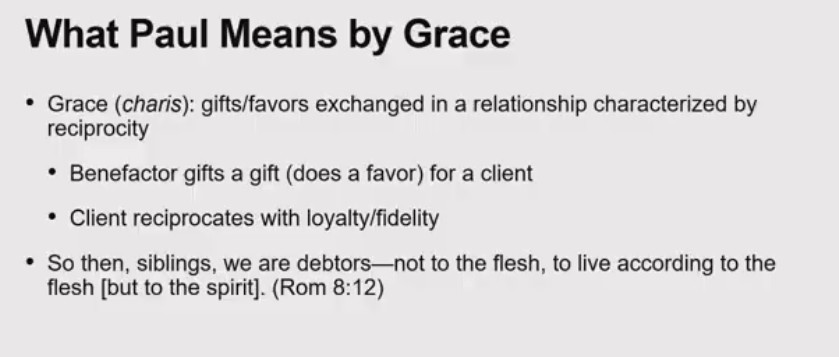
Kings gave their daughters to neighboring kings to formalize an alliance between the two kingdoms. Kings paid tribute to the kings of stronger neighboring kingdoms and received in return protection from their enemies if attacked. This concept remains familiar to us today. If we give a neighbor a lift to pick up their car from their mechanic, we reasonably assume that if we need a similar favor from him in the future, he will reciprocate.
The point is that in describing God as giving the gift of His Spirit, the sense Paul, or anyone else in the ANE would have had, was that receivers of that gift had some implied obligation to the Giver that they needed to be faithful to honor.
Staples reads this story as saying that God gave his grace to us leading to freedom from sin in expectation that we would live in that freedom from sinfulness in keeping with His will. If you’re given “salvation by grace” then your faithfulness to Him is His normal expectation of your thankfulness for His gift, and you, in response, choose to live as He wills. (Spirit or not, this interpretation implies that continuing to sin remains an option. But it is no longer a necessity.)
“My Gospel”
Now, this understanding of Paul’s message in Romans (and elsewhere) is in stark contrast to our traditional interpretation of Paul’s key tenants – that we were “saved” (from Hell) by our faith in God/Christ through God’s grace, and that this saving was “not your own doing; it is the gift of God” (Eph 2:8). Ask the average Christian that is at least somewhat conversant with Paul’s epistles what his key message was, and you will likely hear a response featuring the words “saved”, “grace”, “faith”, and “gift”. Probably nothing about Jesus or His resurrection. And almost certainly nothing about the indwelling of the Holy Spirit within followers of Christ who trust Him for their lives. And it goes without saying, nothing about being enabled to achieve “the righteous requirement of the law” (Rom 8:4).
One of the ways I think that this interpretation of Paul by Staples can begin to sink in for you, and begin to displace the traditional, bumper-sticker version, is to survey all of Paul’s references to God’s Spirit and His role and actions in believers.
I’ve prepared a list of these texts from all of Paul’s Epistles and some from John, with some notes), which you can review by clicking on this text. I encourage you to look over this list, particularly if your understanding of Paul’s message tends to align with the traditional. I think you’ll find it quite compelling.
and was declared to be the Son of God in power according to the Spirit of holiness by his resurrection from the dead, Jesus Christ our Lord,
But a Jew is one inwardly, and circumcision is a matter of the heart, by the Spirit, not by the letter. His praise is not from man but from God. (This is hugely important as it is in the controversial Rom 2.
and hope does not put us to shame, because God’s love has been poured into our hearts through the Holy Spirit who has been given to us.
But now we are released from the law, having died to that which held us captive, so that we serve in the new way of the Spirit and not in the old way of the written code.
There is therefore now no condemnation for those who are in Christ Jesus. (if you’ve given yourself to your Lord, you are no longer guilty of unrighteousness in God’s eyes.)
For the law of the Spirit of life has set you free in Christ Jesus from the law of sin and death.
in order that the righteous requirement of the law might be fulfilled in us, who walk not according to the flesh but according to the Spirit. (those with the Spirit can actually fulfill the “righteous requirements of the law”.)
For those who live according to the flesh set their minds on the things of the flesh, but those who live according to the Spirit set their minds on the things of the Spirit.
For to set the mind on the flesh is death, but to set the mind on the Spirit is life and peace.
You, however, are not in the flesh but in the Spirit, if in fact the Spirit of God dwells in you. Anyone who does not have the Spirit of Christ does not belong to him.
But if Christ is in you, although the body is dead because of sin, the Spirit is life because of righteousness.
If the Spirit of him who raised Jesus from the dead dwells in you, he who raised Christ Jesus from the dead will also give life to your mortal bodies through his Spirit who dwells in you.
For if you live according to the flesh you will die, but if by the Spirit you put to death the deeds of the body, you will live.
For all who are led by the Spirit of God are sons of God.
For you did not receive the spirit of slavery to fall back into fear, but you have received the Spirit of adoption as sons, by whom we cry, “Abba! Father!”
The Spirit himself bears witness with our spirit that we are children of God,
And not only the creation, but we ourselves, who have the firstfruits of the Spirit, groan inwardly as we wait eagerly for adoption as sons, the redemption of our bodies.
Likewise the Spirit helps us in our weakness. For we do not know what to pray for as we ought, but the Spirit himself intercedes for us with groanings too deep for words.
And he who searches hearts knows what is the mind of the Spirit, because the Spirit intercedes for the saints according to the will of God.
I am speaking the truth in Christ—I am not lying; my conscience bears me witness in the Holy Spirit—
Do not be slothful in zeal, be fervent in spirit, serve the Lord.
For the kingdom of God is not a matter of eating and drinking but of righteousness and peace and joy in the Holy Spirit.
May the God of hope fill you with all joy and peace in believing, so that by the power of the Holy Spirit you may abound in hope.
to be a minister of Christ Jesus to the Gentiles in the priestly service of the gospel of God, so that the offering of the Gentiles may be acceptable, sanctified by the Holy Spirit.
by the power of signs and wonders, by the power of the Spirit of God—so that from Jerusalem and all the way around to Illyricum I have fulfilled the ministry of the gospel of Christ;
I appeal to you, brothers, by our Lord Jesus Christ and by the love of the Spirit, to strive together with me in your prayers to God on my behalf,
and my speech and my message were not in plausible words of wisdom, but in demonstration of the Spirit and of power,
these things God has revealed to us through the Spirit. For the Spirit searches everything, even the depths of God.
For who knows a person’s thoughts except the spirit of that person, which is in him? So also no one comprehends the thoughts of God except the Spirit of God.
Now we have received not the spirit of the world, but the Spirit who is from God, that we might understand the things freely given us by God.
And we impart this in words not taught by human wisdom but taught by the Spirit, interpreting spiritual truths to those who are spiritual.
The natural person does not accept the things of the Spirit of God, for they are folly to him, and he is not able to understand them because they are spiritually discerned.
Do you not know that you are God’s temple and that God’s Spirit dwells in you?
And such were some of you. But you were washed, you were sanctified, you were justified in the name of the Lord Jesus Christ and by the Spirit of our God.
But he who is joined to the Lord becomes one spirit with him.
Or do you not know that your body is a temple of the Holy Spirit within you, whom you have from God? You are not your own,
Yet in my judgment she is happier if she remains as she is. And I think that I too have the Spirit of God.
Therefore I want you to understand that no one speaking in the Spirit of God ever says “Jesus is accursed!” and no one can say “Jesus is Lord” except in the Holy Spirit.
Now there are varieties of gifts, but the same Spirit;
To each is given the manifestation of the Spirit for the common good.
For to one is given through the Spirit the utterance of wisdom, and to another the utterance of knowledge according to the same Spirit, (gives various “gifts” that are capabilities one didn’t have previously)
to another faith by the same Spirit, to another gifts of healing by the one Spirit,
All these are empowered by one and the same Spirit, who apportions to each one individually as he wills.
For in one Spirit we were all baptized into one body— Jews or Greeks, slaves or free—and all were made to drink of one Spirit.
For one who speaks in a tongue speaks not to men but to God; for no one understands him, but he utters mysteries in the Spirit.
So with yourselves, since you are eager for manifestations of the Spirit, strive to excel in building up the church.
For if I pray in a tongue, my spirit prays but my mind is unfruitful.
Thus it is written, “The first man Adam became a living being” (Ge 2:7); the last Adam became a life-giving spirit.
and who has also put his seal on us and given us his Spirit in our hearts as a guarantee.
And you show that you are a letter from Christ delivered by us, written not with ink but with the Spirit of the living God, not on tablets of stone but on tablets of human hearts. (Straight from Jer 31:33
who has made us sufficient to be ministers of a new covenant, not of the letter but of the Spirit. For the letter kills, but the Spirit gives life. (another contrast with the written Law vs the Spirit-enabled conformance with that written law.)
2 Corinthians 3:7-17 (poetic contrast between old covenant and New demonstrating why the New was necessary for the Jews.)
7Now if the ministry of death, carved in letters on stone, came with such glory that the Israelites could not gaze at Moses’ face because of its glory, which was being brought to an end, 8will not the ministry of the Spirit have even more glory? 9For if there was glory in the ministry of condemnation, the ministry of righteousness must far exceed it in glory. 10Indeed, in this case, what once had glory has come to have no glory at all, because of the glory that surpasses it. 11For if what was being brought to an end came with glory, much more will what is permanent have glory.
12Since we have such a hope, we are very bold, 13not like Moses, who would put a veil over his face so that the Israelites might not gaze at the outcome of what was being brought to an end. 14But their minds were hardened. For to this day, when they read the old covenant, that same veil remains unlifted, because only through Christ is it taken away. 15Yes, to this day whenever Moses is read a veil lies over their hearts. 16But when one turns to the Lord, the veil is removed. 17Now the Lord is the Spirit, and where the Spirit of the Lord is, there is freedom.
And we all, with unveiled face, beholding the glory of the Lord, are being transformed into the same image from one degree of glory to another. For this comes from the Lord who is the Spirit.
He who has prepared us for this very thing is God, who has given us the Spirit as a guarantee.
2 Co 5:4
4For while we are still in this tent, we groan, being burdened—not that we would be unclothed, but that we would be further clothed, so that what is mortal may be swallowed up by life. (this is a fascinating contrast between our mortal selves and the “life” that God implored us to choose (Dt 30:19))
The grace of the Lord Jesus Christ and the love of God and the fellowship of the Holy Spirit be with you all. (example of his letter benedictions)
Let me ask you only this: Did you receive the Spirit by works of the law or by hearing with faith?
Does he who supplies the Spirit to you and works miracles among you do so by works of the law, or by hearing with faith—
so that in Christ Jesus the blessing of Abraham might come to the Gentiles, so that we might receive the promised Spirit through faith.
And because you are sons, God has sent the Spirit of his Son into our hearts, crying, “Abba! Father!”
But just as at that time he who was born according to the flesh persecuted him who was born according to the Spirit, so also it is now.
For through the Spirit, by faith, we ourselves eagerly wait for the hope of righteousness.
But I say, walk by the Spirit, and you will not gratify the desires of the flesh.
For the desires of the flesh are against the Spirit, and the desires of the Spirit are against the flesh, for these are opposed to each other, to keep you from doing the things you want to do.
But if you are led by the Spirit, you are not under the law. (The presence of the Spirit functionally replaces the law.)
But the fruit of the Spirit is love, joy, peace, patience, kindness, goodness, faithfulness,
If we live by the Spirit, let us also keep in step with the Spirit.
For the one who sows to his own flesh will from the flesh reap corruption, but the one who sows to the Spirit will from the Spirit reap eternal life.
In him you also, when you heard the word of truth, the gospel of your salvation, and believed in him, were sealed with the promised Holy Spirit,
that the God of our Lord Jesus Christ, the Father of glory, may give you the Spirit of wisdom and of revelation in the knowledge of him,
For through him we both have access in one Spirit to the Father.
In him you also are being built together into a dwelling place for God by the Spirit.
which was not made known to the sons of men in other generations as it has now been revealed to his holy apostles and prophets by the Spirit. (conveys revelation)
that according to the riches of his glory he may grant you to be strengthened with power through his Spirit in your inner being,
eager to maintain the unity of the Spirit in the bond of peace.
There is one body and one Spirit—just as you were called to the one hope that belongs to your call—
And do not grieve the Holy Spirit of God, by whom you were sealed for the day of redemption.
And do not get drunk with wine, for that is debauchery, but be filled with the Spirit,
and take the helmet of salvation, and the sword of the Spirit, which is the word of God,
praying at all times in the Spirit, with all prayer and supplication. To that end, keep alert with all perseverance, making supplication for all the saints,
for I know that through your prayers and the help of the Spirit of Jesus Christ this will turn out for my deliverance,
Only let your manner of life be worthy of the gospel of Christ, so that whether I come and see you or am absent, I may hear of you that you are standing firm in one spirit, with one mind striving side by side for the faith of the gospel,
So if there is any encouragement in Christ, any comfort from love, any participation in the Spirit, any affection and sympathy, 2 complete my joy by being of the same mind, having the same love, being in full accord and of one mind. 3Do nothing from selfish ambition or conceit, but in humility count others more significant than yourselves. 4Let each of you look not only to his own interests, but also to the interests of others. 5 Have this mind among yourselves, which is yours in Christ Jesus,
For we are the circumcision, who worship by the Spirit of God and glory in Christ Jesus and put no confidence in the flesh—
and has made known to us your love in the Spirit.
because our gospel came to you not only in word, but also in power and in the Holy Spirit and with full conviction. You know what kind of men we proved to be among you for your sake.
And you became imitators of us and of the Lord, for you received the word in much affliction, with the joy of the Holy Spirit,
Therefore whoever disregards this, disregards not man but God, who gives his Holy Spirit to you.
Do not quench the Spirit.
But we ought always to give thanks to God for you, brothers beloved by the Lord, because God chose you as the firstfruits to be saved, through sanctification by the Spirit and belief in the truth.
Great indeed, we confess, is the mystery of godliness: He was manifested in the flesh, vindicated by the Spirit, seen by angels, proclaimed among the nations, believed on in the world, taken up in glory.
Now the Spirit expressly says that in later times some will depart from the faith by devoting themselves to deceitful spirits and teachings of demons, (forewarned)
for God gave us a spirit not of fear but of power and love and self-control.
By the Holy Spirit who dwells within us, guard the good deposit entrusted to you.
he saved us, not because of works done by us in righteousness, but according to his own mercy, by the washing of regeneration and renewal of the Holy Spirit,
24 Whoever keeps his commandments abides in God, and God in him. And by this (keeping his commandments) we know that he abides in us, by the Spirit whom he has given us.
2By this you know the Spirit of God: every spirit that confesses that Jesus Christ has come in the flesh is from God, 3and every spirit that does not confess Jesus is not from God. This is the spirit of the antichrist, which you heard was coming and now is in the world already. 4Little children, you are from God and have overcome them, for he who is in you is greater than he who is in the world. (The “spirit of Antichrist” isn’t some malevolent being coming in the future to inflict punishments on the world. It is simply man’s natural rejection of Christ as the Lord of his life.)
13 By this we know that we abide in him and he in us, because he has given us of his Spirit.
9(which is symbolic for the present age). According to this arrangement, gifts and sacrifices are offered that cannot perfect the conscience of the worshiper, (Good summary of the difference.)
124 matches of “Spirit” in Romans-Philemon of which 97 are references to the Holy Spirit/Spirit of God.
Of 124 references to “Spirit” in Paul’s Epistles, an overwhelming 97 are his mentions of the Holy Spirit/God’s Spirit and His role in Paul’s Church members’, and fellow Apostles’, lives. In a bit of contrast, his references to “grace” in these Epistles total 82 occurrences. Of these, 52 are references to God’s grace to himself or his churches (apart from Paul’s use of the term in the blessings and salutations of his letters). So, by this simplistic metric, God’s provision of His Spirit to believers was far more significant in Paul’s messages than was God’s grace in dispensing Him.
Conclusion
I am indebted to Dr. Jason Staples for presenting this revealing interpretation of Romans in such clear and precise terms. I’m not sure how the traditionalists will counter Staples’ interpretation. The first thing they should probably address is how it was that they accepted wholesale the superficial interpretation of Paul’s message extant in the 16th century. It seems they’ve had hundreds of years to exegetically drill down to determine if Luther’s (or indeed Calvin’s) interpretation of Paul’s message lacked anything. Instead, it seems the overall theme of Paul’s message has gone simply unexamined.
Was the interpretation of his message (Ep 2:8) “8For by grace you have been saved through faith. And this is not your own doing; it is the gift of God,” the only message Paul was endowed to give us?
Staples’ analysis concludes that “No. Not only wasn’t that Paul’s exclusive message, it wasn’t even his most important or most emphatic message.” Further, it appears that the salvation Paul was discussing wasn’t the salvation from judgment/Hell (although that might be its ultimate result). Rather, it seems that it was salvation from the sentence of sin and death that had been exposed by his Torah.
The gift of God’s Spirit, inaugurating God’s New Covenant through which we are transformed into His children, capable of obedience to His will, was its most significant message.
Paul’s message was a thoroughly Jewish, thoroughly Biblical one that, contrary to his traditional critics, aligns Paul’s message of God’s grace perfectly with the teachings of Jesus and with the Messianic and New Covenant expectations of his Jewish brethren prophesied by their prophets. From the beginning, God sought from Israel a “kingdom of priests, a holy nation” (Ex 19:6). What Paul explains in his Epistles is not only how God was achieving this outcome, following the resurrection of Christ and the “pouring out” of His Spirit among the Jews, but also achieving it among Gentiles throughout Paul’s missionary world.
Hopefully, Staples’ interpretation of Paul’s message will gather more academic, and then evangelical support over time. However, I’m not sure I’ll hold my breath waiting for that outcome.
[i] A Fresh Look at Paul – A Pilgrim’s Search
[ii] Being a Disciple – A Pilgrim’s Search
[iii] Since I’ve been writing about this character of God’s salvation for many years now, it was particularly affirming to have someone of Dr. Staples stature confirm this reading of Paul.
[iv] By “New Covenant” reading, I’m pointing out that the out pouring “on all flesh” of God’s Spirit was one of the core images of the Hebrew Bible’s New Covenant prophecies (i.e. Joel 2:28, Dt 30:6, Isa 44:3-5, Isa 32:15-17, Jer 31:33-34, Eze 11:19-20, 36:26-28, 37:14), Zec 12:10, and Micah 4:1-5). The revelation that I think Staples brings to the discussion is that Paul the Apostle was fully committed to the interpretation of Christ’s ministry, death and resurrection, and the subsequent pouring out of God’s Spirit on Pentecost, as, in fact, the advent of the fulfillment of God’s New Covenant announced by the prophets.
[v] Interpreting the New Covenant – A Pilgrim’s Search
[vi] We don’t have time in this short piece to untangle all of the misunderstandings and their consequences (in thought and doctrine). But if you’re interested in a resolution of this particular dichotomy, I recommend Recovering the Gospel – I – A Pilgrim’s Search and its section headed “What About Ephesians and Romans?”
[vii] Woody Allen interview by Time Magazine, 1992.
[viii] Madison, James. Federalist No. 51. Published February 6, 1788. In The Federalist Papers, edited by Clinton Rossiter. New York: Signet Classics, an Imprint of New American Library, a Division of Penguin Group (USA), 2005
[ix] In Romans 5:8-10 Staples believes Paul is contrasting Moses going down through the Yam Suph and up on the mountain (Sinai) to get God’s written Law to give to Israel, with Jesus’ going down through death only to rise up to receive God’s perfect Law, the basis of His New Covenant, so that He can write it on believers’ hearts through the provision of God’s Spirit. See Acts 2.
