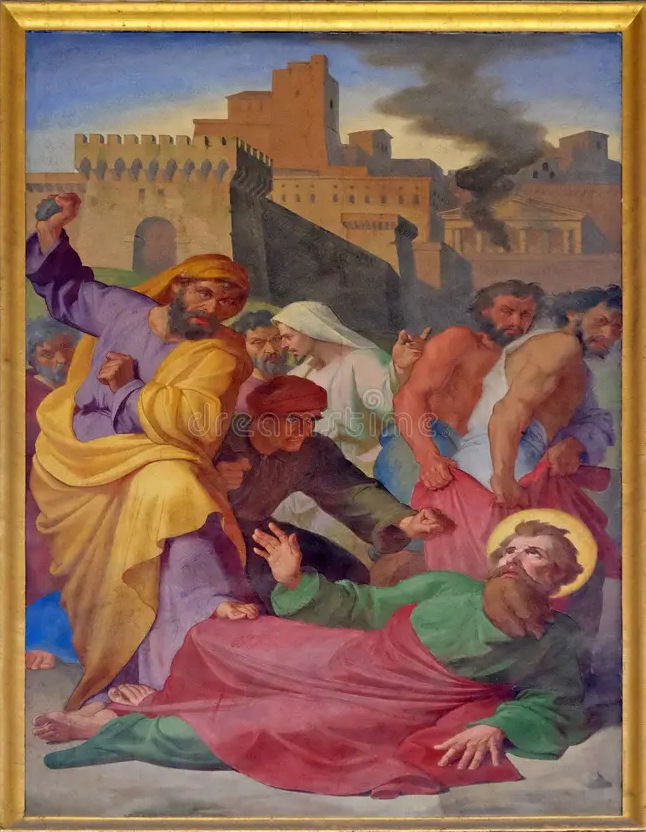
Category: Paul
-
Forgiven, or Transformed to Righteousness?

For centuries, the traditional, Christian interpretation of Jesus’ death has been that it was an atonement for the sins of those who would choose to “believe” and follow Him. This scenario portrayed a kind of cosmic cleansing for those who believed, though no one told us what that meant. A common assumption is that having one’s sins atoned for/forgiven is having them excused. For the record, not everyone completely bought the cosmic cleansing story, citing texts (e.g. Luke) that didn’t completely embrace the sacrificial atonement theme.
-
Learning the Real Paul (and Unlearning What You’ve Been Taught)

Scholars and expositors have been mangling Paul’s message in his epistles (particularly Romans) for centuries. If we are to see Paul’s true message, we’re going to have to dig much more deeply into the text, and then unlearn nearly everything we thought we knew. No small undertaking. But in so doing, we will also see revealed the true Gospel message of not only the entire New Testament, but the Hebrew Bible as well, as one grand story. And once you’ve seen this story accurately, it is doctrine- and theology-upending to the point that you will never again read your Bible…
-
Unpacking the New Covenant Gospel

Many Western Christians [i] and secular individuals have misunderstood the core message of the Bible’s Good News for centuries. This analysis aims to clarify the true Gospel, obscured since the Reformation, by examining relevant New Testament and Hebrew Bible passages to determine whether they support or challenge what I’m referring to as the “New Covenant Gospel”, first proposed by Dr. Jason A Staples. This interpretation diverges from the traditional Gospel message fundamentally.
-
What Does “He Emptied Himself” Mean?

Recently a very long-standing dear friend of mine asked my thoughts on Paul’s phrase “he emptied himself” in Phl 2:7. He said he had been considering the meaning of the phrase for some time. I confessed I hadn’t thought about it. But, as it turns out, many hundreds of bible scholars and theologians have ever since the formation of the very early church. Let’s see what we can find out.
-
The Letters of James and Paul — Different?

There is an undercurrent of opinion amongst scholars of the early Church and Bible students that James, the brother of Jesus, and Paul the Apostle proclaimed two different gospels – that the book of James contains an authentic look into 1st century Jewish Christianity and what his brother, Jesus, taught, while Paul’s epistles lay out a completely different “religion”. Some of these also believe that, since Paul wrote first, that aspects of his letters were borrowed by the Gospel writers, thus propagating the Paul version of Christianity throughout nearly the entire New Testament. Is this viewpoint correct?
-
Paul’s Real Gospel

When you hear a respected biblical scholar reinforcing with conviction what you’ve been learning – and teaching – for the last ten or twenty years, it’s a big deal, not to mention quite the affirmation. Such was my case in coming across a lecture by Dr. Jason Staples (one of my favorite New Testament scholars) in 2024 entitled “Salvation by Moral Transformation: What Paul Really Meant by Grace”. Not to be too dramatic but Staples’ insights into Paul’s real message will be at least as explosive within the traditionalist community as was “The New Perspective on Paul”[i] of Messrs. NT…
-
Does Paul’s Potter/Clay Metaphor Say What Christians Think It Says?

In Romans 9:18-23, Paul gives us a very sparse but dense (contextually) metaphor describing God as a potter working on “vessels” that in one case turn out “for blessing” and in others, turn out “for destruction”. Is Paul saying what traditionally has been believed he is saying? Let’s see.
-
What Did the “Law of Moses” Mean To…?

This post presents a three-part series looking at what the term “Law of Moses” (and similar) meant to different people at different times in the Bible; 1) The Israelites, at various points in their history, 2) Jesus (in His many interactions with others involving His understanding of its meaning), and 3) Paul, who infamously dismissed “works of the law” as valid for justification of his Jewish brethren.
-
Freedom, in Paul

Countless words have been spilled analyzing and debating Paul’s intended meaning of the phrase “works of the Law”, and his theological treatment of the Law itself. In contrast, far fewer words have been spilled analyzing and exploring Paul’s concept of the “freedom” he ascribes to those “in Christ”. Our intention here is to show the relationship between these two concepts and, in so doing, dispel some pervasive misunderstandings, at least among evangelicals.
-
New Life in the Kingdom of God
In the second three chapters of Ephesians, Paul casts his revolutionized view of human life and interrelationships that, as much as any portion of his epistles, brings into sharp focus the life transformation that followers of Christ should both expect and strive for.
-
Don’t Waste God’s Time

Few understand what being called into the life of Christ means to them or requires of them. Fewer still understand, having answered this call, how such a life is even possible, let alone what that life looks like as it is lived out. And very, very few know that answering that call and living that life is what God expects of all of us.
-
The Law of Faith

Paul in Romans 3:27 says: Then what becomes of our boasting? It is excluded. By what kind of law? By a law of works? No, but by the law of faith. Unfortunately, Paul never explicitly tells us what this law is that he is referring to (this is the only occurrence of the phrase not only in Romans, but in the entire Bible.) In order to understand his meaning, we’re going to have to do a bit of exegetical work on the argument he is waging in Romans 3 and preceding.
-
The Obedience of Faith

In this note we’ll look at this imperative of obedience to Christ as portrayed in the Bible, and uncover some insight into what the Bible means by “obedience” and “believe”.
-
Recovering the Gospel – II

Here I want to look at, to the degree we can, how Jesus Himself thought about the Gospel He was bringing. What did He think the Gospel was that He was bringing, and, more importantly for our present situation, how did He see it being enacted?
-
Biblical Love

In the Bible the people of God are commanded to love Him (Deut 6:5, 11:13, 30:6, Mt 22:37) and love their neighbors (Lev 19:34, Mt 22:39-40), whether those neighbors are love-able or not. But what is Biblical love? And how do we get it, and give it away[i]?