Introduction
About 2000 years ago, Christ rode into Jerusalem on a donkey, prophesied by Zechariah (9:9) of Israel’s long-awaited Messiah, and hailed by His followers with “Hosanna[i]”. In keeping with God’s plan for His Creation, Jesus was murdered, buried, and then arose from death only to reappear to the Disciples and many who knew Him. During His ministry, He repeatedly taught about the immanence of God’s Kingdom on Earth (i.e. “at hand”, “in your midst”, etc.)
The Bible says that for His act of sacrificial obedience, Christ was given all authority in Heaven and on Earth. Yet, here we sit, 2000 years later, and, while we can find some instances of God’s Kingdom on Earth (in the lives of dedicated Christ-followers), the vast majority of mankind is not only not following Christ, they’re not following the true God at all.
Was there something left undone in Christ’s death and resurrection that leaves humanity in its current state of ungodliness rather than living in God’s Kingdom “on earth as it is in Heaven”? And is this even a legitimate question?
Theories
It can be argued from the text that Paul and Peter (if not all of the Disciples) thought that Christ’s return to initiate the New Heavens and New Earth was immanent following His resurrection. I think it is easy to see their understanding that the scene on the Temple Mount of “not one stone left upon another” equaled the end of the age and Christ’s return to establish the new kingdom of God in Israel. And Jesus told them “all these things” (including the Temple destruction) would be seen by some of those in the then-current generation.
They didn’t live to see Christ return to rule on earth. Nor have the last fifty generations.
There are many variant theories in Christian theology as to what is sometimes called our “now” condition vs our “not yet” aspirations (read on). But of all these variants for our purposes we’re only concerned with the main two: Eschatological Redemption, and the (aforementioned) doctrine of the Kingdom of God on earth as both “now”, though incompletely realized until the “not yet” of Christ’s second advent has occurred.
(There is yet a third major eschatological belief which holds that God has accomplished everything He wills for His Creation. It’s all done, and this is what we have. People holding this belief are called “preterists”, implying that all of God’s prophesied actions have occurred previously. There are degrees of this belief ranging from “full” preterism to degrees of “partial” preterism, in which varying amounts of prophecy are believed to be yet unfulfilled. If all of the Bible’s forward-looking prophecies have already been fulfilled (“full preterism”), then none of its end times prophesies are unaccomplished and are yet to happen in the future. We might call this belief “Completed Eschatology”. Such folks constitute a tiny minority of believers, and so I’ll just leave it at that.)
Eschatological Redemption
The hallmark of this doctrinal school is that humanity is not completely redeemed until a) the individual dies, or b) Christ returns for His church. What happens in the meantime? The people who adhere to this worldview don’t appear to particularly care. (Its name can be more plainly identified as “end-times redemption”; that is, true redemption occurs at the end of this world when all are judged.)
Their claim (despite Christ’s repeated admonitions and characterizations in the scripture of the Kingdom of God) is that the Kingdom of God is the reign of Christ/God over all humanity upon Christ’s return to earth and (supposedly) taking up His throne in Jerusalem.
If there is no Kingdom until Christ’s return, then, of course, it is foolishness to assume that Christ, for example in His Sermon on the Mount (Mt 5-7), was outlining the God-ordained patterns for how one is to live within that Kingdom on earth, and declaring how His death and resurrection would be the event that enabled God to pour out His Spirit on those who took Christ as their Lord, that would enable them to live that life He described. This idea is apparently not even entertained by these folks, though it dominates much of the New Testament.
Technically speaking, these people are “futurists” in that they believe that all of God’s real work on earth is “on hold” until eventually He elects to send Christ back for the Church (i.e. His followers). Consequently, we find this group (by far the largest sub-group of Christians in the US – but only there) persistently interested in trying to interpret the scriptures to figure out when that return will be.
The developer of the eschatological narrative most widely used in the US today was an Irish churchman named Charles Nelson Darby. Having split from the Church of England in the 1830s, Darby traveled to America where he proselytized his dogma in the States and southern Canada during the post-Civil War period. And he was hugely successful. (We have mainline seminaries today pumping out his ideas, and of course, the notes in the Schofield Bible.) But few who adopt his dogma bother to stop and question why it is that none of the Disciples or early Church Fathers could figure out the interpretation that it took Darby to discover in their words 1800 years later.
So the futurists claim that “The world isn’t supposed to be transformed/redeemed until Christ returns.”
Perhaps, then, they should also answer why it is He came in the first place. What, exactly, was Christ’s first advent’s purpose?
Inaugurated Eschatology
Those who believe that Christ’s life, death, and resurrection “inaugurated” (or provided a new method of access to) God’s Kingdom on Earth are said to believe the doctrine of “Inaugurated Eschatology”. The view of this doctrine from 30,000 feet is that Christ’s resurrection initiated a period of the final things – the end times – in which God’s Kingdom would manifest itself on earth within His heretofore mostly apostate humanity.
Yes, there were faithful followers of God in Christ’s day. These are called the faithful remnant (of Israel), and they are those who, in addition, accepted Christ’s call to submit to His Lordship. But these were a tiny minority of Jews in Judah or the Galilee. (Luke 17:22)
But the hallmark of this “school” is that they believe that Christ’s death and resurrection, not to mention His provision of His Holy Spirit at Pentacost, actually achieved something. And what it achieved was that, for those that believed Jesus was their risen Lord, they were endowed with His Holy Spirit which enabled them to be faithful and obedient to Him and His teachings. And by this transformation they immigrated into the Kingdom of God Jesus preached, in which love of neighbor and God was common, routine, and what all those in His Kingdom normally do.
So this Eschatology is fundamentally different from the “Eschatological Redemption” doctrine. This view says that God’s Kingdom is on earth now in the interaction of His followers with their neighbors. They’re not waiting for the second coming. They’re living out what they understand to be His admonitions in the power of the Holy Spirit now in their everyday lives.
Do they believe that there will ultimately be a second coming; a “New Heavens and New Earth”? Yes, of course. But they’re not sitting and idylly waiting for it, as the futurists are. From a prophetic point of view, most of this belief can be classified as partial preterists – that is, those who believe that some of God’s eschatological prophecies have already been accomplished. But that some (like the “New Heavens and New Earth”) have not.
Unlike their futurist brothers and sisters, their understanding is that God’s Kingdom is here now, and that they are to live in it and be God’s images/representatives on earth as God attested (Gen 1: 26).
Rapheal’s Metaphor
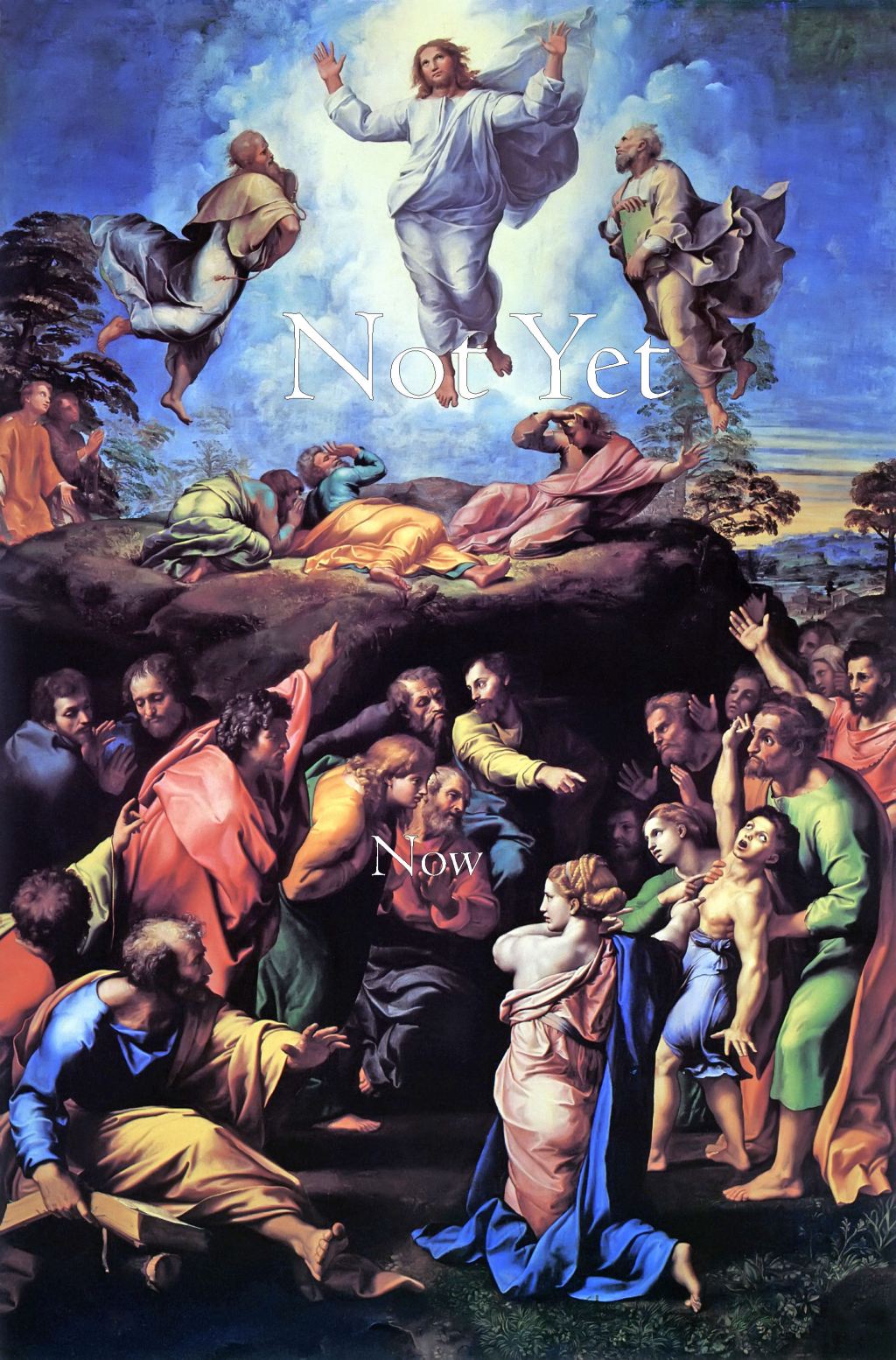
In his painting “The Transfiguration”, the sixteenth-century artist Rapheal (see featured picture, below) created a metaphoric image (though unintentionally, as the painting depicts Christ’s transfiguration on Mt. Tabor) exemplifying the current earthly situation (“Now”) below the ultimate transformational renewal inaugurated by Christ’s second coming (“Not Yet”).

The implicit message of this painting, and the theology that it unintentionally depicts, is that things on earth will continue to substantially consist of conflict and suffering until Christ’s second advent heals all infirmities and transforms His belivers into transformed beings equipped to live with Him eternally. (Come, Lord Jesus!)
So What Is God Waiting For?
In my opinion, nothing. Of course, whatever our eschatology (unless we’re “full” preterists), as Christians we are waiting in expectation of Christ’s return – His Parousia. But are we to wait for it? Where does the Bible tell us that? I’ve looked and it doesn’t.
What it says is that we are to serve others out of the leading and power of God’s Spirit living within us (e.g. Acts 1:8, 1 Cor 12:11, Eph 3:16, 2 Tim 1:7). People animated and empowered by this Spirit living together is the Kingdom of God (“on Earth as it is in Heaven”).
Paul tells us as much in Phl 2:13 (NET):
[13] for the one bringing forth in you both the desire and the effort – for the sake of his good pleasure – is God.
In an earlier piece[ii] I had this to say about the enabling and strengthening of the Holy Spirit:
“Through the Spirit of Christ we’re given access to the grace (charis) of God from which comes the gifts (charisma) of the Holy Spirit to sustain and enable us to do things we naturally could not do.
2 Corinthians 9:8 And God is able to make all grace (charis) abound to you, so that having all sufficiency in all things at all times, you may abound in every good work.”
The world is in its present state of chaos and ungodliness precisely because too few of its people share in God’s Spirit, and so experience the power of His grace to live in His Kingdom as if He is their Lord, something that is available to all of them but only if they will commit their lives to obediently following Christ as His earthly agents[iii].
Will Christ return for His Church (the collection of all those who have followed Him as Lord throughout history)? Yes. But, again, what are we to do in the meantime?
Christ repeatedly answered that question.
The entire New Testament is filled with teachings on living in God’s Kingdom. The availability of life in the Kingdom of God was the preeminent message of Jesus’ ministry. Why would He have spent all the time on this topic and offered us so many parables describing it if it were some reality only available following our physical deaths in heaven or at His Parousia?
The answer is He wouldn’t have. Jesus’ message of the Kingdom was a call to faith and a call to action.
Today’s world remains in a state of moral decay at least as decadent as it was in Jesus’ day (if not more so) because more of its members have not chosen[iv] to live their lives for and in Christ. Too few of us have chosen to turn from our worldly lives and priorities and ask Christ to be our Lord (not just our Savior), and to live as if He is.
Conclusion
Lots of people look around at the state of the world today and laugh out loud at the assertion that Jesus, the Christ, was Israel’s Messiah, God’s Son and “savior of the world” (1 Jn 4:14). “If Jesus was the ‘savior of the world’”, they ask, “then why hasn’t He saved it?”
Now some of this is from just simple ignorance of what the Bible says. But a good helping of it is the sinful nature’s glee (perhaps under the influence of some dark forces: who knows?) at having the apparent justification to deride and treat with disdain the Son of God. And of course, a lot of it in our modern secular society comes from the godless secularist judging those who have faith and follow Christ as simple and ignorant; believing ridiculous things about the myths they read in their Bibles and hear from their leaders.
But there is a more insidious reason. Modern secularists look at members of the organized church and see people just like themselves, aside from their church attendance. “If those are Christians”, they reason, “what’s the big deal with this Jesus guy? As far as I can tell, they’re no different than me.”
And this is our existential problem. Since the gospel of Christ as our Lord and the indwelling of the Spirit of God has been, for all intents and purposes, abandoned by the organized church, its only function has been to create social organizations whose members perhaps occasionally help each other, but otherwise produce people indistinguishable from those who have never darkened a church’s door.
This is the challenge of our time. Before we can “lead people to Christ” we have to first be honest as to what that involves for them, something that the organized church is willfully deceptive about. Second, we have to give them clear and unequivocal guidance not only on how to become Christ’s disciples, but how to know if they are, in fact, members of Christ or not.
Paul seems to offer the acid test in 2 Cor 5:17
[17] Therefore, if anyone is in Christ, he is a new creation. The old has passed away; behold, the new has come.
This seems quite simple. Am I a “new creation”? This is not a difficult question. Are my priorities now fundamentally different; my esteem for God; my interest in things in the world compared to my life previously? No? Then it is very likely that I am not, according to Paul’s script, “in Christ”. If this is your situation, you now, hopefully, know why[v].
But suppose I find that my interests are radically transformed – directed at knowing and serving God, at striving to know Him more and more and dedicated to serving others. In that case, there can be no other explanation than that the Spirit of God has taken up residence within me. I am in Christ as a member of Him (1 Cor 12:27). And it is within Him that His Kingdom is realized and, eventually, that the world will be first reformed, and then transformed.
[i] The English “hosanna’ is a transliteration of the Greek “5614. ὡσαννά hōsanná”, itself a word transliteration of the Hebrew phrase–3467. יָשַׁע “yāša”`: (A verb meaning to save, to help, to deliver, to defend), with — 577. אָנָּא ‘ānnā’, אָנָּה “‘ānnāh”: (An interjection of entreaty meaning “I beg you”) resulting in something like: “save (us) now, help (us) now, or save (us) we pray thee”. See Ps 118:25.
[ii] “Belief, And the Indwelling of the Holy Spirit”
[iv] I understand that there are entire Christian denominations that don’t believe humans have any part in their ending up as follwers of Christ – that it is exclusively God’s choice of who will and who won’t. Obviously, that’s not my position. If you’re interested in my scriptural exegesis of the Calvinist “proof texts”, you can have a look at: “A Defense of the Character of God”.

Leave a comment