Introduction
Only some people believe that Jesus of Nazareth was divine, the same thing as God. Almost none of those believe that God is a singularity. They would say that He is “three in One”. Does the assertion of Jesus’s divinity by itself create a dichotomy between these two ideas, as many claim?
The purpose of this piece is to demonstrate that a single Divinity does not represent a dichotomy but rather a transcendent truth that goes by the label “Modalism”[0]. We will look at some of the voluminous textual evidence that supports this case and find that, far from being some fringe theological theory, it represents the most pragmatic resolution of the various pieces of seemingly contradictory textual data we have.
Preliminaries
Many react to passages in which Jesus alludes cryptically to Himself in some special relationship with God with cynicism, claiming instead that these were just later “interpolations” added by 2nd century (or later) church authorities to substantiate their case for Jesus’s divinity.
Anything is possible. But where’s the textual evidence for that conclusion specifically for these divinity passages being late? There is none that I am aware of[i]. It seems to be a wish – a hope, by those who seem to want Jesus to be a faithful Jewish rabbi – maybe a prophet, but nothing more.
For our purposes here, while recognizing these charges exist, we’re just simply going to assume that Jesus said the things the Gospel authors say He said.
What Is Modalism?
Modalism, (a type of Monism), is the theory that God is singular, but that He has the ability to manifest Himself whenever, wherever, and in whatever form (e.g. a physical man, a burning bush, a glorious, bright, glowing light on a mountain, a pillar of cloud by day and fire by night, understandable speech “from heaven”, an image in a vision He chooses to give to one of His saints, or any other form, or all of these at once. Such manifestations or “expressions” are referred to as His “modalities”.
In case you may not be familiar with the Hebrew Bible’s most blatant example of God choosing a manifestation of Himself in the form of a man who was conversant with humans, please review the story of Abraham’s three visitors who announce Sarah’s impending pregnancy, enjoy a feast and conversation with Abraham, and then leave on foot (Gen 18:1-16).
The text says the lead visitor (of the three) was the LORD (i.e. YHVH). Yet here He is eating and drinking and talking with Abraham. How are we to classify this apparently-human man?
The Bible calls Him YHVH. Should we be forced to call Him an “angel”? That’s not what the text calls Him. Was He purely a human whom God had conscripted to carry His Spirit and message for the purpose of this meeting? While possible, the text doesn’t give us information to support that theory.
Taken at face value, that “man” was, according to the Genesis author, YHVH. In other words, He was a manifestation of the God of the Universe with the appearance (and possibly biology) of a human.
Of course, the Hebrew Bible records other manifestations of YHVH. Jacob’s wrestling mate was identified as YHVH, though apparently human (Gen 32:22-32). The LORD appears to and speaks with Gideon in Jdg 6:12-18. There are many other manifestations the Bible identifies as “angels of the LORD”. Manoah and his wife in Jdg 13 host a visitor who doesn’t claim to be YHVH but speaks YHVH’s words, so manifesting Him audibly. A similar manifestation visits Hagar in the desert who again conveys YHVH’s words (Gen 16:7-13). In a practical sense, such visions/hearings are manifestations of YHVH, though the Bible refers to many of them as “messengers” (i.e. angels). They, like the visitor in Gen 18, manifest an expression of YHVH.
This, to my mind, is exactly what Jesus of Nazareth was doing, just like the Abraham visitor at Mamre: presenting an expression[ii] of YHVH.
Why Did Trinitarianism Develop?
The reason for the development of the theory of a Trinity of divine, co-equal ‘personalities’ as agents of the One God is embarrassingly simply. The NT talks about three figures: the Father, the Son, and the Holy Spirit. Jesus talks about His “Father”. He also talks about the “Helper” (3875. παράκλητος paráklētos) that He will “send” (whom YHVH identifies as Himself in, e.g., Hos 13:9). So, if the NT mentions three different actors, then the doctrine needs to address and rationalize exactly three different actors. Thus, we get the church’s “Trinity” doctrine.
The Trinity was enfranchised in the First Council of Nicaea in 325 AD. The main question this gathering of early church officials was convened to answer was in what way Jesus of Nazareth was divine[iii]. Apparently, they weren’t so bothered by the question of in what way the Holy Spirit was divine, as that, perhaps, seemed more intuitive. So that question wasn’t doctrinally proclaimed until the Council of Constantinople in 381 AD[iv].
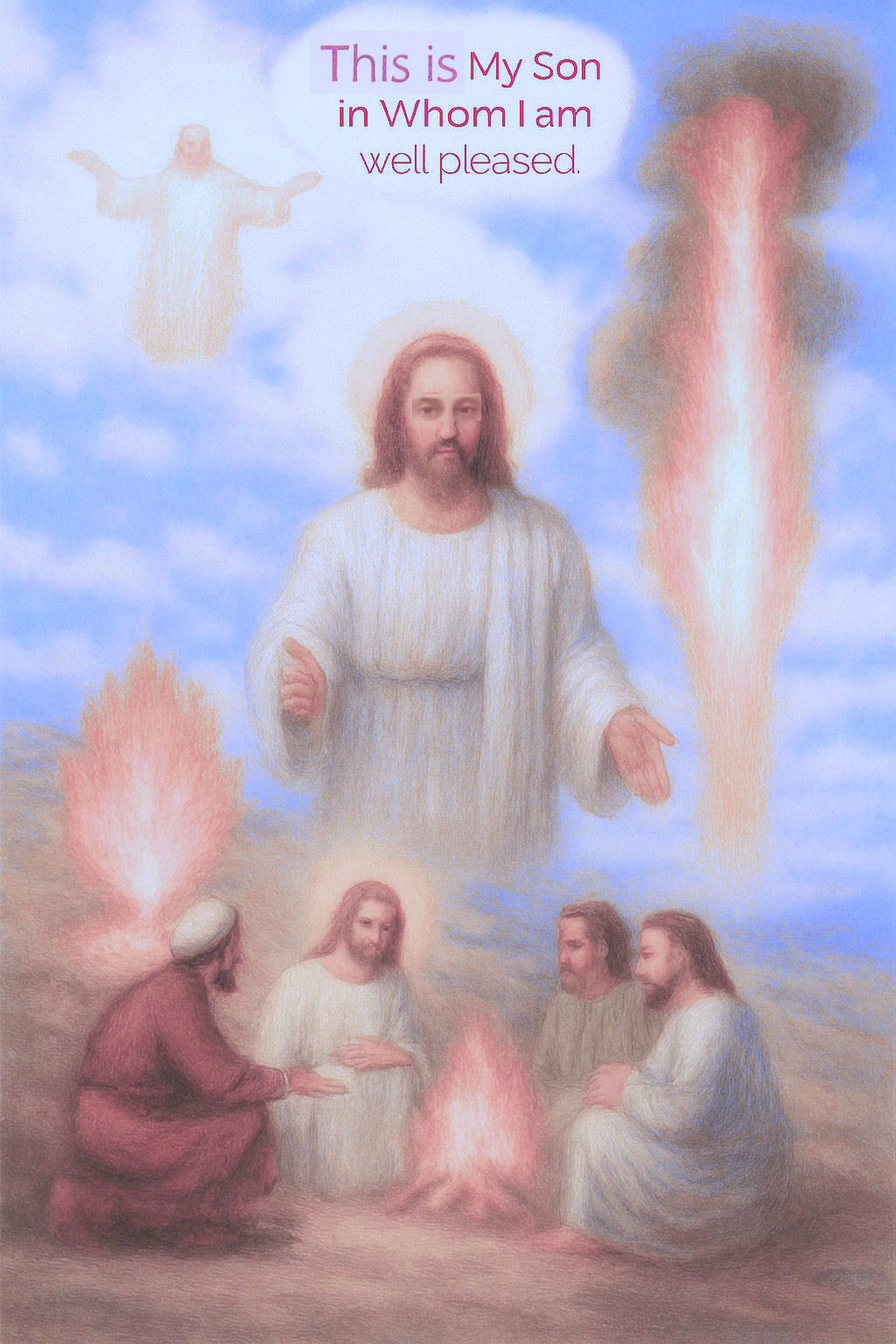
But this Jesus guy was an anomaly. He was a human, “born of a woman”. He didn’t just appear on the scene (like our Abraham visitor). His neighbors had watched Him grow up (Mt 13:55). Yet, texts in the NT have God audibly attesting that Jesus was “my Son, with Whom I am well pleased” heard by all those in Jesus’s company twice – at His baptism (Mt 3:17), and later at His transfiguration (Mt 17:5).
So, people could look at His appearance as a human man; talk with Him; eat food with Him; observe Him sleeping; and perhaps most importantly, listen to Him praying to (or, perhaps, with) God, His “Father”.
After experiencing His humanness for three (or 30) years, who in their right mind was going to presume that this Jesus fellow was God Himself, though “incarnated” (enfleshed) in the body of Jesus of Nazareth?
And, it is from this empirical evidence that early Christian fathers and writers needed to come up with an identity for Jesus separate from God (Jesus’s father figure who is presumed to occupy “Heaven”), though sharing in His essence/substance. And what they developed were the theories of Jesus as a separate divine personality who pre-existed with God from before the beginning (Jn 8:58, Jn 17:5, Jn 17:24, Col 1:16-17, Phl 2:6-7, Heb 1:2-3).
Johannine Christology and Pre-Existence
The author of John features this pre-existence theme from the opening passages of his gospel: Jn 1:1-3
1 In the beginning was the Word, and the Word was with God, and the Word was God. 2He was in the beginning with God. 3 All things were made through him, and without him was not any thing made that was made.
The author here is unequivocal that the Word was “in the beginning” ‘with’ God (i.e. in some sense distinct from God, implying a different identity so that “with-ness” was appropriate). We should note that even the author of John is quite ambivalent here. While he says that in His distinctness the Word was “with” God, in the next breath he says He was God[v]. And, He (the Word) created everything.
Wow. The author of John says He didn’t just pre-exist Creation, He made it.
This forces us to come to grips with a new dichotomy of sorts. In Gen 1:1 the author says:
1In the beginning, God created the heavens and the earth.
So, who’s right, the author of John, or the author of Genesis? Or are they both right?
We shouldn’t fail to notice John’s other passages re: Christ’s pre-existence: Jn 8:58, Jn 17:5, Jn 17:24. These are passages in which Jesus in His own words claims pre-existence “with”[vi] God before the world, and so divinity.
Similarly, the NT authors, confronting the mention in their sources of a “Holy Spirit”, resulted in propagating the existence of yet another divine “personality”. We have no evidence of any theological debate (until 381 AD) as to whether this Holy Spirit was, in fact, distinct from God, only that these sources identified it/Him as distinct from God the Father (Who, of course, John identified as Spirit – Jn 4:24, and who identified Himself as that Spirit/Helper in Hos 13:9!) God the Father is distinct from His Spirit, then, in what way, exactly? We’re not told.
Why Early Christians Believed Jesus Was Divine
Aside from disingenuous, late emendations of the original Gospel texts by church leaders (which we’ve stipulated we’re not going to entertain for a lack of evidence), why might have NT authors first have recorded, and later church leaders endorsed, its passages that paint Jesus as divinity?
My theory (and I have no first-hand evidence other than Acts and the Epistles) is that these people – authors and later editors of the gospels — had observed church members having been completely transformed by God’s Spirit. (The magnitude of this change is unmistakable when you encounter it firsthand or, better yet, experience it.) The thinking, activities, and worldview of Spirit-transformed people are completely transformed: from “me”-focused to God-focused virtually overnight. These author/editors knew enough of their Hebrew scriptures to know that they were looking at the workings of God’s New Covenant (and its “new heart and new spirit” promises).
The connection? Perhaps they would have recalled Zec 8:3
3Thus says the LORD: I have returned[vii] to Zion and will dwell in the midst of Jerusalem, and Jerusalem shall be called the faithful city, and the mountain of the LORD of hosts, the holy mountain.
If Jesus was divine and so at least a representative of God, they may have reasoned, then here was a prophet stating that long after God’s presence had left the Temple and Jerusalem (Eze 11:22-23), He would (assuredly) return[viii]. And in Jesus, He did, extending His invitation one more time. This same Zechariah had prophesied our New Covenant these editors were experiencing: Zec 12:10
10“And I will pour out on the house of David and the inhabitants of Jerusalem a spirit of grace and pleas for mercy, so that, when they look on me, on him whom they have pierced, they shall mourn for him, as one mourns for an only child, and weep bitterly over him, as one weeps over a firstborn.
I speculate these editors, based on their experience with those in their churches, would have been prompted to question: “Who has the ability to deploy God’s Spirit to those seeking Him, and so be transformed?”
It seems that logically they would say…God.[ix]
Jesus’s Use of “Father” Language
Jesus’s favorite metaphor was of God as His “Father”. Why might He employ that semantic? Well first, it paints Him as God’s “Son”, a term in the Hebrew Bible reserved for those faithful to God which, for a moment, was the classification given the entire nation of redeemed Israel. The question we have to deal with is in what respect Jesus, the man, was God’s “Son”.
Of course, we have Luke’s description of Jesus’ birth following the impregnation of Mary by the Spirit of God. Certainly, in deference to Luke’s story, Jesus the man was quite literally God’s “Son”.
But how else might we think about Jesus positioning Himself as the Son of His “Father”?
The first fact we have to internalize is that whatever Jesus’s true identity, He took the form of a man. He had all the limitations of a human: physical processes that led to hunger, fatigue, emotion, eating, sleeping, being limited to His single position in time and space, and so needing to physically travel to change His position.
Let’s just stipulate for a moment that the animating Spirit/force within the man Jesus was God (as it is, by the way, but no doubt to a lesser extent, for millions of people who have given their lives to the love of and obedience to God, and have received God’s indwelt Spirit to help them do that). If you were that man, how would you talk about that animating Spirit/force within You and to Whom You were exclusively devoted? How would you, a man, characterize yourself vis-à-vis God? Might you consider and refer to that Spirit/force as your “Father”? You know you are a human with mortality. So, you’re certainly not identical with that Spirit/force. Would you call Him the One? How about using His name, YHVH? But neither of those express your relationship as a human with that Spirit/force. Maybe “my Master” or “my Lord”? How about “I am”. Oh, wait. (More later.)
As a human, is there a better description of one who forms your character, leads you, and loves you than “Father” (at least where that role is filled properly)? It seems to me that “Father” is an apt description by someone utterly dependent on and derivative of God, as the man Jesus was.
Both the language and Jesus’s physical reality created a fundamental distinction (Jesus vs “God”) that the church’s fourth century leaders had to rationalize. They claimed to accept monotheism. But here they are challenged by two (three?) divine “beings”.
They chose the route of describing the meta-physics[x] of Jesus’ identity vs God’s identity – homoousias, rather than focusing on the fact that Jesus was a human being who happened to incarnate God, and God was, well… God.
Jesus’s Claims About Himself
Jesus made these two seemingly contradictory statements: Jn 14:16
16And I will ask the Father, and he will give you another Helper, to be with you forever,
and, Jn 16:7
7Nevertheless, I tell you the truth: it is to your advantage that I go away, for if I do not go away, the Helper will not come to you. But if I go, I will send him to you.
The One who will send the Spirit/Helper is the Father/Jesus. He’s trying to give us information here.
Earlier, Jesus had answered Pharisees challenging His authority saying their Patriarch Abraham “rejoiced to see My day”, and, when challenged concerning the timing of this event says: Jn 8:58
58Jesus said to them, “Truly, truly, I say to you, before Abraham was, I am.”
The issue here isn’t timing. The issue is Jesus’s invocation of the phrase “I am” (ἐγώ [egṓ] εἰμί [eimí]). This is the same phrase YHVH used to identify Himself to Moses in Ex 3:14 of the Septuagint (LXX — the Hebrew Bible of Jesus’s day):
14God said to Moses, “I AM WHO I AM.” And he said, “Say this to the people of Israel: ‘I AM has sent me to you.’”
The phrase additionally appears in the LXX in God’s voice in Is 41:4, 43:10-13, 46:4, 52:6. Once again, Jesus is dropping us hints here.
Also ambiguous are Jesus’s statements in Jn 10:30
30 I and the Father are one.”, and Jn 14:9
9Jesus said to him, “Have I been with you so long, and you still do not know me, Philip? Whoever has seen me has seen the Father. How can you say, ‘Show us the Father’?
All of these allusions are quite plain, even to modern Western readers of English translations. There is another, however, that takes considerably more unpacking to understand and this stems from Jesus’s quotes in which hypothetical petitioners address Him as “Lord, Lord” (i.e. Mt 7:21-22, Mt 25:11, Lk 6:46). I have written about this exegesis by Dr. Jason Staples in Did Jesus Say He was YHWH?. I encourage you to review this paper to grasp the full force of Staples’s argument.
The issue raised is that this double invocation of the (Greek) address “Lord, lord” was used exclusively in the Septuagint in addressing YHVH. The Septuagint translated “Adonai, YHVH” (יהוה אדנ) as κύριος, κύριος – “Lord, lord”.
The Septuagint was the Hebrew Bible for most 1st century Jews (and is extensively quoted by NT authors). So, Jesus knew perfectly well how it used this phrase and the Hebrew from which it emanated, naming “Lord YHVH”.
Now, many argue that this duplicative construction is designed simply to emphasize emotional angst or excitement. Maybe. But there are an infinite number of ways Jesus could have conveyed that angst or excitement other than using this very loaded double Kurios/Kyrie construction of the LXX. It seems that, once again, He was dropping us clues.
Jesus’s references to Himself paint an image of one who is uniquely related to the God of Israel. Many commentators have parsed what Jesus’s identity was in this relationship. But they haven’t fundamentally disagreed on the fact of that relationship. What we see in His life and message is Jesus as YHVH’s enlisted agent, not dissimilar to God’s former agents: Moses, Jeremiah, Isaiah, Ezekiel, Elijah, etc. But uniquely dissimilar from these former agents in His works. In evaluating these dissimilarities, the question we are posed is: “What do Jesus’s distinctions from God’s former prophets tell us about Him?”
New Testament Authors’ Characterization of Jesus
Having reviewed many of the NT verses that “hyperlink” from an act or message of Jesus to an act or message of YHVH, I conclude that this was one of their preeminent goals: leaving the reader with the unmistakable message that Jesus was the human incarnation of God – God subject to His human limitations.
Many poo-poo Jesus’ divinity despite the (to them, disputed) testimony of the Gospels and Epistles because, with the sole exception of John 1:1 (even in it’s ambivalence), never does a NT author state unequivocally that Jesus was God. Why do you suppose that was?
A quick review of 1st-3rd century social history of the Roman Empire will reveal that those claiming either to be (a) god, or to follow One who they believe was (a) god had effectively a death wish. Anyone disclaiming Ceasar as the preeminent god could be imprisoned, tortured, or crucified. And many, many were.
So, whomever the NT authors were, they were smart enough to know that if they wanted to stay alive, they best remain anonymous and, as regards the divinity of Jesus, obscure and discreet. And they were.
The Testimony of Mark
The author of Mark has an unwarranted reputation, in my opinion, as the theological lightweight of the Gospel authors. Mark’s author presents a smorgasbord of deeply theological citations[xi]. In these citations it seems that this author’s primary objective wasn’t so much historical narrative as explaining who Jesus was.
Announcing Jesus as Son
Mark’s author immediately launches into a characterization of Jesus’s identity. We read in Mk 1:3-4:
3 the voice of one crying in the wilderness:
‘Prepare the way of the Lord,
make his paths straight,’”
4 John appeared, baptizing in the wilderness and proclaiming a baptism of repentance for the forgiveness of sins.
Here he throws down the gauntlet through his citation of Mal 3:1 in which a “messenger” is to prepare the way for ‘ha ādôn”, “the Lord” (see also Is 40:3). Every time this definite article construction is used it is a reference to YHVH, here saying He is coming “to His Temple”.
Next Mark has Jesus being baptized by John and immediately thereafter Mk 1:10-11
10And when he came up out of the water, immediately he saw the heavens being torn open and the Spirit descending on him like a dove. 11And a voice came from heaven, “You are my beloved Son; with you I am well pleased.”
So, these verses comprise a Trinitarian favorite: We have the One John is announcing analogized as ‘ha ādôn’, YHVH; we have the heavens opening and God’s Spirit descend onto Jesus; and we have “the Father” testifying that Jesus is His “beloved Son”. Initially this is as far as the author takes us re: Jesus – “my beloved Son”. But this checks all the Trinitarian three-personality boxes.
In Mk 12:1-9, the author elaborates on the “Son” identity with Jesus’s Parable of the Tenets, in which the owner of a vineyard sends servants one-by-one to demand “the fruit of the harvest” from the tenets working the vineyard, each of whom the tenets murder. Finally, he sends his son who is also murdered so that the tenets can claim his inheritance. Jesus explains the owner is God and his “servants” who were beaten or murdered are the prophets. In casting Himself in the role of “son”, Jesus is positioning Himself above the prophets (who are not kin of the Master but only His servants) as the rightful inheritor.
Healing the Paralytic – Forgiveness of Sins and Knowing Hearts
The story of the healing of the paralytic in Mark 2 contains two “hyperlinks”, if you will, to actions of God. In it we read Mk 2:5-9
5And when Jesus saw their faith, he said to the paralytic, “Son, your sins are forgiven.” 6Now some of the scribes were sitting there, questioning in their hearts, 7“Why does this man speak like that? He is blaspheming! Who can forgive sins but God alone?” 8And immediately Jesus, perceiving in his spirit that they thus questioned within themselves, said to them, “Why do you question these things in your hearts? 9Which is easier, to say to the paralytic, ‘Your sins are forgiven,’ or to say, ‘Rise, take up your bed and walk’?
The first we see is Jesus forgiving the paralytic’s sins, followed closely by knowing the hearts of those in the room. The Gospel author is alerting his audience to the fact that, as they know (and as the Pharisees within earshot also knew), this is an act that only YHVH can perform. They would be reminded of 1Ki 8:39:
39then hear in heaven your dwelling place and forgive and act and render to each whose heart you know, according to all his ways (for you, you only, know the hearts of all the children of mankind),
Psalm 44:21 also attributes knowing hearts to YHVH, and Psalm 103:2-4 His forgiveness of sins.
We have a somewhat related story in Mk 7:29-30 in which Jesus proclaimed that a petitioning gentile woman’s demon-afflicted daughter had been freed of her affliction from the woman’s spiritual trust (“even the dogs under the table eat the children’s crumbs.”) The point is that Jesus knew the state of the little girl, some distance removed from Him – a kind of telepathy, we might say, not totally dissimilar from knowing peoples’ hearts.
Healing the Blind
Mark presents two instances of Jesus healing blind men. Blindness in antiquity was permanent. There were no treatments. If you were blind, you would remain blind, short of being the recipient of a miracle of God. Mk 8:22-25 and Mk 10:46-51 present these stories. And they are 1st century hyperlinks to verses such as: 2 Kings 6:17-20, Ps 146:8, and Is 35:5 in which YHVH gives sight.
Miscellaneous Miracles
If the purpose of retelling Jesus’s miraculous acts was to demonstrate His divinity, perhaps none were more powerful than those in which He “calms the storm” (Mk 4:39) and walked on water to the disciples’ boat (Mk 6:47-52). These hearken back to characterizations of YHVH saving people from the storms of chaos (Ps 33:7, 65.8; 89.11; 104.7, Job 26.12; 38.8). In presenting these stories, the author of Mark is not subtle. He is quite explicit and adamant that his subject is divine.
Mark Asks the “Who” Question
The narrative in Mark has the author rhetorically ask several questions as to Jesus’s identity and (untraditional) practices. Instances include Mk 1:27, 2:7, 2:16, 2:24, 4:41, 6:2, and 7:5. Here he’s asking the reader to himself ask these questions, because in the remainder of his gospel he has provided the answers (starting with Mk 1:7).
Synthesis of NT Testimonies
We’ve only just scratched the surface here on the author of Mark’s Gospel (and some of John’s and the others), not to mention the Epistles. But the pattern should be clear to us.
Far from being primarily concerned with the historical narrative of Jesus’ ministry, our Gospel authors, as exemplified by practical Mark, were far more focused on using their narratives to feature statements of Jesus’s actions and messages that immediately called to their audiences’ minds scripture that they knew described the actions of God, YHVH. This seems to be the overarching pattern of the NT Gospels.
The Nature of Jesus’s Divinity
This is the crux of the issue. Those who don’t believe Jesus was divine have their own problems to deal with (or just ignore) in reconciling what He said, what He is said to have done, and what happened at Pentecost.
We’ve seen that Jesus claimed His own divinity (particularly the ‘with the Father before the foundation of the world’ statements.) The Gospel authors went out of their way to paint Jesus as a divinity, as did Paul and, by extension, the author of Acts. We have to believe that at least some of the dozens of miracle stories were true and were either observed by the authors, or passed down to them from near-first-hand observers that were, for those authors, credible sources.
So, if those authors were correct, that Jesus was in some sense divine, how were they correct? In other words, what was the nature of Jesus’s divinity?
Jesus As “Son” of God
This point is relatively straight-forward. Jesus was a human being. God is God. So, it seems imminently reasonable that any human professing His agency of God’s will to His neighbors wouldn’t proclaim Himself as God, but rather a dependent of God – say a Son, making God His “Father” figure in discussions with His followers, an image they could easily relate to.
Jesus’s human limitations provided the crystal-clear demarcation between Jesus the man and God, for Him and for those around Him. Jesus freely and often attested that as a human, He was not God but had God as His “Father”. But He also attested on several occasions that He was that God (e.g. “I am”, “Lord, Lord”, etc.).
It’s worth noting that Jesus never refers to Himself as “Son of God”, though the Gospel writers do ten times in various narratives. So, He never claimed that He embodied the Jewish God, at least explicitly. What He claimed was that His Father was that God, establishing a familial relationship between Himself and God; a member of God’s family. This semantic jujitsu tends to obscure the logical elephant in the room – that He was, therefore, at least a “Son of God”, and so, assumedly, divine (a son being of the same type as the father).
And in expressing this relationship, He was adamant in His assertions that He wasn’t expressing His will, but rather that of His Father. What He seemed to be teaching through His message, life, suffering, and death is a model of one totally dependent on God. Again, He modeled dependency on God as the defining behavior of a Son of God.
Which brings us to the question of the “preexistence” doctrine.
Did Christ Preexist, Before “the Beginning”?
Well, the Apostle John seemed to think so, based on chapter one of his gospel. And, as a result, so should have his “disciples” of Polycarp, Ignatius, Irenaeus and their followers. But we don’t find it in writings of the fathers until Irenaeus (mid-2nd century) and later Origen (3rd century) and the Nicene Fathers (4th century). (Polycarp and Ignatius oddly had nothing to say about Christ’s preexistence.)
Now, in fairness, we find Jesus Himself alluding to His history with the Father Who loved Him “before the foundation of the world” (Jn 17:24). Here’s where we quickly get “out of our lane”. Here we have Jesus, who virtually everyone believes was a human man (as at least a part of His identity) talking to One who He (Jesus) was “with” “before the foundation of the world”.
In what sense are we to understand this “with-ness”? Is this Jesus, the human inhabited by the life of God, recalling His experience before His incarnation? In other words, how do we know that the “correct” interpretation of this “union” (a term that inherently assumes a duality) is that there were two “personalities” that were at that time somehow united in the Father’s domain?
Might it not be that at that time, before Jesus’s manifestation, that God was simply God? In other words, can a reference by a manifestation of God (granted, in some way distinct from His essence), not simply refer to the time when the manifestation was literally undifferentiated from the essence – experiencing the singular Glory of (being) God?
Makes sense to me. And I think it would have made sense to John’s latter disciples who contributed to the Trinity doctrine.
But the modalist’s[xii] primary interest (and mine) is to grant that the God of the Universe has the facility to manifest Himself to His humanity in as many instances, and in as many forms, perhaps simultaneously, as He chooses.
Think about this thoroughly traditional Christian image. God’s Spirit indwells hundreds of thousands of His followers simultaneously. Do you think He is challenged by simultaneously responding to your daily life experiences vs the hundreds of thousands of others who He leads that are living their lives through completely different circumstances and time zones? If we assume He can manifest as our indwelt Spirit, is it so challenging to believe that He can manifest within a man in Galilee in the 1st century? I don’t believe it is.
The Modalist Paradigm Revisited
For myself, I am most persuaded not just by Jesus’s testimony of Himself, but by the Hebrew Bible’s commitment to its One God, YHVH. I am interested in the question: “If God is omniscient, omnipresent, omnipotent, what does He need of other divinities in His employ?” I think two things about this question. First, God needs nothing, certainly not from our material world, but even less from His. He is the singular, all-powerful actor in our Universe, and so has no unmet “needs”.
Second, if He wants to interact personally with His creation (say in getting Moses’s or Abraham’s attention and allegiance), He can do that (whether as a “burning” bush, or a hungry, human visitor).
So, why should we presume that if He wanted to fulfill the prophecy in Zec 8:3 in the form of Jesus of Nazareth, that, no, that can’t be how He works? That if we see an individual claiming God as His “father”, that that automatically means that person’s life is separate from God’s life?
Perhaps we can all just initially agree that God doesn’t need any “help” from anyone (though of course, He can conscript people into His service as meets His purposes.) If He doesn’t need any other entity, why should we presume He has other “entities”/”personalities” in His domain and in His employ? What value do they add to the One Omni God’s[xiii] ability to accomplish His plan? I can’t think of any.
The Nicene Fathers apparently thought that because Jesus assumed the form of a human being with the mission of calling those descended from Abraham/Jacob back to their God, that that mission was somehow distinct from the mission of the One God (Father). Why they would think that is puzzling. Surely they knew verses like Eze 37:1-23, and Isa 11:11-12 in which YHVH vows to regather all of Israel to Himself. Why then suddenly conclude that what He really meant was that He would send His “Son” to carry out that mission? Why confuse the subject of the action?
Similarly, they saw that God’s Spirit had the mission of indwelling and leading those who sought Him. So, to these interpreters, ‘separate mission, separate “personality”’? On what possible basis can we conclude that either a) these missions were not the One God’s (e.g. calling Israel back to Himself), or b) that the One God was above such mundane things so He enlisted other divine entities to pursue them? Why does that even make sense to people?
One other point re: the early Jesus follower’s acceptance of His divinity, is the 2005 discovery in Megiddo of a Greek mosaic dated to about 230 AD (the earliest known Christian inscription) that contains the dedication: “The god-loving Akeptous has offered the table to God Jesus Christ as a memorial.” This is significant in exposing what at least some followers of Jesus thought about His identity well before there was such a thing as the organized Church or its formal doctrines.
To see a summary of some key differences between Modalism and Trinitarianism, click this text to pop up a table itemizing them.
| Category | Modalism (Oneness/Monistic Theism) | Trinitarianism (Nicene Orthodoxy) |
|---|---|---|
| Core Claim | God is one Person who manifests Himself in different modes (Father, Son, Spirit). | God is one Being in three co‑equal, co‑eternal Persons (Father, Son, Spirit). |
| Divine Unity | Absolute, undivided unity. No internal distinctions of persons. | Unity of essence, distinction of persons. |
| Jesus’s Identity | Jesus is YHVH manifested in human form — a modality of the One God. | Jesus is the second Person of the Trinity, eternally distinct from the Father. |
| Father–Son Language | Relational language describing God’s manifestation within human limitations; not ontological distinction. | Literal interpersonal relationship between two divine Persons. |
| Holy Spirit | Another mode or manifestation of the same God. | A distinct divine Person who proceeds from the Father (and the Son, in Western theology). |
| Pre-existence of Christ | Christ pre‑exists as God Himself; “with God” refers to God’s own eternal self-expression (the Logos). | Christ pre‑exists as a distinct Person who is “with” the Father before creation. |
| Interpretation of John 1:1 | “The Word was with God and was God” = God’s own self-expression, not a second divine Person. | “With God” = interpersonal distinction; “was God” = shared divine essence. |
| Interpretation of “I AM” (Jn 8:58) | Direct claim to be YHVH in human form. | Claim to share divine identity but not to be the same Person as the Father. |
| OT Theophanies (Gen 18, Gen 32, etc.) | Precedents for God manifesting as a man; Jesus is another such manifestation. | Often interpreted as appearances of the pre‑incarnate Son (the “Angel of the LORD”). |
| Miracles | Evidence that Jesus is YHVH acting through a human modality. | Evidence that Jesus shares divine nature with the Father. |
| Sending of the Spirit (Jn 14–16) | Jesus and the Father sending the Spirit = same divine agent acting in different modes. | Father and Son send a distinct Person of the Trinity. |
| Prayer of Jesus | Human nature praying to divine nature; communication within a single divine Person manifest in flesh. | Genuine interpersonal communication between two divine Persons. |
| Baptism Scene (Mk 1:10–11) | One God manifesting simultaneously in three modes (voice, dove, Son). | Three Persons acting together in one event. |
| Philosophical Motivation | Preserve strict monotheism and avoid multiplying divine entities. | Preserve Jesus’s divinity while maintaining His distinction from the Father. |
| Historical Development | Early modalistic tendencies in some 1st–2nd century interpretations; later rejected as heresy. | Formally defined at Nicaea (325) and Constantinople (381). |
| Strengths | Strong continuity with OT monotheism | Tradition |
What Difference Does It Make?
Whether the doctrine of the Trinity is the correct interpretation of Jesus’s identity or the Modalists have it right, what difference does it make?
To answer, we first have to have a clear understanding of what the Trinitarian proposition is really saying. It says Jesus is divine; that He was “begotten” not “made”; that He preexisted “with” God from before the beginning. To my way of thinking this characterization says that there are (at least) two divinities – essentially two Gods. The Nicene Fathers went out of their way to stress that God the Father and Christ were of the same “substance”. The only conclusion we can draw then is that there are two co-equal Gods, which immediately raises red flags.
Yes, they characterized the Trinity as one God with three “personalities”. But that, it seems to me, is nothing more than invented language to resolve the issue of Jesus’s addresses of the “Father” they encounter in the NT.
Therefore, to me it makes all the difference and has impacts on our faith life in at least these respects:
- When you read Jesus’s words, you understand with clarity Who you’re hearing. There’s no separateness and so no chance of ambiguity. There’s one source of love for His mankind.
- When you read your Hebrew Bible (well, at least most of it) you are clear that you are hearing from the same LORD who will manifest Himself later in Jesus.
- When you pray, you’re clear on Who the God is that you’re praying to. There is no ambiguity between a “Father” and a “Son”. It’s God.
Hopefully, through this and other resources, you now at least understand the arguments for the “heresy” of modalism. I was drawn to it because it a) doesn’t require a theo-philosophy degree in meta-physics to understand, b) doesn’t leave loose ends in establishing “who” did what, and c) is simple and elegant, as I believe the One true God is.
[0] Technically, what I am proposing here is not, strictly speaking, Modalism since Modalists believe in a “manifestation-at-a-time” model. As this is a completely arbitrary restriction, I dispense with it and postulate a deity who manifests Himself in whatever set of ways He deems necessary at any given time. The classic case for this view is the Spirit’s indwelling within His untold number of disciples simultaneously. One God. Untold number of manifestations.
[i] Of course, there is evidence for later modifications of NT texts, e.g., the ending of Mark, chs 15 and 16 of Romans, etc. There just isn’t textual evidence that these words of Jesus were later emendations to the autograph text.
[ii] This term “expression” means a perceptible occurrence of God’s presence (i.e. being visible, or being audible, or creating visible things, like a “burning” bush). It takes on a quite specific character in Jesus’s case as the creator of our material world (Heb 1:2-3, 1 Cor 8:6, Jn 1:3).
[iii] Of course, there remained several other branches of the church in the early 4th century that completely disclaimed Jesus’s divinity including Gnostics, Ebionites, and various other early belief systems centered on Jesus.
[iv] The salient statement of the Council of Constantinople Creed describing the Holy Spirit is: “the Lord, the Giver of Life, Who proceeds from the Father, Who with the Father and the Son is worshipped and glorified, and Who spoke through the prophets”
[v] As I explain in John’s Identification of Jesus, in the Greek the statement actually is “and God was the Word”, not the other way around as it is rendered in our English translations.
[vi] As far as I can tell, the preposition “para” (3844. παρά pará – ‘with’) can be equally rendered “from”. How would it change our mental image of the relationship between God and Jesus if Jesus persistently referred to Himself as “from” the Father before the beginning of the world?
[vii] This an instance of a Hebrew tense called the Prophetic Perfect (sometimes called the prophetic past tense): a literary and grammatical device in Biblical Hebrew where a verb is expressed in the perfect aspect (completed action) to describe a future event.
[viii] It seems to make sense that the Babylonian returnees would have had expectations for implementing reforms that would have attracted their God back to live with them, His presence once again in their Temple, though we have no record of that event ever having occurred.
[ix] We should note that Jesus in His declarations about the gift of the Holy Spirit was Himself obtuse as to whether it was He Who would send Him, or the Father.
[x] There was a lot of meta-physical interpretation going on in the early centuries of the church. Those that ascribed divinity to Jesus chose to differentiate between Jesus (the human, the one who was crucified) and Christ (the divine Spirit, who was not crucified but Who rose to God’s right hand).
[xi] Larsen, Kevin W, “It Really Is All About Jesus: A Defense of Christology as the Foundation of the Second Gospel”, Pepperdine Digital Commons, Leaven, Vol. 19 [2011], Iss. 1, Art. 4
[xii] Technically, formal Modalism holds that God can assume any manifestation He chooses, but, essentially, one at a time. That’s not what I’m describing. My view of God’s ability to manifest is that He can produce as many of those in whatever form for whatever audience He chooses without restriction, while all the while remaining the One.
[xiii] The term “Omni God” is shorthand for the enumeration of God’s omni-effective characteristics: omniscient, omnipresent; omnipotent, omnibenevolent.
