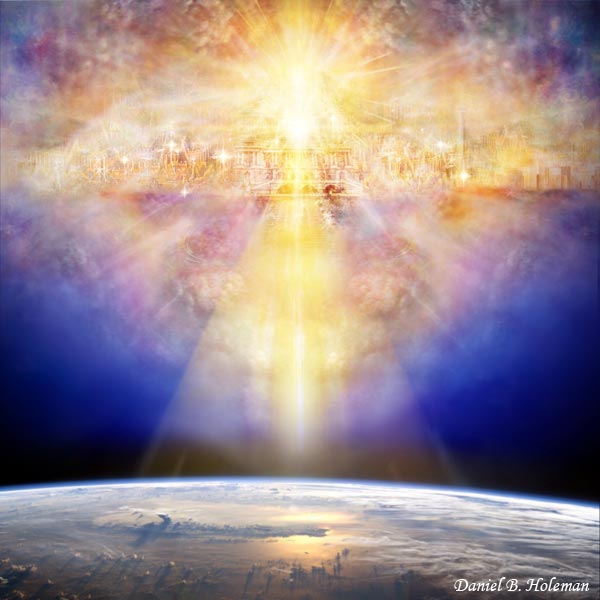
What Happens At The End?
Introduction
What is the proper interpretation of the Bible’s passages describing the Eschaton — the end and resolution of the world? Most, for the last 1200 years or so, have believed that when they die, they will go to “heaven”, despite the paucity of biblical evidence for this view. But what happens at the end of all things? Surely it is a point in time beyond which all of God’s plans for His Creation are realized.
Increasingly in the past few years, the Bible’s few prophecies of the New Heaven and New Earth have become more and more popular competing with the much more common understanding of the faithful living with God where He lives (i.e. heaven) for eternity, and for the unfaithful, to be destroyed (Ps 37:38).
Our job here is to understand this view and, if we can, look at its literary basis, and understand why its popularity is increasing.
A Brief Survey of Biblical End-of-Time Prophecies
Earliest Prophecies Were of the End of the Age, Not the End of All Things
We find some chronologically early instances of this type of “end of things as they are” prophecies when the author of Genesis almost immediately has Adam and Eve being removed from their idyllic garden and instead being sentenced (prophesied) to toil in the ground and incur pain in childbirth, not to mention ultimately die. God’s instruction to not eat of the tree carries the prophetic warning that “if you do, you will surely die”, which of course they do. The punishment they are dealt in fact includes the death of their earthly lives.
A few chapters later (Gen 6) we have Noah and his family being told to build an ark and secure themselves and sets of animals within it because of the impending “end of things as they are” in the form of the flood. In this story, Noah is the prophet who receives God’s prophetic warning and instructions to save himself, his family and the animals. But unlike other “end of things as they are” prophecies, he is not instructed to pass the warning on to others. (However, he is called a “preacher” [or “warner” or “herald”] for some reason in 2 Peter 2:5.)
The standard pattern would have Noah implore the people to repent and turn to their God or else they will die in a flood. In this case, the “end” is going to come precisely because God has already judged all of His creation corrupt, requiring its destruction (de-creation). He must have judged they were incapable of repentance. Following this cataclysm, creation itself is cleansed as the waters recede to reveal a once-again pure earth for man to inhabit. This story, then, establishes the biblical precedent for the cleansing/rehabilitation/redemption of the earth itself, somewhat independent of its inhabitants.
The early Hebrew Bible also contains local prophecies limited to one or a small number of people and purveyed by people identified as a seer (ro-eh, hozeh), prophet (navi), or man of God ( ish-ha-Elohim). Gad was the hozeh (seer) of David (2 Sam 24:11). Samuel was the ro-eh (seer) of Saul. And Nathan was the navi (prophet) of David (1 Chr 29:29). The stock-in-trade of these people was divining the future for their clients. Collectively these early “prophecies” are known as so-called “preclassical prophecy”.
In Jos (24:19-22) we have Joshua warning Israel not to forsake the Lord and serve foreign gods as if they do, God will bring disaster upon them. The people respond: “we will serve the LORD”.
22 Then Joshua said to the people, “You are witnesses against yourselves that you have chosen the LORD, to serve him.” And they said, “We are witnesses.”
So this sets the stage for future failures and judgments by God of those failures.
Only a few paragraphs later we have an “angel of the LORD” (from Gilgal, the same place the Israelites had just promised Joshua they would “serve the LORD”) condemning them for their disobedience to the LORD:
Jdg 2:1 Now the angel of the LORD went up from Gilgal to Bochim. And he said, “I brought you up from Egypt and brought you into the land that I swore to give to your fathers. I said, ‘I will never break my covenant with you, 2 and you shall make no covenant with the inhabitants of this land; you shall break down their altars.’ But you have not obeyed my voice. What is this you have done? 3 So now I say, I will not drive them out before you, but they shall become thorns in your sides, and their gods shall be a snare to you.” 4 As soon as the angel of the LORD spoke these words to all the people of Israel, the people lifted up their voices and wept.
This is the LORD’s second announcement to Israel of the “end of things as they are”. The first was His proclamation to the Exodus generation that they would wander in the wilderness for forty years until they died off. Now, things for their descendants were going to change yet again.
Exilic Prophecies Introducing Ideas of An Ideal Future
In the exilic and post-exilic prophesies (so-called “classical” prophecies, which emphasized a return by the nation of Israel both to their land and to faithfulness to their God) we find a mixture of prophecies specifically dealing with the exile or its return, and a collection of apocalyptic poetry which lacks a specific context that is appended to these specific prophecies. We’ll look at a couple of examples of these.
This contextless, apocalyptic language has therefore been traditionally interpreted as referring to the end of time – the Eschaton – since the idyllic, miraculous scenes it portrays have not been realized to date. But is that what its authors intended? Might this not be just extreme apocalyptic imagery designed to reinforce the prophet’s vision (i.e. a kind of hyperbole) of the resolution of the prophesied event? No? Why not? Tradition? How do we know? The only thing we have is an apocalyptic literary form grafted onto a temporally-fulfilled prophecy.
Biblical scholars and theologians still debate whether these passages are either poetic embellishment on a near-term prophecy, or prophecy of “the end”. We’ll see if we can find any way to distinguish the time frames intended by their authors for these passages.
Isaiah 25 is a classic example of classical exilic prophesy (v1-5) followed by a passage of apocalyptic poetry (v6-9), and culminating with a prophecy of a return to the mountain/city (v10-12).
The author starts with a prophecy in which the city of Judah will be exiled and its palace laid waste by God, while Judah’s poor will be protected by Him:
25:1 O LORD, you are my God;
I will exalt you; I will praise your name,
for you have done wonderful things,
plans formed of old, faithful and sure.
2 For you have made the city a heap,
the fortified city a ruin;
the foreigners’ palace is a city no more;
it will never be rebuilt.
3 Therefore strong peoples will glorify you;
cities of ruthless nations will fear you.
4 For you have been a stronghold to the poor,
a stronghold to the needy in his distress,
a shelter from the storm and a shade from the heat;
for the breath of the ruthless is like a storm against a wall,
5 like heat in a dry place.
You subdue the noise of the foreigners;
as heat by the shade of a cloud,
so the song of the ruthless is put down.
Then we get this contextless apocalyptic passage talking about an apparently ultimate redemption in which death itself is “swallowed up”.
6 On this mountain the LORD of hosts will make for all peoples
a feast of rich food, a feast of well-aged wine,
of rich food full of marrow, of aged wine well refined.
7 And he will swallow up on this mountain
the covering that is cast over all peoples,
the veil that is spread over all nations.
8 He will swallow up death forever;
and the Lord GOD will wipe away tears from all faces,
and the reproach of his people he will take away from all the earth,
for the LORD has spoken.
9 It will be said on that day,
“Behold, this is our God; we have waited for him, that he might save us.
This is the LORD; we have waited for him;
let us be glad and rejoice in his salvation.”
Finally, the author returns to the imagery of the punishing of Israel’s neighbor Moab, and its King following their return:
10 For the hand of the LORD will rest on this mountain,
and Moab shall be trampled down in his place,
as straw is trampled down in a dunghill.
11 And he will spread out his hands in the midst of it
as a swimmer spreads his hands out to swim,
but the LORD will lay low his pompous pride together with the skill of his hands.
12 And the high fortifications of his walls he will bring down,
lay low, and cast to the ground, to the dust.
The question this raises is: ‘What led the author to jump from the return-from-exile imagery to the eradication of death itself? Was he actually prophesying the elimination of literal death as a consequence of Israel’s return to their land? Is death being swallowed up simply a metaphor for release from exile? Is this just hyperbole underscoring how good life will again be once they have returned (“the reproach of His people He will take away from all the earth,”)’?
In Isaiah 10-11 we find a similar apocalyptic insertion in another classical exilic prophecy, speaking of the coming Assyrian invasion of Israel and Judah. In Isaiah 10 we read this:
20 In that day the remnant of Israel and the survivors of the house of Jacob will no more lean on him who struck them, but will lean on the LORD, the Holy One of Israel, in truth. 21 A remnant will return, the remnant of Jacob, to the mighty God. 22 For though your people Israel be as the sand of the sea, only a remnant of them will return. Destruction is decreed, overflowing with righteousness.
The context here is that the author is prophesying God’s preservation of Assyrian exiles of both Israel and Judah, and once again the prophecy is for their redemption (through their return to Him). He goes on to itemize the movements of the invading army before completely shifting gears in Isaiah 11, and launching into a messianic prophecy:
11:1 There shall come forth a shoot from the stump of Jesse,
and a branch from his roots shall bear fruit.
2 And the Spirit of the LORD shall rest upon him,
the Spirit of wisdom and understanding,
the Spirit of counsel and might,
the Spirit of knowledge and the fear of the LORD.
3 And his delight shall be in the fear of the LORD.
He shall not judge by what his eyes see,
or decide disputes by what his ears hear,
4 but with righteousness he shall judge the poor,
and decide with equity for the meek of the earth;
and he shall strike the earth with the rod of his mouth,
and with the breath of his lips he shall kill the wicked.
5 Righteousness shall be the belt of his waist,
and faithfulness the belt of his loins.
6 The wolf shall dwell with the lamb,
and the leopard shall lie down with the young goat,
and the calf and the lion and the fattened calf together;
and a little child shall lead them.
7 The cow and the bear shall graze;
their young shall lie down together;
and the lion shall eat straw like the ox.
8 The nursing child shall play over the hole of the cobra,
and the weaned child shall put his hand on the adder’s den.
9 They shall not hurt or destroy
in all my holy mountain;
for the earth shall be full of the knowledge of the LORD
as the waters cover the sea.
These images are famously idyllic: the branch (Messiah) having the Spirit of YHWH, judging righteously, convicting the world of its sin by his words, etc. And then we encounter the first of two of Isaiah’s scenes of carnivorous animals dwelling in peace with herbivores, being led by a “little child”, and a child playing near a deadly snake. The punchline of this prophecy seems to be that “the earth shall be full of the knowledge of the LORD”. (See Jer 31:34)
This apocalyptic scene seemingly has little or nothing to do with preserving a remnant of Israel and Judah from the Assyrian invasion in the late 8th century. But it may have everything to do with such a remnant returning to their God and, along with the earth (land?), to “be full of the knowledge of the LORD”. It’s easy to see it as the prophetic remedy (and redemption) for the nation having abandoned the things of their LORD, which then led to their judgment and exile. This could be their way back.
But we should also not lose sight of the fact that it is a Messianic prophecy. The Messiah, for Israel, was going to set everything right for them, and essentially for the nations as well. At this stage of their development, He was not considered an end-of-time phenomenon but an “end-of-the-age in which we have been attacked and oppressed and starved under siege” phenomenon.
Now it is true, particularly once the exiles happened, that the Jews increasingly looked forward to a Messiah who would be instrumental in saving them from their oppressors, ruling over all, etc. (The “branch”, above, is chronologically likely the first reference to the Davidic Messiah in the Hebrew Bible.)
But the unnatural imagery here of no predators, no dangers, and a population filled with the knowledge of the LORD seem to be poetic embellishments appended to the claim of pure salvation from their oppressors by their Messiah. For these conditions to occur, wouldn’t we (and the prophet) have to be talking about a different earth than ours?
If the author was looking ahead beyond the regathering of the Jews, how can we know that? In this case, it seems probable that the prophet equated the arrival of the Messiah to relieve the current suffering to be, coincidentally, the Eschaton. Otherwise, conflating these two prophetic images seems to make little sense.
Another classic example of this cosmic (contextless) eschatological imagery is found in Is 2:1-5. It follows Chapter 1’s diatribe against Jerusalem, promising that both sinners and rebels in it “will be consumed”.
Chapter 2 opens (following Chapter 1’s judgment on the people of Jerusalem) this way:
2 It shall come to pass in the latter days
that the mountain of the house of the LORD
shall be established as the highest of the mountains,
and shall be lifted up above the hills;
and all the nations shall flow to it,
3 and many peoples shall come, and say:
“Come, let us go up to the mountain of the LORD,
to the house of the God of Jacob,
that he may teach us his ways
and that we may walk in his paths.”
For out of Zion shall go forth the law,
and the word of the LORD from Jerusalem.
4 He shall judge between the nations,
and shall decide disputes for many peoples;
and they shall beat their swords into plowshares,
and their spears into pruning hooks;
nation shall not lift up sword against nation,
neither shall they learn war anymore.
5 O house of Jacob,
come, let us walk
in the light of the LORD.
The author says all of these idyllic, cosmic-sounding reforms will come about “in the latter(/last) days”, a euphemism for “a long time from now”. This is perhaps one of the better examples of end-of-all-things prophecy. The actor (“He”, v4) who is to accomplish these things is not said to be their Messiah, but rather the LORD Himself. It establishes an expectation for an idealized creation in which there is no more war, and in which Gentiles from all over the world stream to Jerusalem to be taught God’s ways.
But how did the Judahite in, say, the 8th century understand how he was going to be affected by this apocalypse in “the latter days”? It’s hard to say. The passage seems to be talking about the corporate redemption of Jerusalem at the end of all things. It’s just not clear that the 8th-century Judahite had any personal expectation for partaking in this redemption of his nation (i.e. through some sort of resurrection).
Prophecies Conveying the Idea of The End, and What Comes Next
Resurrection from the dead.
The concept of life after death came quite late into Israelite thought and theology. Early on, most of what we read of death is simply “going down to Sheol” – the ground, the place of the dead, not a place of consciousness. For example, this is Jacob’s lament of the loss of Joseph in Ge 37:
35 All his sons and all his daughters rose up to comfort him, but he refused to be comforted and said, “No, I shall go down to Sheol to my son, mourning.” Thus his father wept for him.
And Psalm 6:5 says:
“For in death there is no remembrance of you; in Sheol who will give you praise?”
But gradually we begin to pick up bits and pieces of if not pure prophesy, then at least hopefulness of a life preserved after death. We’ve seen an example of this thought in Is 25 (above) with its “swallow up death” idiom.
The original concept of salvation through resurrection was that of the pious, or righteous, who had been slain by the unrighteous (e.g. pagan armies) and so recovering their unjustly taken lives [i] (p141). It was not thought of as a universal prescription (i.e. some global resurrection), but rather an implementation of justice by God for the righteous victim – a wrong was being righted. Since God inhabited the skies (i.e. heavens), it may be that these early believers in life after death thought they would be in His heavens experiencing their redeemed life with Him. Arguing against this conclusion, however, is the fact that the Greek concept of the soul – that thing that could live on in God’s presence – was quite a late development in Jewish thinking[ii].
“In more clear language, Isa 26:19 declares that the dead and buried will receive life again. Finally, Dan 12:2 remains as the only Old Testament text that not only speaks of the resurrection of the dead but also distinguishes between those who will receive eternal life and those who are condemned to eternal shame and reproach.”[iii]
A major point of ambiguity in these verses is when, or the extent to which, the idea of individual or corporate life after death arose. Since the previous model dealt with the righteous victim of the unrighteous, perhaps by the time of the exiles (in which all Jews and Israelites could be seen to be victimized by unrighteous Pagans), the concept of corporate life after death started to take hold for the nation. Another point of ambiguity is that since death is universal, it only comes “at the last day” for a few. For all those already dead, it would seem that resurrection, either of all, or of at least the righteous, would have to be the method of conferring their renewed life.
The New Heaven and New Earth
The phrase “new heaven(s) and a/the new earth” originates in a few places in the 6th-century portion (“trito-Isaiah”) of Isaiah. Is 65:
17 “For behold, I create new heavens
and a new earth,
and the former things shall not be remembered
or come into mind.
18 But be glad and rejoice forever
in that which I create;
for behold, I create Jerusalem to be a joy,
and her people to be a gladness.
19 I will rejoice in Jerusalem
and be glad in my people;
no more shall be heard in it the sound of weeping
and the cry of distress.
20 No more shall there be in it
an infant who lives but a few days,
or an old man who does not fill out his days,
for the young man shall die a hundred years old,
and the sinner a hundred years old shall be accursed.
21 They shall build houses and inhabit them;
they shall plant vineyards and eat their fruit.
22 They shall not build and another inhabit;
they shall not plant and another eat;
for like the days of a tree shall the days of my people be,
and my chosen shall long enjoy the work of their hands.
This passage comes after the prophet’s prayer for the restoration of (exilic) “Israel” (his “Holy Ones”) throughout chapters 63 through 65. So the prophet is anticipating God acting to return the remnant to their homeland, and painting the rhetorical scene for life after they return.
The author here seems not to be talking of a cosmic end of things. Rather, he seems to be simply idealizing what the Babylonian exile returnees (or “remnant”) will experience once they have returned to their land, specifically Jerusalem. In the author’s mind, these new heavens and new earth seem to be about a restored Jerusalem.
However, just to keep us on our toes, the author closes out this passage with the 2nd of Isaiah’s images of carnivorous animals living peacefully with herbivores:
25 The wolf and the lamb shall graze together;
the lion shall eat straw like the ox,
and dust shall be the serpent’s food.
They shall not hurt or destroy
in all my holy mountain,”
says the LORD.
So once again we’re confronted with the question as to in what setting the author is prophesying these conditions to be experienced: the end of time, or in the idealized Jerusalem the exiles return to?
In the following chapter, the author says this:
20 And they shall bring all your brothers from all the nations as an offering to the LORD, on horses and in chariots and in litters and on mules and on dromedaries, to my holy mountain Jerusalem, says the LORD, just as the Israelites bring their grain offering in a clean vessel to the house of the LORD. 21 And some of them also I will take for priests and for Levites, says the LORD.
22 “For as the new heavens and the new earth
that I make shall remain before me, says the LORD,
so shall your offspring and your name remain.
23 From new moon to new moon, and from Sabbath to Sabbath,
all flesh shall come to worship before me, declares the LORD.
24 “And they shall go out and look on the dead bodies of the men who have rebelled against me. For their worm shall not die, their fire shall not be quenched, and they shall be an abhorrence to all flesh.”
This prophecy, though employing the cosmic phraseology of ‘new heavens and new earth’, seems to be anchored firmly in the idealized return/restoration/rebuilding of Judah/Jerusalem, God’s promise that they and their children will remain there, and with Gentiles streaming in to make offerings and with some even serving as priests and Levites! It feels like the author’s hyperbole/idealization.
These previous two passages constitute the sum total of prophetic mentions of “new heavens and a/the new earth” in the Hebrew Bible.
In the New Testament, we have a few verses mentioning or alluding to new heavens and new earth.
Romans 8:21: “That the creation itself will be liberated from its bondage to decay and brought into the freedom and glory of the children of God.
While we don’t have a literal reference here, the idea of a “creation…liberated from its bondage to decay” fits the description. (It sounds like God is going to terminate the 2nd Law of Thermodynamics!)
2 Peter 3:10-13: ” 10 But the day of the Lord will come like a thief, and then the heavens will pass away with a roar, and the heavenly bodies will be burned up and dissolved, and the earth and the works that are done on it will be exposed.
11 Since all these things are thus to be dissolved, what sort of people ought you to be in lives of holiness and godliness, 12 waiting for and hastening the coming of the day of God, because of which the heavens will be set on fire and dissolved, and the heavenly bodies will melt as they burn!
13 But in keeping with his promise we are looking forward to a new heaven and a new earth, where righteousness dwells.”
The author of 2 Peter’s focus is clearly (v3 — “scoffers will come in the last days) the cosmic end, the Eschaton.
One interesting feature of this author’s view, and a distinction currently being argued among Biblical scholars and theologians, is that he sees the heavens and heavenly bodies being first destroyed before being made new. Many theologians, including J. Richard Middleton and NT Wright among many others, see the new heavens and new earth as a “making right” of the old as a kind of restoration project, not a complete replacement[iv].
And finally, we come to the book of Revelation’s narratives. Rev 21:
21:1 Then I saw a new heaven and a new earth, for the first heaven and the first earth had passed away, and the sea was no more. 2 And I saw the holy city, new Jerusalem, coming down out of heaven from God, prepared as a bride adorned for her husband. 3 And I heard a loud voice from the throne saying, “Behold, the dwelling place of God is with man. He will dwell with them, and they will be his people, and God himself will be with them as their God. 4 He will wipe away every tear from their eyes, and death shall be no more, neither shall there be mourning, nor crying, nor pain anymore, for the former things have passed away.” 5 And he who was seated on the throne said, “Behold, I am making all things new.” Also he said, “Write this down, for these words are trustworthy and true.”
Here John, like the author of 2 Peter, sees a new heaven and new earth as a replacement for the old, not its restoration. And, he sees a new Jerusalem as its centerpiece. It is interesting that in John’s first-century Revelation, he focuses on a new Jerusalem much as the prophets focused on it and its rebuilding following the Babylonian exile. The creation of the book of Revelation is debated, but the majority view is that it was written pre-70 AD, before Jerusalem’s destruction by the Romans. If, however, it was written following that destruction, the focus on a new Jerusalem in this apocalyptic prophesy would make much more sense.
And finally, we have this description by John of what the new heavens and new earth/new Jerusalem will be like:
Rev 22:1-5: “Then the angel showed me the river of the water of life, bright as crystal, flowing from the throne of God and of the Lamb through the middle of the street of the city; also, on either side of the river, the tree of life with its twelve kinds of fruit, yielding its fruit each month. The leaves of the tree were for the healing of the nations. No longer will there be anything accursed, but the throne of God and of the Lamb will be in it, and his servants will worship him. They will see his face, and his name will be on their foreheads. And night will be no more. They will need no light of lamp or sun, for the Lord God will be their light, and they will reign forever and ever.”
So here we have several conditions characteristic of the Eschaton: God on His throne, access to the Tree of Life, healing (/redemption) of the nations, God’s radiance eliminating the need for the sun. This is clearly John’s vision of the final outcome.
Arguments for the New Heaven and New Earth Narrative
Richard Middleton has argued,[v] extensively for what he terms a “holistic reading of the Bible’s story of redemption”. By this, he means essentially this: In the expectation of a new heaven and a new earth, one should not be myopic about the effect on humanity. The whole of creation was defiled by the fall, he surmises, and therefore, the entirety of creation needs to be renewed/redeemed.
From this point of view, he, with like-minded others, endorses the (apparently unfulfilled) role of humanity in at least exercising “dominion” over the creatures of creation. Having read his material I am left with the impression that his philosophy or perhaps ideology has colored his exegesis of the biblical material. That’s just my take-away. You may come to a completely different conclusion. One idea he presents, likely stemming from an underlying philosophy of redemption, is the idea of the redemption of human culture. In his paper, he says this[vi]:
“Creation in the biblical tradition, however, includes human society and culture in all its complexity and fullness, along with our earthly environment—an idea that the Bible shares with its ancient Mesopotamian milieu.5 This fuller biblical conception of creation—which includes the entire human socio‐cultural order—is ignored by many Christians in their reading of Scripture.” (Emphasis mine.)
It is hard to know exactly what Middleton has in mind here, as he never clearly explains himself. But it is clear, by his own words, that he’s seeing something in the Eschaton redemption that average Christians do not.
I find this idea also in some extrapolations from NT Wright, a guy whose work has acted to positively form my view on many Biblical issues. Here Wright, quoting from his “Surprised by Hope “[vii], says this:
“The word ‘eschatology’, which literally means ‘the study of the last things’, doesn’t just refer to death, judgment, heaven and hell, as used to be thought (and as many dictionaries still define the word). It refers to the strongly held belief of most first-century Jews, and virtually all early Christians, that history was going somewhere under the guidance of God; and that where it was going was towards God’s new world of justice, healing and hope. The transition from the present world to the new one would be a matter not of the destruction of the present space-time universe, but of its radical healing.”
Now, I like the sound of that statement. He’s talking about a redemptive healing of the physical universe. But if we’re honest with each other, we have to admit that there isn’t a whole lot of unimpeachable biblical data that supports this view. Yes, God charged humanity in Genesis 1:26 with caring for and having dominion over His creation. And I understand that there is this pervasive acceptance of Eve and Adam’s eating of the fruit as the “fall” of God’s perfected creation (though, of course, the Bible itself never claims this).
However, first, God doesn’t assert that His creation is perfect. He asserts that it is “good” and that humanity is “very good”. And, as noted above, the earth (never mind the entire universe), was never cursed by God and so in need of His redemption like His cursed humanity.
The Bible never speaks of a mechanism or its action in transferring humanity’s sin onto the earth. If necessary, reread Genesis 3. The snake is cursed, Adam (humanity) is cursed to toil in the earth to raise his food, the female is cursed to incur pain in childbirth, and all are cursed to physically die.
As a result, I remain unconvinced of Middleton’s (or Wright’s) endorsement of the Eschaton being marked by the advent of a new heavens and new earth that remakes or replaces those we have currently. In looking at the Hebrew Bible’s references, above, we saw that they can all be interpreted as embellishments of the prophet’s primary message using apocalyptic language, most having to do with the exiles’ return to Israel/Judah.
Having said that, I don’t think the case is “open and shut”. If you read these passages and feel they are visions of the literal cosmic restoration of creation at the Eschaton, that’s fine. But I don’t see biblical evidence for this conclusion until we get to some of the New Testament authors. They, unlike the authors of the prophets, had developed the idea of the return (“second coming”) of the Christ – the Parousia, and so co-opted the prophets’ “new heavens and new earth” as a feature of His return.
To be clear, you (the potential NH & NE advocate) could well be right. We just don’t have enough data in the text to conclusively decide. It wouldn’t bother me if the Parousia was implemented via the NH & NE. In fact, I would welcome it. I just don’t think the text convincingly tells us that it is, and therefore that we should plan on it.
Are Exilic Cosmic Prophecies Descriptions of the New Heaven and New Earth?
Or are they simply expressions, in the standard prophetic apocalyptic language, of how good things will be when the prophesied event occurs? Who knows? All we know is that they weren’t yet, then, reality. Nor have many of them ever been true (wolves with lambs, children playing over adder’s holes, no more teaching of war, no more tears, etc., etc.)
For myself, I have concluded that they are not conditions of God’s redemption. So much of the Hebrew Bible’s characterization of the NH & NE is focused on the exilic return that it is impossible to know. But they, the authors of the concept, give us no reason to assume that they are referring to cosmic Eschaton. Certainly, they could be references to this event. But the biblical text gives us no specific reasons to conclude that.
New Heaven and New Earth – Metaphor or Reality?
Passages in Support of Its Reality
I think the most persuasive argument for the reality of the inauguration of a “new heavens and new earth” is the testimony we find in the New Testament. Whether or not they imply a replacement or a restoration is secondary (except for the ecological restorationists). They seem to take most seriously within the context of their historical narrative the reality of a complete rejuvenation of creation, whatever that may entail, at the Parousia. Are they simply co-opting the image painted by their prophetic ancestors of the exile and applying that image to the Eschaton — borrowing the Prophets’ metaphor, as it were? Or are they conveying some new revelation? We just don’t know.
Passages in Support of Metaphor
The idea of “the new heavens and a new earth” as a metaphor is best attested by the exilic and post-exilic prophecies, some of which we’ve examined, above. These are characterized by the phrase entering the prophecy abruptly, not otherwise explained, and preceded and followed by verses solidly in the context of the exilic return. Of course, the entire concept of a “new heavens and a new earth” is not a local (i.e. return from exile) scene, but rather a cosmic image. So, it is natural enough for us to read it and conclude its specific words are referring to an end-of-time event.
But this is where we’re challenged in our exegesis. Do we know enough about the prophets’ vision of the exilic return, not to mention their literary style, to determine conclusively whether or not they were referring to the Eschaton? I don’t think we do. And this is why, in the absence of additional evidence, to conclude that those prophets were adopting a metaphorical interpretation in invoking the cosmic image with the almost equally glorious return of Israelites to their homeland and city makes sense to me.
Middleton, for his part, bases much of his exegesis of redemption eschatological passages on his presumption of God’s intent for creation. He sees creation, as characterized in the Genesis 1 story (which, of course, is a poetic explanation of the existence of humanity, other living things, the earth, and the heavens, not a historical recollection), as depicting the ultimate goal of creation (i.e. the Garden model of God with His people) as the restoration of redeemed humans interacting in His (physical/Garden?) creation. In fact, he takes quite literally the fact that the physical, non-human creation somehow must be also “redeemed” in the Eschaton, along with us.
How he concludes that this is God’s intent he doesn’t tell us. Of course, we know all about God’s intent for humanity to be His Imageo Dei – His image on earth within the humanity He created. But we never learn from Middleton what non-human creation did wrong that requires its redemption – just his assumption that it does that colors so much of his interpretation and exegesis. I think this dichotomy supports the “metaphor” interpretation.
Next, we have his interpretation of several of the New Testament verses having to do with the Eschaton, including those in Revelation 21-22.
Here we find a kind of dogmatic literal treatment of these verses to the extent that they endorse his predefined position. For example, here is his interpretation (Table 8, page 163)i of the key NT verses dealing with the new heavens and new earth outside of Revelation:[i]
| Scripture | Saving Activity of God | Object of God’s Saving Activity |
|---|---|---|
| Acts 3:17-21 (esp v21) | Restoration | All Things |
| Eph 1:7-10 (esp v10) | Gathering up, bringing together, uniting | All things, whether on earth or in heaven |
| Rom 8:19-23 (esp vv. 21, 23) | Liberation, setting free from bondage, Redemption | Creation itself Our bodies |
| Col 1:16-20 (esp v 20) | Reconciliation (by removing the source of enmity, through the blood of the cross) | All things, whether on earth or in heaven |
| 2 Pet 3:10-13 (esp vv. 10,13) | Finding, disclosing, laying bare (having purified) Renewal, making new, re-creation | The earth and the works in it Heaven and earth |
| Basic Characteristics of Salvation | Restorative – Salvation is God repairing what went wrong with creation (not taking us out of the world to “heaven”) | Comprehensive and holistic – God intends to redeem or restore “all things” in heaven and on earth, including our bodies (salvation does not apply only to the human “soul”) |
So here we have Middleton trying to map NT characterizations back on to his idea of Genesis 1 “goals” of creation.
Perhaps I need to digress here for a moment. What were God’s “goals” in creating? He tells us in Is 43:7:
7 everyone who is called by my name,
whom I created for my glory,
whom I formed and made.”
God created us for His glory. There’s no mention here of Him receiving glory from the creation of space-time (though we perceive His glory through His creation — Ps 19:1). His motivation was to achieve glory through something He would orchestrate for us. I believe that this “goal” was realized in Christ and His faithfulness that led to His authority to atone for and redeem the people God had seen fit to create to love Him, and so be “saved”.
And, stepping away a bit further, why should we read the Hebrew Bible, and specifically Genesis, as anything more than the 8th-century allegory of God’s creation that it is? Did God “create”? Yes! Yes, He did. Is Gen 1 some kind of historical record of that act? No. How could it be?
You may say “God could inspire an 8th-century author to record the actions He took, and His reactions to those actions, in what we now have in Genesis. And, of course, you’d be right. But where do we read in that inspired text, for example, of God’s expectation that His Garden would spread to all the world (one of Middleton’s and Wright’s conclusions)?
We don’t. The entire purpose of Genesis 1-3 is to capture the reality of man’s sinfulness – and so his destiny to sin without God’s intervention. To change that behavior pattern God, Himself, is going to have to personally intervene and heal us. He does this in Christ and the incipient provision of His Holy Spirit to those who follow Him.
This is the foundational narrative. This is the narrative that has God building a human family among His creation as His primary goal (“You will be my people, and I will be your God.”)
That Middleton (and NT Wright, and others) doesn’t see this as God’s goal of redemption is not an informed rejection of “heaven”, so much as it is a hubris that claims that it knows what God’s goals were in His Creation; that God intended His physical creation, though itself not cursed, and literally not mentioned past its creation, to be redeemed in His redemption at the End.
Redeemed from what? Could God intend such a thing? Could He decide to freeze plate tectonics so that there are no more earthquakes, and earthquake-induced tsunamis? Yes. Of course. Could He instruct His bacteria and viruses to subside, such that they would not induce any future illnesses? Yes. Could He modify each individual’s cell-level and immune health such that they would not face the risk of physical death by disease or decay? Yes, of course.
But this is not what the Bible has been designed to portray. It is intended, simply, to portray a wayward humanity whose history God oversees and that ultimately demonstrates its abject reliance on Him for its redemption – its transformation. This is, in fact, the headline of the Christian Gospel (and the Hebrew Bible’s New Covenant).
Does this mean we endorse the idea of “going to heaven” either when we die, or at the end? No. I draw no conclusions on this issue due to the lack of conclusive data for either position. We here are simply trying to test the hypothesis that the Eschaton is marked by the inauguration of a “new heavens and a new earth”. I simply haven’t seen the compelling evidence for that conclusion over and against an author’s poetic, literary images. In fact, Middleton provides Genesis and Ezekiel-founded interpretations of Revelation that completely ignore the literary mechanism at work between them in what is nearly universally acknowledged as a symbolic, metaphorical, and apocalyptic excurses of first-century Israel’s impending future.
You, of course, are welcome to your own interpretation.
What Did God Want of His Creation From Its Beginning?
Very simply, God sought a humanity that would recognize and honor Him as their God, and He would then be their God. The portion of humanity that honored Him as their God would become His adopted human family, of which Jesus was the flawless prototype.
So, the question this desire on His part raises is: ‘Does God intend to rehabilitate His Creation to provide an earth-like environment for His redeemed humanity to inhabit forever with Him?’
I think it is responsible to first observe that God doesn’t need any pseudo-physical earth or heavens in which He, as Spirit, lives with His redeemed humanity. Why would He need that, or stipulate it? Yes, He created, and the physical reality He created He called “good” or, with man, “very good”. But does this accolade mean that He is somehow constrained to return physical Creation to a state in which carnivorous animals don’t hunt and consume their prey, or in which children have nothing to fear from venomous snakes, earthquakes don’t kill people, disease doesn’t kill people, their tears are wiped away and are no more?
Does God really need to rehabilitate physical Creation to embrace His adopted family? Of course not! He’s God. But could He elect to rehabilitate the existing physical Creation to house His adopted family, even if they are no longer mortal forms? Of course! But is He going to do it?
We don’t know! And anybody who says he knows (rather than simply offering his opinion) is incorrect. Because nobody knows. Not only are we not to know the “day or the hour”, we’re not, apparently, intended to know the form of the environment He will prepare for His family to live with Him.
One argument that I think can be legitimately lodged against the rehabilitation of the physical Creation is our form. Our physical bodies are not designed to live eternally. So, if we are to do so, something quite profound is going to have to change us. Could He make us immortal, but otherwise designed to live in a physical Universe, in a real sense immune from its natural disasters and plagues (and the Second Law of Thermodynamics[viii])? No doubt. But we’re just not given enough information to draw that conclusion. Might He just as well create a kind of physical-like metaphorical Universe in which Paul’s “spiritual” bodies can live in communion with their God within what they would recognize as their homeland? Of course.
We just don’t know, and we don’t have enough data from the Bible to “know”. What we do know is that the result will be, both for us and God, glorious (Is 43:7).
Conclusion
Did we identify a way to determine whether a cosmic prophecy (e.g. Is 2:4)) (as opposed to an embellishment of a temporal prophecy) was truly an Eschaton prophecy? No, not textually. And, if it makes you feel any better, nobody has resolved that controversy for 2000 years. However, what I hope we have determined is that, to God, the physics of the environment – the new heavens and new earth the Bible says will be established – is incidental at best to His purpose of living with His children. Whether in a physical realm or a spiritual realm (or perhaps something in between) makes literally no difference to God. So, it probably shouldn’t cause us concern, either.
[i] Middleton, J. Richard, A New Heaven and a New Earth: Reclaiming Biblical Eschatology, Baker Academic, 2014, p136
[ii] The adoption of the idea in Israel of life after death was a 2nd century BC, inspired by Greek philosophers whose culture and teachings were imported into the country under the rule of the Ptolemies and Seleucids. Israel’s Pharisees were the first religious group to strongly support the idea beginning in 165-160 BC. — CoPilot
[iii] Tiemeyer, Lena-Sofia, “Eschatology in the Old Testament” in What are we waiting for? Christian Hope and Contemporary Culture ,Paternoster, Milton Keynes, 2008
[iv] It bears mentioning that current interpreters of the restored heavens and earth idea see a corollary responsibility for us in caring for nature and the environment. This view is shaped by their interpretation of God’s intention in Gen 1 that we “have dominion over the fish of the sea and over the birds of the heavens and over the livestock and over all the earth and over every creeping thing that creeps on the earth.”
[v] Middleton, J. Richard, A New Heaven and a New Earth: The Case for a Holistic Reading of the Biblical Story of Redemption, Journal for Christian Theological Research 11, 2006
[vi] IBID, 74
[vii] Wright, T. (2007). Surprised by Hope (pp. 134). Society for Promoting Christian Knowledge.
