Introduction
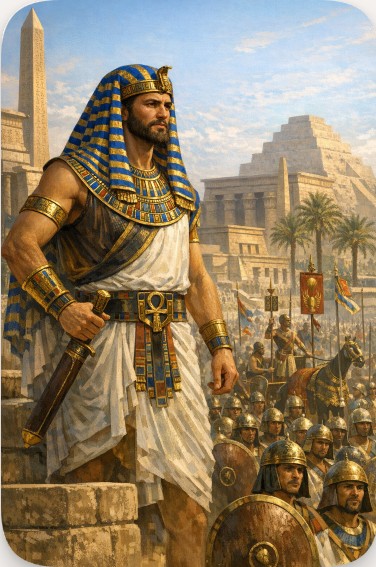
The Bible’s Exodus narrative is quite specific about Moses’s history in Egypt: his adoption by the Queen; His rise to responsibility and power under Pharaoh; his crime, and his flight to Midian to escape justice.
And from Moses’s introduction in this narrative, the Exodus author goes out of his way to inform us that Moses is from the tribe of Levi. We’ll look for Moses in the historical record, we’ll also try to understand the significance of his Levite identity. And, we’ll propose his place in the historical record of Egypt.
First, Some Background
In a previous piece (“Israel in Egypt?“), we looked at the fit of the Biblical Abram, Joseph, and Jacob in the Biblical Egyptian sojourn narratives, and Egypt’s own record of its history. There, we conclude that a good fit for the timing of the Biblical Exodus is 1446 BC (based on 1 Ki 6:1). From this anchor point, we then proceeded to look at options for the each of the patriarchs entering Egypt, the cultural setting for Jacob’s family in the Nile Delta, and the archaeology of Jericho and the Israel highlands in the 14th century BC.
Now, one of the major questions we were exploring was the case that could be made that the Semitic Hyksos people, who similarly were centered in the Eastern Delta just prior to our Exodus date, could plausibly be concluded to be the source of the Bible’s enslaved Hebrews.
The key variable in determining the feasibility of the Hyksos = Hebrew proposition is the timing of the Hyksos presence in Egypt. There are reports of Hyksos in Egypt as far back as the late 20th century BC, almost 700 years before our Exodus event. And, there are records of several Hyksos rulers comprising the 15th and 16th Dynasties (approximately 1650 BC to 1550 BC).
But the story takes a twist in 1550 BC. The Upper Egypt rulers in their capital of Thebes decide to drive out the (foreign) Hyksos rulers in the north (Lower Egypt, headquartered at Avaris). So the historical record says they moved north and eventually laid siege to Avaris, acquiring it, but not through a violent war. The archaeological story is that they, essentially, just walked in and took it. However, prior to this taking, the historical record says that the “elite” of the Hyksos fled to southern Canaan and a walled city there called Sharuhen.
There the Egyptians laid siege for some three years until…well, we just don’t know. Were all the elites killed? Were the attackers called back to Egypt to deal with other military problems? The Pharaoh in charge, Ahmose I, said on his tomb wall that he conquered Sharuhen, implying its destruction. But we just don’t have data to corroborate that story.
This story leaves us with two unknowns: 1) what happened to the elites hold up in Sharuhen, and 2) what happened to the common Hyksos left in Avaris in the Delta? The archaeology there says a semitic population remained at that location but that they gradually assimilated into Egyptian culture (e.g. architecture, pottery, burial practices, etc.). They would live there another 100 years before our Exodus event, no doubt performing labor for the 18th Dynasty, New Kingdom Pharaohs.
Moses in the Record
In the Pharaonic records in Egypt, we find a Pharaoh Thutmose I and his Queen Ahmose taking power around 1493 BC. Thutmose I’s assumed father-in-law, Ahmose I, was the Pharaoh who had driven out the Hyksos elite (and written about it on his tomb walls) between 57 and 37 years previously (1550-1530 BC).
Queen Ahmose, known as “The Great Royal Wife”, had no male children by Thutmose I, and so provided no option for continuing the royal bloodline (in her case, she was actually the one in the royal line). Nevertheless, no heir. Without her providing a son, the line would be forced to proceed through the male sons of Thutmose’s other wives (or, as turned out to be the case, through her daughter Hatshepsut, though for a time with a co-regnant, her stepson Thutmose III, before she eventually took full Pharaonic title and power).
Why all this Pharaonic history?
It turns out that Queen Ahmose ended up (though history doesn’t know how) with a son she named Amenmose – “born of Amun”. Our theory is that this is our Moses.
As the story goes, the Queen’s daughter, likely Hatshepsut, is down by the river when her attendant, Miriam, sister of Moses, hears a baby’s cry. The women find the basket with (the approximately three-month-old) Moses in it. The daughter tells mom of her find.
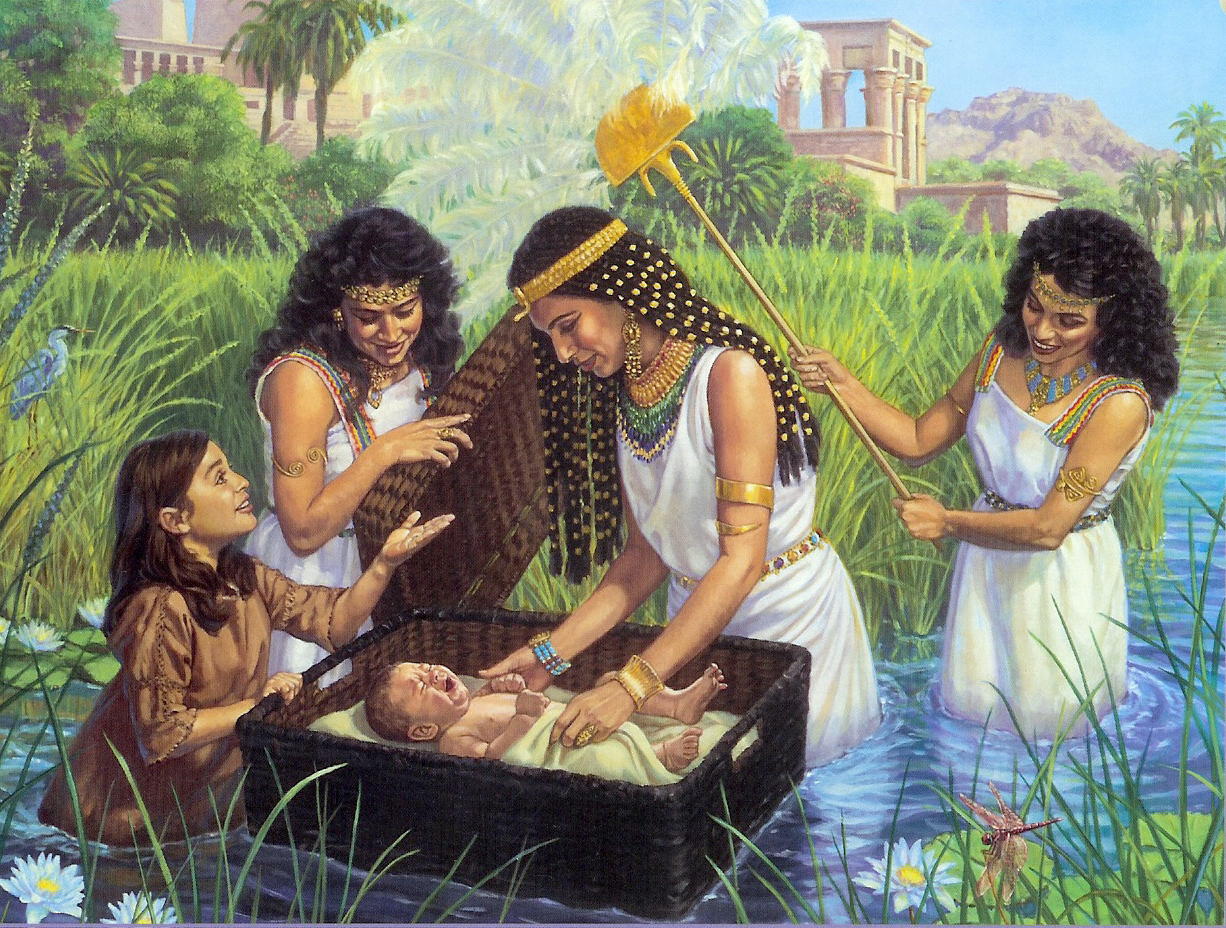
Now, everybody had to know this was a Hebrew baby – skin color, political situation at the time where male Hebrew babies were to be killed. But the Queen was in a tough, high-pressure spot. She had to produce a male heir.
So, after sending the baby away to be suckled and cared for as an infant by his mother Jochebed (arranged by Miriam), the “penny drops” for Queen Ahmose. What if she gets the toddler, names him “born of Amun”, claiming the god Amun was his father?
Who’s going to argue with a Queen who claims she was impregnated by the nation’s god, Amun, resulting in Amenmose? If the child is a son of the god, then that’s as good as it gets for Egyptians looking to carry on a royal, ruling line. Problem solved. We have an heir.
The timing of this event (the basket finding) seemingly had to occur sometime within, or just prior to, Thutmose I’s reign – 1506 BC to 1493 BC. (Since some chronologies have Thutmose’s reign beginning as early as 1526 BC, we see that Pharaonic history is not science.) So rather arbitrarily, we’re going to set the date of Moses’s birth as 1510 BC (which happens to fit our evolving chronology).
Our contention here is that Amenmose is, in fact, our Moses. And apparently, he was treated as the heir apparent, given education (tutored by Paheri), training, and increasing responsibility in the regime resulting in him being called ” Great Overseer of Soldiers “, apparently in charge of Egypt’s armies.
Of course, Moses has his run-in with the authorities after killing one of his overseers, and so escapes to the desert. What does the historical record say?
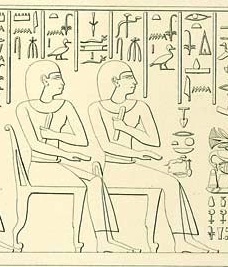
As we would expect, Amenmose disappears from history while quite young, before Thutmose I dies. He is attested in a mural in the tomb of his tutor, Paheri, along with his step-brother, Wadjmose, and he is identified in a small stone shrine (naos) also recovered from Paheri’s tomb dated to the 4th year of Thutmose I’s reign (or 1502 BC).
So how old was Moses when he escaped Egypt? If he was a young boy in 1502 BC (let’s guess 12 years old) and he disappears before Thutmose I dies (as late as 1493 BC), and we know he was at least old enough to attain the status of “Great Overseer of Soldiers” and “Generalissimo of His Father”[i], then how old might he have been at his escape? Ex 2:11 says he was “grown up”
While Pharaohs were known to accede to their position as children, such would not be the case with someone designated with these titles. We have to assume, therefore, that Moses was at least a late teen, early adult. If we guess at 20 years old, that puts the year of his escape at 1492, which is later than Thutmose I’s death, and so not possible. It seems Moses would have to be 18 or less at the time of his escape.
Now, this creates a bit of problem for us, as the Bible attests to Moses’s age in a few places. Acts 7:23 says he was 40 years old when he fled to Midian, and Ex 7:7 and Acts 7:30 say or imply he was 80 when he arrived back in Egypt for the Hebrews. Arguing for these ages is Dt 34:7’s statement that he was 120 at his death, which forms a kind of chronological pattern of 40 years in Egypt, 40 years in Midian, 40 years wandering, and death. Now 40 is one of those special, symbolic numbers in the Hebrew Bible – days of rain in and duration of the flood (Gen 7), days Moses spent on the mountain (twice!), number of days of spies in the Canaan, etc.
Therefore, assuming Moses didn’t take 22 years to cross Sinai to Midian, we’ve got a bit of a timing conflict. It is more likely that the Bible’s narrative ages are off than that the archaeological dates of artifacts in Egypt are off (although +- 10 years isn’t uncommon in dating events in Egyptian antiquity). The writer of Acts (Luke?) no doubt read Exodus 7 and perhaps concluded that the age 40 had to be Moses’s age as he left Egypt because Exodus said he was 80 when he returned after a 40-year sojourn in Midian. There is no explicit claim of Moses’s age when he left Egypt for Midian in the Hebrew Bible.
We’ll just elect to stay with our chronology in favor of the Bible’s age data, realizing that it may create other problems with the narrative, but also that it was written 1,000 or more years after the facts it describes. Our chronology would have Moses leave Midian for Egypt at 58, and die on Mt. Nebo at 98 (assuming the two 40-year durations involved are correct).
The Levites and The Hyksos
As we developed in the predecessor piece, the Hyksos (“foreign rulers”) are attested as a semitic people from the Levant (eastern end of the Mediterranean) who not only made their home in Egypt in the Nile Delta city of Avaris before, during and for 100 years or so after, Moses’s time there. They actually ruled the country from approximately 1650 BC to between 1550 BC and 1530 BC.
Their story, as documented in the historical record, starts in Egypt just before Abram would have sojourned there to escape famine, continues through their century or so of reign in the 15th-16th Dynasties, and tapers off as a semitic presence into the 15th century. The end of the semitic presence in Nile Delta coincides, more-or-less, with our assumed 1446 Exodus event.
Now, there were apparently two classes of Hyksos: the elite (described in the Egyptian historical record) and the common. The elite were driven out of the country in 1550 BC-1530 BC by Theban forces under Pharaoh Ahmose I. But the fate of the common people is not described. Archaeologically, we see continued semitic habitation evidence (pottery, etc.) in the Delta following 1530 BC, with a steady trend toward their Egyptian cultural assimilation, but the historical record is silent.
Now, these Hyksos elite didn’t only rule as Pharaoh. They held positions of responsibility throughout the culture including as priests, traders, managers, and assistants to royalty. These were certainly not common laborers, farmers, or shepherds.
It’s at this point that we need to come back to the Moses story and note that his family was of the tribe of Levi. We also need to note that Moses’s sister, Miriam, was described as employed as an assistant to the Queen’s daughter. Now, obviously, someone working within the Pharaoh’s household, attending his daughter, held a privileged position, just like our evidence for the Hyksos elite.
Now, does this mean all Levites were members of the Hyksos elite class? No, not necessarily. But neither does it present evidence that would challenge that assumption (for example, if the story was instead something like Miriam, after making mudbricks all day, took her baby brother and left him at the palace’s door, where the daughter took him in.)
The chronological problem with claiming that the Levites were the Hyksos elite is that the historical record has them being driven out (to Canaanite Sharuhen) by 1530 BC. Yet on our timeline, Moses’s Levitical family is still in Egypt in approximately 1510 BC, twenty years or so after the elite have left. Now, 20 years is not much of a discrepancy in ancient history. So, maybe it’s “close enough”.
The other possibility would seem to be that non-ruling Hyksos elite (e.g., professionals, etc.) were not seen as a threat by the Theban regime, and so allowed to stay which, no doubt, many of them would, as their standard of living was quite desirable[ii] given the alternatives. But, with only this one data point, it is too much of a stretch to infer that all Levites were in the population known as Hyksos, let alone elite Hyksos.
One other question that we’ll ask but not answer is: Why is it that nearly all names of Levites in the Bible are Egyptian, but essentially none of members of other tribes? Someday, I hope we’ll be able to answer that question. What was their connection that today we can’t see?
Conclusion
Within limits, we can fit together the Biblical pre-Exodus narrative with the historical record. Significantly, we have a logical candidate for Moses in the late 16th/early 15th centuries in the guise of Amenmose, a Pharaonic Prince in the household of Thutmose I and “The Great Royal Wife”, Queen Ahmose, fulfilling their need for a male, royal (in this case, divine) heir[iii].
Do the dates fit perfectly? I’m not sure historical dates ever fit any scenario perfectly, and ours surely follow suit. However, they’re plausible. They can be fine-tuned as more archaeological and historical information becomes available. In the meantime, I think it’s very cool that we can plausibly read of the Bible’s Moses in the history of Egypt.
[i] Both titles appear on the fragmentary stone naos (shrine model) recovered from Paheri’s tomb.
[ii] The whole subject of the conquest and removal of the Hyksos elite is an enigma in a mystery. Clearly, they had been the previous ruling class. As such, their normal treatment in antiquity would have been to be destroyed by the new rulers. But this was not the case here. Here, we’re told that the elites left Avaris before the Theban troops even arrived, and there is no archaeological evidence of a battle or destruction at Avaris in that timeframe.
So, what was the relationship between the Hyksos elite and the 18th dynasty rulers? We don’t really know. And why did some Hyksos remain in Egypt following the evacuation of their elite? We don’t really know.
[iii] I am indebted to the online podcaster Blk Shp Scott and his video entitled “Who Adopted Moses From the Nile (My theory)” for the inspiration and impetus to dig into this topic. This podcaster is legitimate and serious and has many thought-provoking videos. I recommend you have a look: Blk Sheep Bible Talk.
