Israel in Egypt?
Introduction
Where is the evidence for Israel in Egypt and their Exodus from it? When we look for its memory in Egypt we don’t find it. When we look for it at Jericho we don’t find it. When we look for it in Egyptian or Mesopotamian records we don’t find it. You would think something as momentous as an entire nation emigrating from one land to another would get some mention in the historical (not just the Biblical) record. But we don’t see it, explicitly.
Did it not happen (at least as recorded in the Bible)? Or, did it happen, but just not when we have been looking for it[0]?
Can we find Abram in Egypt? How about Joseph? Were the semitic Hyksos[i] rulers in Lower Egypt related to the Hebrews? What evidence do we have of this? And, what happened to them? Our goal is to propose a history that includes Abram’s arrival in Egypt, Joseph’s arrival and ascendancy in Egypt, the period of the growth of the tribes of Jacob in Egypt, and the circumstances of their exodus from Egypt. And for each of these we’ll propose supporting data.
Our answers are in layered strata of this question, its history, and its characters which we will try to point out, but not necessarily completely defend. (For that, you’ll need to consult referenced material.) We start with the question of when the Exodus happened, and work backwards.
The Battle of Timelines
There are basically two different theories of the timing of the Exodus. One relies on deduction, given prevailing circumstances in Egypt at its chosen time (and the Biblical narrative), while the other is based on straightforward arithmetic from dates based in the Bible. That’s one variation – Late Exodus (1250 BC) vs Early Exodus (1446 BC).
The other variation in both timelines is the meaning of “Israel’s” 430 years “in Egypt” (Ex 12:40). Should we interpret this as just the duration of Jacob’s family in Egypt (i.e the so-called “Long Sojourn”)? Or, should it rather start with Abram’s migration to Canaan and subsequent sojourn there (“Short Sojourn”, where short/long refers to the amount of time actually spent by Jacob’s family in Egypt), reenacting the very familiar strategy of escaping famine in the land by moving to Egypt.
A Note on the Short Scenario
Several scholars have noted that the Samaritan Pentateuch and Septuagint describe Israel’s sojourn as “in Canaan and Egypt”, while Josephus (Antiquities 2.318) divides the 430 years into two equal halves. So, their interpretation of 430 years is that it includes all of the time of the patriarchs living in Canaan as well as their and Jacob’s family’s time in Egypt divided equally into 215 years before Jacob enters Egypt and 215 years sojourn there.
Both variations significantly affect the resulting timelines and their alignment with the historical and archaeological record.
I’ve hidden the detailed section developing all of the possible dates for the entry into Egypt of our Patriarchs — Abram, Joseph, and Jacob — according to late (1250 BC) and early (1446 BC) dates of the Exodus, and the possible durations of Jacob’s sojourn in Egypt. To display that section, just click on this text. Click again to re-hide it.
The Late Timeline
This timing is favored by far by the majority of modern scholars, starting in the early 20th century. It is built on an interpretation of Exodus 1:11, which notes that the Hebrews built the storage cities of Pithom and Rameses. Since Ramesses II (1279-1213 BC) was the greatest builder in Egyptian history, scholars assume he must have been the Pharaoh of the Exodus.
The Exodus
Scholars in this camp pick 1250 BC as the year of the Exodus. Why 1250?
- 1250 marked the peak of the construction of Pi-Ramesses, becoming the royal capital. After 1200 BC the city begins to decline.
- The Merneptah Stele requires “Israel” to have been in Canaan at its writing, 1208 BC. A later Exodus date would not allow for the forty-year wandering period before settling in Canaan.
- Experts observe reduced Egyptian military activity in Canaan in mid-century vs earlier, as if the forces were depleted or, perhaps, drawn away to other fronts.
- Settlement patterns (unwalled villages) in Canaan’s highlands begin around 1200 BC
- Ramesses II’s military was known to have featured chariots, as emphasized in the Exodus narrative. Following 1200 BC chariot forces decline due to Bronze Age collapse pressures.
- Archaeology reveals destruction layers at Hazor and other Iron I sites between 1230-1220 – within 10 years of this timetable and so within the range of error.
Long Sojourn Scenario
Jacob Enters Egypt
We’re told in Ex 12:41-42 that Israel was in Egypt for 430 years. So, 430 years before 1250 BC is 1680 BC. In this scenario we take “Israel in Egypt” to mean “Jacob’s family in Egypt”.
Joseph Enters Egypt
We’re told that Joseph was 30 (Gen 41:46) when he “stood before the Pharaoh” (Gen 47:7-9). We’re also told that he was 17 (Gen 37:2) when he was left for the Ishmaelites/Midianites. Following being put in Pharaoh’s service Joseph oversees seven years of plenty and two years of famine (Gen 45:6) – nine years. So, Joseph must have entered the land 30-17+9 = 22 years prior to his brothers there summoning Jacob. So that would have Joseph enter Egypt in the year 1702 BC.
Now the interesting thing about this date is that it sits just on the earliest edge of what 20th century scholars established as the range of dates which included the advent and rise of the Hyksos people in Lower Egypt in the Nile Delta. More on the Hyksos to follow.
Abram Enters Egypt
To determine the date of Abram’s entry to Egypt we have to work backward from Jacob’s date of 1680.
First, we know that Jacob was 130 years old when he stood before Pharaoh (Gen 47:9). And we know that Isaac was 60 years old when Jacob was born (Gen 25:26). And, that Abram was 100 years old when Isaac was born (Gen 21:5). This tells us Abram was born 100+60+130 or 290 years before Jacob entered Egypt.
We’re told that Abram was 75 when, having received the promise, he set out for Canaan (Gen 12:4), and, once there, that he left Canaan for Egypt essentially immediately (Gen 12:10). So, the time prior to Jacob entering Egypt is 290-75=215 years, placing Abram’s entry to Egypt in (1680+215) = 1895 BC. This will turn out to be potentially very significant when we investigate the historical and archaeological evidence of this period below.
This places Joseph in the late Middle Kingdom / Second Intermediate Period transition, roughly contemporaneous with the rise of the Hyksos (which, admittedly, is the goal of some of its advocates).
Short Sojourn Scenario
Jacob Enters Egypt
Since the Exodus occurs on this timeline in 1250 BC, and the duration of Jacob in Egypt is 215 years (see scenario discussion, above), Jacob enters Egypt around 1465 BC.
Joseph Enters Egypt
Based on our Joseph calculations above, Joseph enters Egypt 22 years prior to Jacob or 1487 BC. This is 150-200 years after the advent, rise and disappearance of the semitic Hyksos rulers in the Delta area.
Abram Enters Egypt
Based on this scenario’s bifurcated 430 year sojourn period, Abram would have entered Egypt 215 years prior to Jacob, or 1680 BC.
The Problem: When you look for a collapsed civilization in Egypt (due to the loss of such a large percentage of its population through the Exodus) in 1250 BC under the reign of Rameses II, you don’t find it either in the historical or archaeological records. In fact, you find just the opposite; an Egypt that was experiencing its Golden Age of prosperity and security. Nor do you find material evidence in Canaan that indicates substantial population growth in a short amount of time.
Many scholars conclude, therefore, that the Exodus didn’t happen: that it was just a mythical fantasy.
The Early Timeline
While historians have spent decades arguing about when the Exodus could have happened, the Bible actually tells us exactly when it did happen. It gives us a specific, mathematical anchor point that allows us to synchronize biblical history with Egyptian history. The anchor is found in 1 Kings 6:1: “In the four hundred and eightieth year after the people of Israel came out of the land of Egypt, in the fourth year of Solomon’s reign over Israel… he began to build the house of the Lord.” This is our Rosetta Stone, so to speak.
Solomon became King in 970 BC. He started building the Temple in 966 BC.
So, 480 years before 966 BC is 1446 BC as the Exodus date.
Long Sojourn Scenario
Once again, Jacob is said to have been in Egypt 430 years (Ex 12:41-42).
Jacob Enters Egypt
Jacob enters Egypt 1446 BC + 430 = 1886 BC. We’ll comment on the potential significance of this timing below.
Joseph Enters Egypt
This occurs 22 years prior to Jacob or 1886 + 22 = 1908 BC.
Abram enters Egypt
Again, we’ll use the Patriarch formula that places Abram’s entry 215 years before Jacob or 2101 BC.
Short Sojourn Scenario
Here Jacob’s family is only in Egypt for 215 years.
Jacob Enters Egypt
1446 BC + 215 years = 1661 BC
Joseph Enters Egypt
Joseph precedes Jacob by 22 years = 1683 BC
Abram Enters Egypt
Abram enters the country 215 years before Jacob or 1876. This is potentially significant.
This Early Exodus, Short Sojourn scenario is our most likely candidate for our chronology. It is notable for its possible connection to other historical markers along its timeline, which we’ll examine next.
Meshing the Early Timeline with the Historical Record
The Beni-Hasan Mural
When we examine Egyptian history around 1880 BC, what do we find? This was the Twelfth Dynasty, in the heart of the Middle Bronze Age (2000-1600 BC). One historical fragment from this time is the Beni-Hasan mural (see below) discovered in a cemetery just north of Amarna in central Egypt in the tomb of one Khnum-hotep II, a regional governor/administrator of the area, typical of other regional “nomarchs” of the 12th Dynasty.
These “nomarchs” had significant status within their society, sufficient in this case to warrant a quite elaborate mural painted on the wall of his tomb.
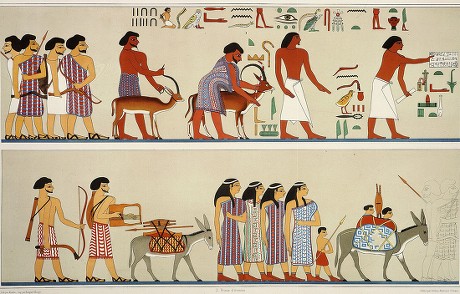
Asian family arriving in Egypt, after fresco, c. 1900 BC 12th dynasty
The mural depicts a prestigious semitic entourage, led by a figure identified as Abisha the Aamu, identified as a Hyksos, assumedly visiting the nomarch to transact trade. We presume the visitors were prestigious because the deceased sought to promote his own status by depicting their visit to him in his tomb.
Now the fascinating thing about the mural’s leader being identified as “Abisha” is that that name (an Egyptian transliteration) means “exalted father”. Interestingly, the name Abram means exalted (“ram”) father (“Ab”). So, “Abisha” is an attempt to replicate what the nomarch was told the visiting leader’s name was in his native (Akkadian – Hebrew didn’t exist yet) language, but in Egyptian.
Now the connection that is made by advocates of this timeline is that this may well have represented Abram and his family. However, it could possibly represent Isaac as both he and his father (and later Jacob) had sojourns in Egypt to escape famine. After all, the clothing and hairstyles/beards are semitic. The goods depicted on the 37-member caravan speak of wealth, especially the lyre. The family had a musician to entertain them at their camp stops, and also to play for their hosts in Egypt (a typical expression of respect by visitors for their hosts).
Also depicted appears to be a bellows. There is a long tradition of the Kenites (predating Israelites) being metal workers. So. it seems likely this group was not only interested in trading goods for grain but perhaps in trading their technology with the nomarch.
The Bible tells us that there “was a famine in the land” – Canaan (Gen 12:10). Assumedly, Abram’s entourage would have been looking to trade his substantial goods for sustenance for themselves for a significant period of time. Straight forward.
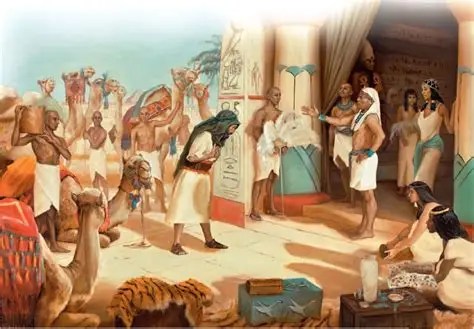
Of course, these prominent semitic visitors may have had no relationship with Abram or the patriarchs. But if it wasn’t him/them, what other wealthy Levantine Semite in the early 1800’s BC might it be? We have no extra-biblical information to answer that question. But we do have the biblical story and its testimony that Abram was, in fact, wealthy (Gen 13:2, 13:5-6, 14:14, 20:14-16, 24:35), travelled to Egypt (Gen 12:10), and so would have been esteemed by leaders who received him there. Therefore, we have established that this is possibly, if not conclusively, our Abram.
Finding Joseph
Manetho is a 3rd century BC Egyptian historian who wrote recounting the Hyksos period (as reported by Josephus in “Against Apion” 1:82-97[ii]). Manetho identified (as quoted by Josephus) a “Salitis” who, he says, the Hyksos made “king”. Both Manetho and Josephus wrote in Greek.
So “Salitis” appears to be a kind of phonetic transliteration of the Hebrew term 7989. שַׁלִּיט šalliyṭ, meaning mastery, power. This term is used sparingly in the Hebrew Bible, but it is used, as it turns out, of Joseph himself in Gen 42:6, where it is rendered “governor” in the ESV: Ge 42:6
6Now Joseph was governor over the land. He was the one who sold to all the people of the land. And Joseph’s brothers came and bowed themselves before him with their faces to the ground.
This portrayal of the station Pharoah had bestowed on Joseph is also expressed in Ge 41:41-44
41And Pharaoh said to Joseph, “See, I have set you over all the land of Egypt.” 42Then Pharaoh took his signet ring from his hand and put it on Joseph’s hand, and clothed him in garments of fine linen and put a gold chain about his neck. 43And he made him ride in his second chariot. And they called out before him, “Bow the knee!” Thus he set him over all the land of Egypt. 44Moreover, Pharaoh said to Joseph, “I am Pharaoh, and without your consent no one shall lift up hand or foot in all the land of Egypt.”
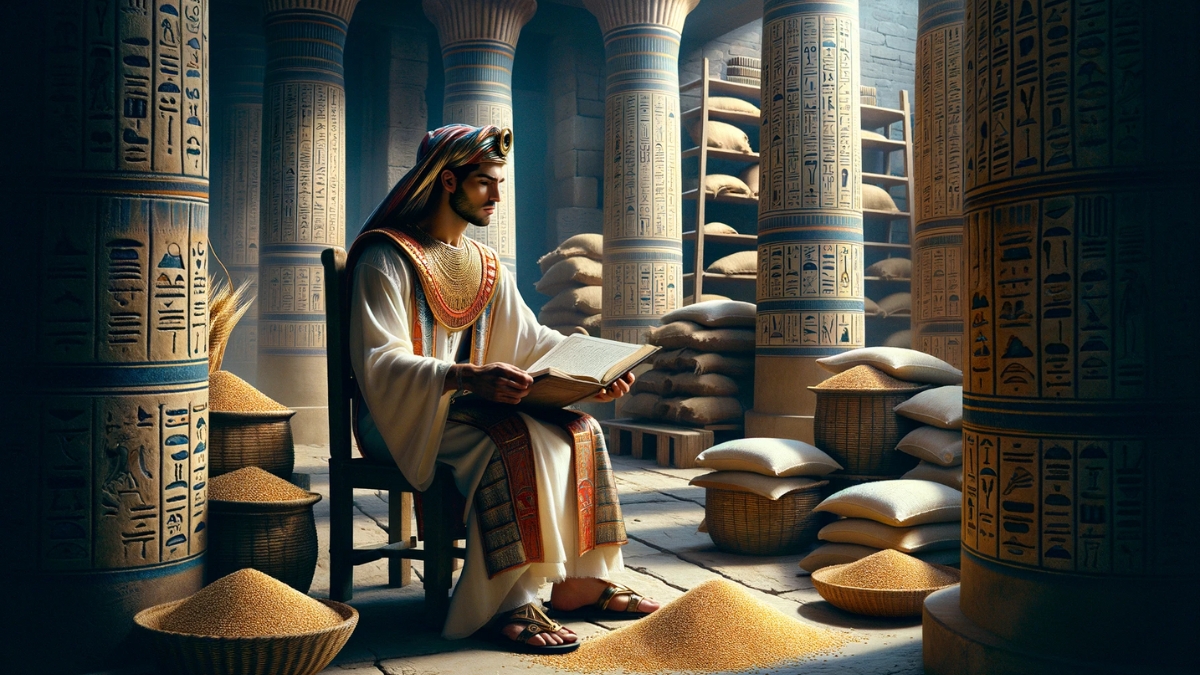
We’re told Joseph’s principal responsibility was seeing to the provisioning of Egyptian cities with grain from their surrounding fields Ge 41:49
49And Joseph stored up grain in great abundance, like the sand of the sea, until he ceased to measure it, for it could not be measured
Now, just so you’re fully informed, there is an argument out there today supporting this timeline, that Manetho via Josephus, identified Salitis as a “corn counter”. He did not.
This confusion is the result, initially, of Josephus incorrectly identifying the term Hyksos as meaning “shepherd kings”, or similar. Later medieval scribes misunderstood the term and used a gloss of “corn-counters” or “corn-measurers”, referring to all the Hyksos, not Salitis. In fact, Manetho characterizes Salitis as much more of a military commander than a corn-counter. So, this “rabbit trail” is a dead-end.
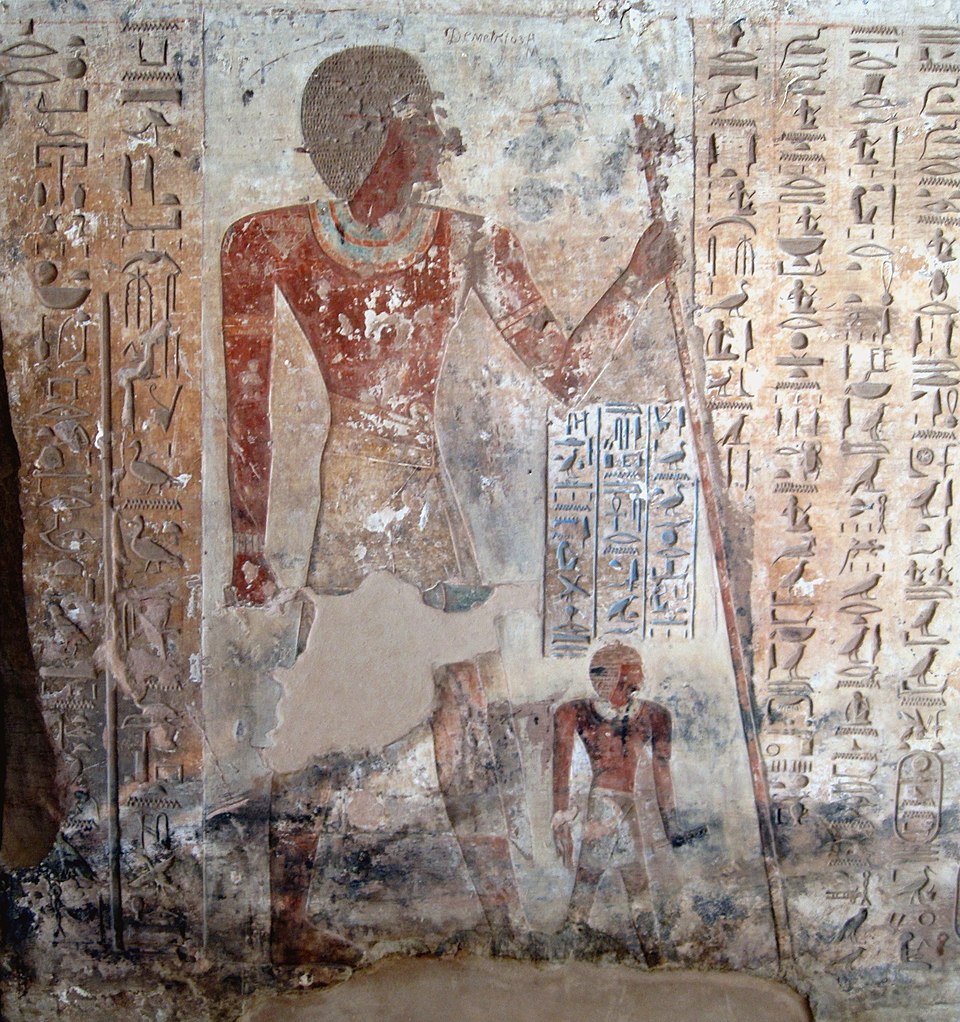
There is, however, an additional circumstantial piece of evidence, and that is a tomb in a cemetery in Avaris that consists of a prominent pyramid structure in which was discovered the remains of a statue.
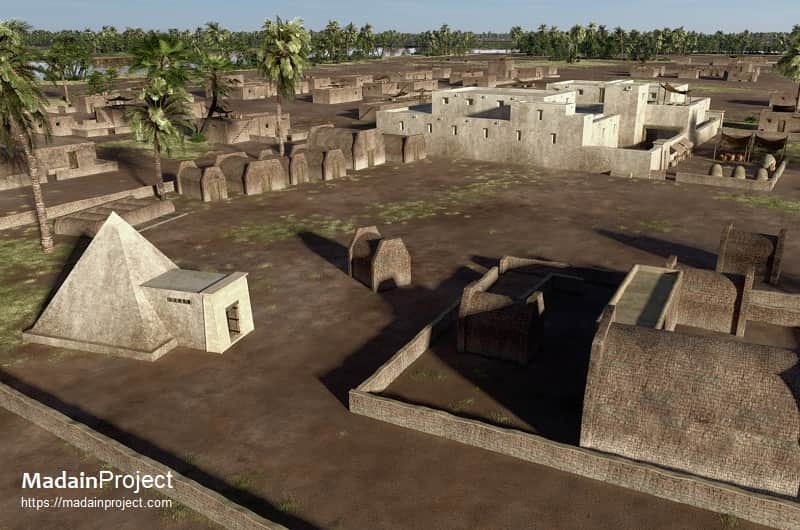
Two interesting facts about this cemetery are that 1) It is in Avaris, the Hyksos capital, and its ruins are from the time of Hyksos occupation of the area, and 2) it contains a funerary pyramid. Now that kind of pyramid tomb was reserved for prominent priests, governors, and rulers. So, the occupant of this structure was a big-wig in Hyksos polity.
Within the remains of that structure was found the severely damaged statue of a man. There are three unusual features of this man’s portrayal. First, his skin is yellowish, distinguishing him as Asiatic/Semitic, not the more common reddish-brown of Egyptian portrayals. Second, he’s wearing a turban which was common among Semites of the time. And third (as if on queue), his garment is a multi-colored robe stereotypical of Semitic peoples.
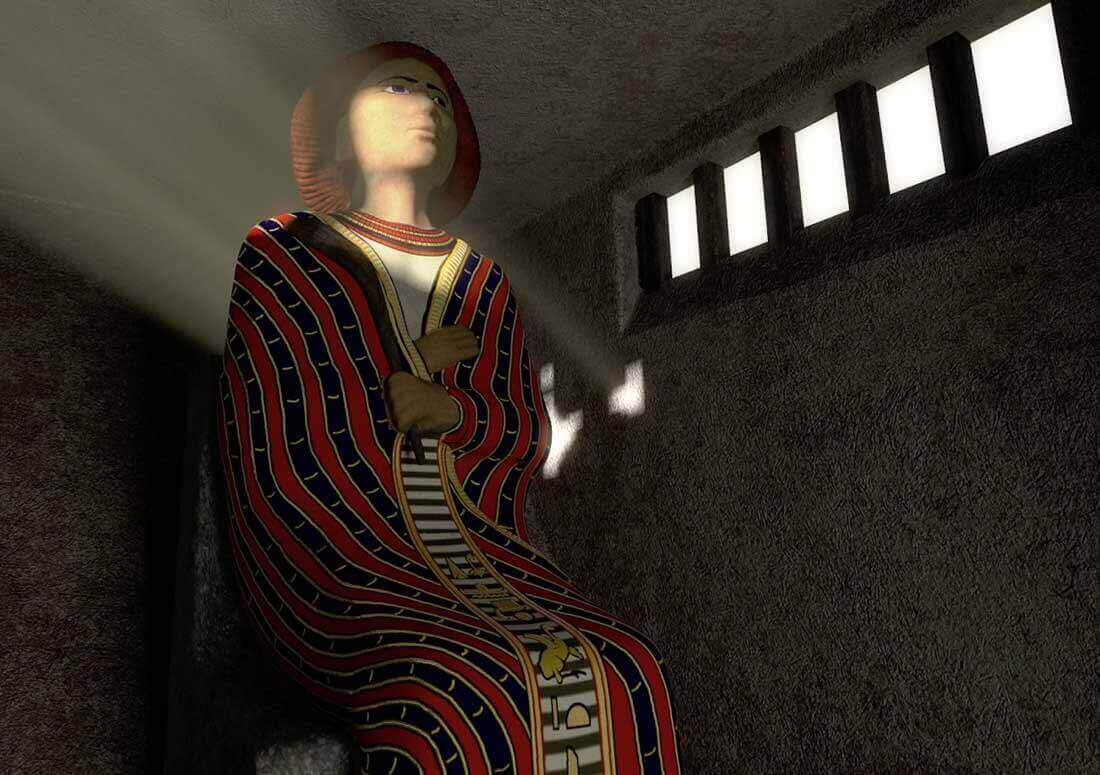
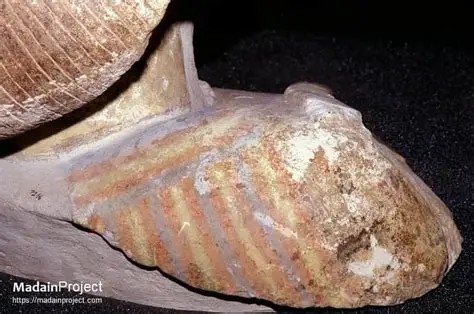
So, is this the tomb of Joseph, who lived to be 110, and whose bones his descendants took back with them to Canaan? Some scholars and many non-scholars think so.
The Hyksos
This was the period in Egypt known for the takeover by semitic Hyksos people of the district of the Nile Delta (1700-1550 BC) – Lower Egypt, establishing their capital at Avaris. Now, what semitic people are we told in the Bible entered Egypt around this time period? It seems that is the Joseph story and the family of Jacob around about 1661.
Manfred Bietak[iii] (with others) has been performing extensive excavations of the Avaris (Tell el‑Dabʿa) site for decades. His key findings include:
- The residents were largely not Egyptian, but Levantine, from the region surrounding the Eastern Mediterranean (including Canaan) making Avaris distinctive in terms of its burial customs, clothing, Syro‑Palestinian architectures, and Canaanite pottery. In addition, recent strontium isotope tests[iv] on the tooth enamel of several skeletons from that time confirm that many of those came from Levantine heritage.
- These foreign settlers began their immigration over three hundred years before eventually departing the region (late 1500’s to early 1400’s BC), about which more below.
- The prime vocation of these people seems to have been trading with their network of kinsmen in the Levant, maintaining close cultural ties to Canaan. In fact, these people likely moved freely[v] between sojourns in the Levant and also in Egypt.
Hyksos History
The advent of Levantine residence in the Nile Delta began gradually in the 19th century BC. As the population grew in size, so did its political power and organization.
Then toward the end of the 13th Dynasty (≈1650 BC), the central authority of Egypt began to fragment and weaken. This weakening provided the opportunity for the already politically-organized Hyksos to take autonomous political power in the Delta area.
Aside from archaeology, we have some textual evidence from our historian Manetho. Manetho calls these people “shepherds”, “pastoral people” which he equates with the syllable “sos”, of Hyksos in the source Egyptian, while the “Hyc” syllable he claims represents “king”. Scholars dispute this interpretation, associating the people instead with Sheiks of the (south Syrian) Bedouins[vi],[i]. He also incorrectly (remember, he was writing 1300 years after the fact) claims these “shepherds” invaded and “savagely attacked” the Egyptians to take power. There is zero physical evidence for such a violent takeover. The Hyksos were already there and organizationally established, enabling them to simply assume self-control within the Delta region. There they eventually become the 15th Dynasty.
These Hyksos leaders had West Semitic names (e.g., Khyan, Yaqub-Har, Apepi/Apophis). They apparently favored the Levantine storm god Ba-al (the Egyptian’s “Seth”) and were despised by their Egyptian neighbors.
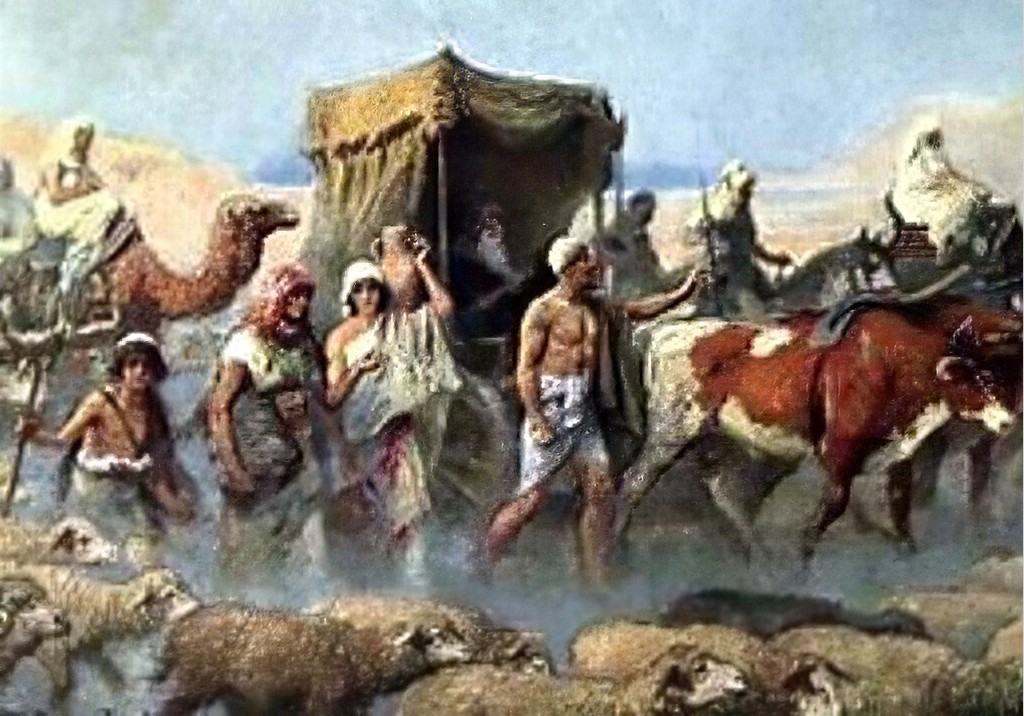
The Hyksos reigned and dominated from Avaris between the mid-1600s BC and roughly 1550-1530 BC when the 17th dynasty Thebans attacked and eventually expelled them (just their ruling class?) from Egypt. Here is where the story takes an interesting turn.
It is theorized that when the Theban attack from the south was immanent, the Hyksos elite (that had been running things in the Delta – priests, administrators, well-to-do traders) left and travelled by way of the Way of Horus, a road skirting the Mediterranean coast, to southern Canaan. But interestingly, a majority of the rank-and-file Hyksos remained, and fell under the control of the Theban ruler Ahmose I. It is therefore likely that this is our pharaoh of which the Bible says: Ex 1:8
8Now there arose a new king over Egypt, who did not know Joseph.
Ahmose I was the first “king” of Egypt in the 18th Dynasty, the dynasty that ushered in Egypt’s “New Kingdom”. This was the beginning of trouble for the Hyksos elite, and potentially the beginning of the enslavement of those left at Avaris.
Having entered Egypt in 1683 BC (according to our subject timeline, at age 17) Joseph would have preceded Ahmose I (1540-1515) by some 140 years. Joseph, living to the age of 110, would have died around the year 1590 (+-). Therefore, it seems likely that Ahmose I wouldn’t have “known” Joseph as Joseph had been dead for around 50 years when Ahmose I took power.
Escape To…?
Where did the elite emigrate to? Our historian friend Manetho says they “built a city in Canaan”, which others have equated with Jerusalem. Another possibility, supported by historical and archaeological evidence, is that they emigrated to a city in the southern Levant named Sharuhen[vii] (Tell el-Far’ah South), a fortified Canaanite city. The city itself is said to have had strong connections (trade, etc.) with the Delta area.
Egyptian records (the tomb of Ahmose, son of Ebana, dated to the Seventeenth and early Eighteenth Dynasties – approximately 1550-1480 BC) describe its siege. In its inscription, Ahmose the soldier (not the king) testifies about besieging Avaris as a soldier of Ahmose I, taking spoil and a few slaves from it, then besieging Sharuhen under Ahmose I for three (sometimes reported as six) years, from which he also took two slave women.
Further, Ahmose I’s Abydos Stellae are reported to recall his conquests of both Avaris and Sharuhen (reference material, however, appears unavailable).
Admittedly the evidence that the Hyksos elite emigrated (fled?) to Sharuhen is circumstantial. But here is a list of the more compelling data that they fled there before the Theban attack reached Avaris from the south:
• The archaeological record shows their removal from dominance at Avaris, not their destruction. There’s no destruction layer at that time at Avaris. There’s just evidence of a greatly reduced population.
This scenario makes sense if the elite who had been in charge were no longer there to be eradicated. The lower classes wouldn’t represent a threat to the King if they had no leadership or organization. In fact, they would represent a labor pool.
- The Tomb of Ahmose graffiti claims the siege of Avaris and Sharuhen
- The Funerary Stellae of Ahmose I at Abydos in which he (reportedly) recounts these events (among many others)
- The fact that Sharuhen was known to have Delta cultural ties and was fortified made it a logical destination for the escaping Hyksos elites.
- The fact that its siege lasted for (at least) three years as reported in these Egyptian sources indicates the seriousness with which Ahmose I took them as a threat to his reunifying nation.
However, this still leaves the open issue of what happened to the balance of Hyksos people left at Avaris and now subject to the King’s rule over them? After Sharuhen, the Hyksos as a people disappear from history. We’ll offer some speculation in the summary.
Jericho
Now we come to a point of controversy – the absence of a destruction layer at Jericho where it should chronologically be to support a 1446 exit from Egypt and a 40 year wilderness sojourn. (We should note it’s not at the 1210 BC level either that would support the Late Exodus timeline.)
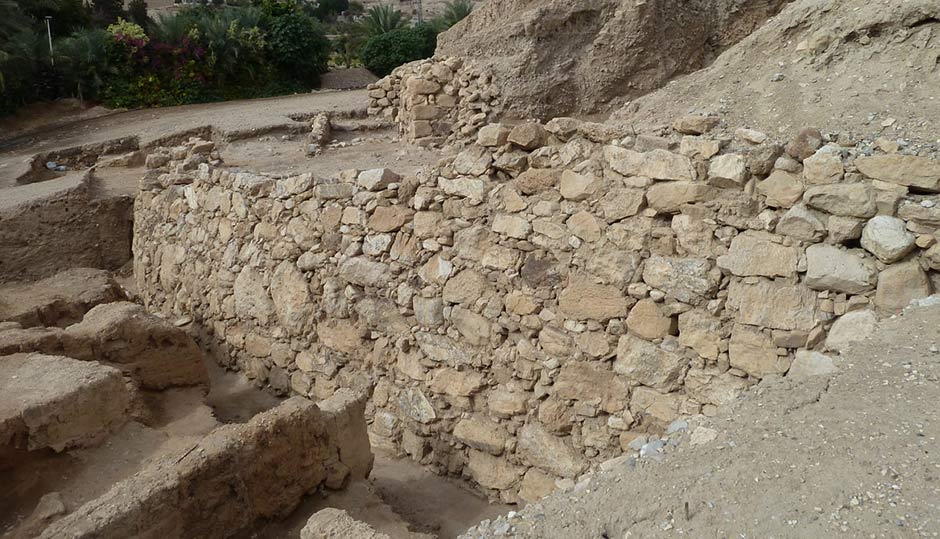
The majority of archaeologists today (which phrase, by itself, should send up red flags[viii]) conclude with Katherine Kenyon, from her excavation of Jericho in the mid-20th century, that the most recent destruction layer in Jericho dates to from 1550 to 1580 BC (“City IV”).
However, this majority does not include John Garstang, who excavated the site in the 1930’s, nor Bryant Wood, who has reevaluated Kenyon’s data and come to the conclusion that Jericho’s most recent destruction did not occur in the Middle Bronze period but in the Late Bronze period. While Wood has put out more recent public presentations[ix] than his 1990 BAR article, the facts have not changed.
The technical arguments Wood presents in both of his articles are not needed for our exposition here, but you can review these references at your leisure. To summarize, Wood’s primary arguments for a 1400 BC destruction of Jericho are:
- His contention that the pottery Kenyon dated to Middle Bronze (2000-1550 BC) are not restricted to that time period, and in fact have been found elsewhere in Israel in Late Bronze Age I (LB I) contexts (Hazor, Ashdod). Kenyon made other misinterpretations, like her misidentification of the bichrome pottery at the site as being later, local pottery, when Wood convincingly cites its LB I, Cypriot origin. This turned out to be the conclusive “evidence” for Kenyon to date the entirety of the destruction layer to MB IIB, 120-150 years too early for the biblical Jericho destruction.
- Very interestingly for our interests in this piece, Kenyon also biased the destruction of Jericho earlier (MB IIB) in order to tie it to the Hyksos expulsion from Egypt that she dated to 1570 BC.
- His identification of Egyptian scarabs from the cemetery at Jericho that identified Hatshepsut (1503–1483 BC), one of Tuthmosis III (1504–1450 BC) and two of Amenhotep III (1386–1349 BC)—as well as a seal of Tuthmosis III. It makes no sense for these to exist in a city that, according to Kenyon, was destroyed in 1580-1550 BC.
- Lastly, a piece of charcoal was Carbon-dated to 1410, +- 40 years, supporting a 1410-1400 BC destruction.
Now interestingly, one of the pieces of evidence “experts” use in favor of Kenyon’s dating was the C14-dating of charred grain supposedly from the same destruction layer resulting in a 1550 BC date (+-). (Wood contends those samples were from a “contaminated” context.)
So, if we accept Bryant Wood’s analysis (which, as an amateur, I do), we find another point where the biblical narrative and the physical and literary evidence interconnect.
Outstanding Questions
Were the Hyksos the descendants of Jacob in Egypt? Well, not exactly. The record knows of Semitic residents in Egypt in the 19th century BC, and Semitic rulers of the divided kingdom (Lower Egypt) in the 14th Dynasty (1700-1650 BC), encompassing the time that Joseph entered the country ≈ 1683 BC. This pattern certainly fits our Early Exodus, Short Sojourn timeline (e.g. Jacob’s arrival in 1661 BC, and estimates of the Hyksos ascension to power from the early part of that century to about 1600 BC[x].
We’ve seen that the Hyksos’ rise to power in the Delta was not the result of a military action (contrary to some historical reports). Rather, it was an internal rise to power, likely facilitated by the weakening of power in Memphis in the 12th Dynasty and its move to Thebes in the 13th, by a long-established immigrant population, without conflict.
What about this proposed timeline either disagrees with the Biblical narrative, or the physical evidence?
Biblical Narrative
One obvious issue for our timeline is the Biblical references to Pi-Ramesses (e.g. “Raamses” Ex 1:11) and Pithom. The name “Pi-Ramesses” means “House of Ramesses” and is the same location being referred to in the Bible as “Raamses”. The problem for us is that when a Pharaoh named Ramesses/Ramses appeared on the scene, according to our timeline, the Hebrews/Hyksos were long gone. And there were lots of them (Ramses), the first serving from 1292-1291 BC and the eleventh from 1106-1077 BC. So, how should we interpret this?
The Hebrew Bible is full of anachronisms – references to places, people or things that are completely out of the picture (generally much later) of the narrative in which they are referenced. We should expect that this is one of those cases, as the first Ramses postdates our Exodus by 150 years.
But, actually, it’s not too far wrong for as it turns out, Pi-Ramesses is built on top of the ruins of – Avaris, which the Hyksos most certainly did build, but not at the direction of some national ruler. They built and ran it for themselves, and very successfully. In fact, the whole concept of “store cities” mentioned in the Bible is not attested until Seti I and Ramesses II in the 19th and 20th Dynasties, not prior to the 18th during which time the then-Hyksos/Hebrews are said to have built them.
And the story is similar for the other city the Hebrews were said to have built – Pithom. The city of this name was built on the ruins of former cities that were inhabited much earlier than the Ramesside period. But the name “Pithom” was not in use in the 15th century and likely not until the 13th. However, it apparently was a city recalled in Egyptian history by the (much later) Biblical author.
A similar case is Ex 13:17’s reference to Philistines. There were no Philistines on the Mediterranean coast of Canaan in the 15th century BC. That coast was entirely controlled by Egypt. Philistines wouldn’t arrive there until around 1175 BC.
There are many, many such textual problems with a 1446 BC Exodus date (other than, of course, the fact that this is when the Bible’s 1 Ki 6:1 says it occurred).
Physical Evidence
One of the top contemporary archaeological problems with the Early Exodus timeline is that the evidence of a large population moving into and settling in Canaan at the beginning of the 14th century simply does not exist[xi]. These communities don’t start showing up until the 12th century (1200 through 1000 BC), at least 200 years too late.
Conclusions
Some of the narrative puzzle pieces from our Early Exodus (1446 BC), Short Sojourn (215 years) scenario fit with historical and archaeology data, and some don’t. What can we plausibly tie together? Here’s the list:
Abram in Egypt
We can plausibly place Abram entering Egypt (because of famine in Canaan) in the early 18th century BC. This timing lines up quite well with the Beni-Hasan mural in central Egypt depicting an entourage of Semites entering the area with apparent wealth, ostensibly to trade. This lines up with the Biblical narrative quite well, though not perfectly. Critics like to complain that Abram would not have led a family group of 37 people, as depicted in the mural, on such a mission. Such a conclusion likely depends on Abram’s goal for the visit: buy grain and take it back to draught-stricken Canaan, or settle in Egypt where food is available for the duration of the famine in Canaan. You can decide what you would do, and so who would accompany you – women and children (as depicted) or not.
Joseph in Egypt
Here we have the (somewhat chaotic) testimony of the historian Manetho both testifying to the Hyksos presence in Avaris, but also identifying one “Salitis” who he claims the Hyksos made “king”. We’ve shown that the term “Salitis” is likely a corruption of the Hebrew שַׁלִּיט (šalliyt), meaning mastery, power, and used as the title assigned by Pharaoh to Joseph in Ge 42:6, “governor”. The entry of Joseph in 1683 BC would put him in the mid phase of the Hyksos settlement in Egypt.
Jacob in Egypt
Here we have to rely on the general pattern of the story that Jacob and his sons and their families entered Egypt to escape a famine in Canaan. And they remained there for some time. The Bible calls it “430 years”, but we’re using the fact that the Septuagint and Samaritan Pentateuch identify this as the duration of the fathers in Canaan and Jacob in Egypt, along with Josephus’s testimony that Jacob’s time in Egypt was half of this total time.
In any event, we have at least a 215-year period of the propagation of the Jacob tribes within Egypt. Such a period of time could certainly produce a substantial population – possibly several hundred thousand, before they somehow leave for Canaan.
The Hyksos as Jacob
Here we’re simply speculating. We have a population (Jacob’s family) located in the Nile Delta identified as the “Land of Goshen” (which was, in fact, the region on the Eastern side of the Delta in which Avaris was located) biblically (also the “Land of Rameses” and the “Land of the Hebrews”) that matches the 16th – 15th century population of Hyksos at Avaris.
The most common objections to this hypothesis are:
- The social roles don’t work. The (early) Hyksos were rulers. The Hebrews were slaves.
- The memory of the Biblical Exodus is a later (Persian period?) recalling of Israel’s formative past, not a literal recollection of the Hyksos era.
- No Ancient sources establish any connection between the Hyksos and another sojourning Semitic population – the Hebrews.
- The timeline doesn’t work. The Late Exodus timeline eliminates any overlap of Hyksos and Hebrews. The Early Exodus timeline at least makes their chronological overlap possible. But the problem critics observe is that the (elite) Hyksos were expelled from Egypt by 1550-1530 BC, after having ruled the Delta, 85-105 years before our Exodus.
Here is where we have to pull the thread on the “elite” vs “common” Hyksos strand of the story. Several sources (e.g., Manetho) indicate that only the “ruling class” was expelled by 1550 (seeking refuge in Canaanite Sharuhen). Nothing is recorded about the fate of the non-ruling class Hyksos, presumably left behind in the Delta.
Why can’t these be the Hebrews who eventually (100 years later, after actually having been placed in servitude to the Theban Pharaohs who drove out their elite) made their Biblical Exodus?
It seems that no one has an interest in this possibility (other than to dismiss it[xii]) because virtually no data exists by which to connect the two peoples. To recap, here’s what we know about these people left in Avaris following its siege:
- First, there is no destruction layer in Avaris in 1550-1530 BC. The people nor the city itself were destroyed in some military operation.
- Second, the Avaris site shows signs of continuous occupation following 1550-1530 BC by a Semitic people.
- Based on archaeological evidence, the population of Avaris gradually assimilated into Egyptian culture, based on its pottery and burial customs
- Ramses II, 300 years later, rebuilds Avaris as “Raamses” (Pi- Ramesses). This period marked the Golden Age of ancient Egypt. So whatever economic damage had been done by the exiting Hyksos/Hebrews had been overcome by this time.
Hebrews/Israelites Destroy Jericho
Looking at the archaeological data (i.e., Woods, Garstang) we see that the case can be made for Jericho’s “City IV” destruction in approximately 1400 BC, fitting the Early Exodus timeline.
Israelites Settle in Canaan
Here’s where the narrative breaks down with the material evidence. There is no evidence, currently, of the widespread settlement of the Israelite highlands before the 12th century BC. This is just one of several other archeological anomalies/anachronisms associated with Israel’s “conquest” of Canaan (e.g., the “destroyed” Canaanite Ai was actually uninhabited in the 14th century; the Hazor destruction layer is 13th century, not 14th, etc.)
Speculations
The authors of the Hebrew Bible had a shared cultural memory of their ancestors coming out of Egypt. They didn’t have specific data that dated or provided historically accurate details of that emigration. Nor did they particularly care when or how, precisely, it occurred. The main point of the story is to demonstrate the faithfulness of their God in redeeming them from an oppressive environment to freedom in the land that He had promised to their “fathers”, establishing His covenant with them.
Could this memory have been based on the historical expulsion of the Hyksos elite from Avaris? After all, they were Semites and they did flee to southern Canaan, chased by the Egyptians. Or, might their memory be based on a slightly later exit of Semites from Egypt when the remaining Hyksos in the Delta, now in bondage to the Theban Pharaohs, escaped Avaris and their servitude – i.e. the Biblical narrative of fleeing their slavery?
One puzzling aspect to all of this for me remains the status of the Hyksos elite. There is historical data that at least some members of this elite were Levites. How do we know this? Well, Moses’ sister, Miriam, was apparently a trusted employee of the Pharaoh’s household, attending to his daughter. Of course, she, as well as Moses and his family, were Levites. In other words, she wasn’t a laborer, nor, we can assume was her father, both Levites. In fact, she was in one of the most trusted positions by Egypt’s royalty that existed. So, assumedly, this places them in the category of “elite”. But to what end?
If all the Levites (including Moses’ family) didn’t leave Egypt with the Avaris incursion, along with the other “elites”, why not? (It may be a related curiosity that most of the Levites’s names in the Bible are Egyptian, starting with Moses.)
You may wonder, in fact, where is Moses in all of this? Turns out his connection with the historical and archaeological record is even more stunning than that of the fathers. But there is just too much there to include in this piece. It’ll need its own. So, stay tuned.
I think that we’ve established both the plausibility and the feasibility of this scenario, assuming the Early Exodus timeline, with the exception of the apparent problem of the missing material record in the hill communities in Canaan/Israel in the proper time period (14th century, not 12th century). To resolve this will, of course, take a significant breakthrough either in the Exodus timing (is the 480 years of 1 Ki 6:1 actually correct?) , or new archaeological findings revealing Israel’s settlements prior to 1200 BC.
Admittedly, our analysis here only skims over the surface of what is an extremely complex, sometimes opaque network of people, places and events to interpret in terms of the Biblical narratives. But from this vantage point, it looks very promising.
Click on this text for a summary table of the key dates in our different timeline scenarios.
| Scenario | Exodus Date | Jacob in Egypt | Joseph in Egypt | Abram in Egypt |
| Late Exodus Lg Sojourn | 1250 BC | 1680 BC | 1702 BC | 1895 BC |
| Late Exodus Short Sojourn | 1250 BC | 1465 BC | 1487 BC | 1680 BC |
| Early Exodus Lg Sojourn | 1446 BC | 1886 BC | 1908 BC | 2101 BC |
| Early Exodus Short Sojourn | 1446 BC | 1661 BC | 1683 BC | 1876 BC |
[0] I am indebted to a gentleman who goes by the name “Blk Shp Scott” online through his podcast “Blk Shp Bible Talk” (on Youtube) for the inspiration for this piece, and much of its material. He has done a ton of research on these topics, produced many professional-looking podcasts that cover them, and is in the final throes of publishing his book to be titled “Dynasty of Slaves”. He’s not a biblical scholar. He’s just a very talented bible researcher who knows how to publish the material he uncovers.
[i] Meaning “foreign ruler” or “ruler of foreign lands”
[ii] Josephus, Against Apion 1:86
[iii] Bietak, Manfred, Avaris: The Capital of the Hyksos (1996)
[iv] Machemer, Thresea, New Research Reveals Surprising Origins of Egypt’s Hyksos Dynasty, Smithsonian Magazine, July 17, 2020
[v] Stantis, Christina, Multi-isotopic study of diet and mobility in the northeastern Nile Delta, Springer Science and Business Media LLC, 2020
[vi] Hastings, B.D. i. Egypt, 659 b)
[viii] Something like “most scholars believe…”
[ix] Wood, Bryant, Dating Jericho’s Destruction: Bienkowski is Wrong On All Counts, Associates for Biblical Research, 2012
[x] The name Hyksos (“foreign ruler”) wasn’t applied to this group of Nile Semites until they rose to power in the 1600’s BC
[xi] Gadot, Yuval, The Iron I Settlement Wave in the Samaria Highlands and Its Connection with the Urban Centers, JSTOR,
[xii] Geobey, Ronald A., Joseph the Infiltrator, Jacob the Conqueror? Reexamining the Hebrew-Hyksos Correlation, JBL 136, no. 1 (2017):23-37


Leave a comment