Introduction
When we read Jesus teaching in the New Testament, we know instinctively that He is speaking and teaching differently than we do today in the modern West. How is it different? What influenced His teaching “style” that we have become so familiar with over the years, but remains so distinctively “foreign” to our modern, Western ears?
That’s what we’ll dig into and explain.
For this entire piece, I am indebted to Dr. John DeLancey and his teaching that, if you’d prefer to simply watch his (45-minute) video on the subject, is available here. Otherwise, read on as I think this piece captures the information he presents in his video.
Context
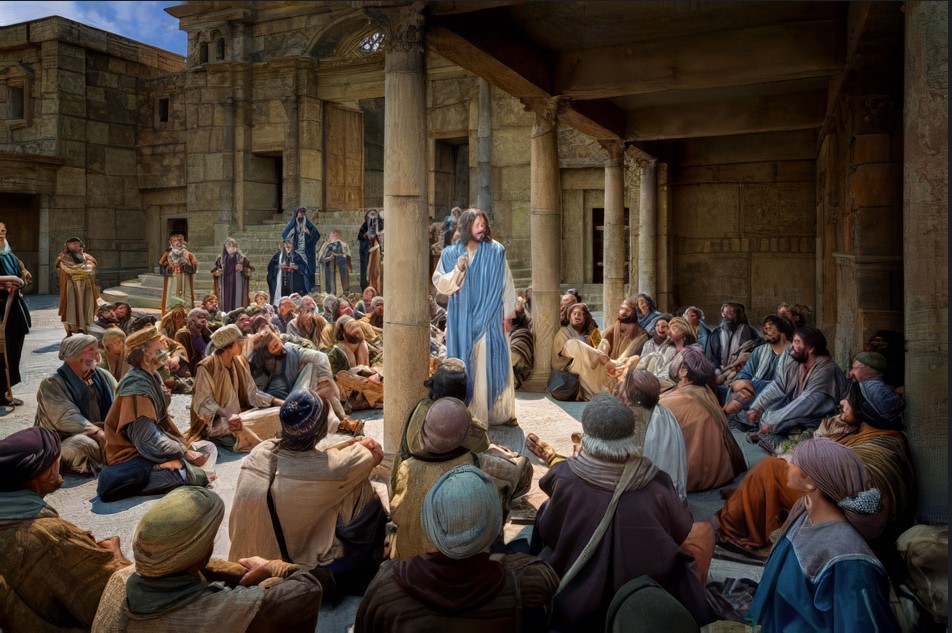
Jesus was a first-century Rabbi (teacher) in Israel who, we should not be surprised, taught using the rhetorical methods common to first-century (and later) Rabbis. In other words, His teaching techniques/genres were Jewish. So, quite obviously, if you’re a 21st century Gentile, His manner of speaking will seem quite strange to you, being as we are separated from Him not just by 2000 years, but more importantly by being completely separated from the rabbinical culture that shaped His teaching approach.
While Jesus’ messages were revolutionary, His teaching style was not. Why? He was trying to communicate with His Jewish brethren who were used to hearing certain styles of teaching. Since His mission was to communicate His message as clearly and straightforwardly as possible (subject to some caveats that we’ll look at toward the end), He communicated using these familiar forms.
Hebrew
Jesus taught in the tradition of His native language (and its close cousin, Aramaic) that was characterized by several literary and rhetorical techniques, foremost among them its repetition/rephrasing of keywords and phrases in its poetic forms. These language forms were simply the way a Jew would communicate a story to his kindred Jews, quite apart from the content of the story.
Kal v’chomer
This Jewish (transliterated) phrase means “Light and Heavy”. What it describes is a literary technique that made plain a truth by contrasting its lesser condition and evidence with its greater. Instances of this form typically include the phrase “how much more…”. One classic example of the use of this idiom is Luke 12:27-28:
[27] Consider the lilies, how they grow: they neither toil nor spin, yet I tell you, even Solomon in all his glory was not arrayed like one of these. [28] But if God so clothes the grass, which is alive in the field today, and tomorrow is thrown into the oven, how much more will he clothe you, O you of little faith!
Here the common man is compared to Solomon, as he is compared to the splendor of the lilies. They are emblematic of the beauty of God’s creation, of which man is its crown, and do literally nothing to continue to receive God’s favor. Yet man is, says Jesus, greater than lilies (the heavy greater than the light) and so should expect God’s favor as His created ones.
Another example of Kal v’chomer is Matthew 7:11
[11] If you then, who are evil, know how to give good gifts to your children, how much more will your Father who is in heaven give good things to those who ask him!
In other words, “if you (the light thing) are inclined to give good gifts to your children, how much more will your Father (the heavy thing) who is in heaven give good gifts…?”
The use of Kal v’chomer (or Kal v’homer) was a very common teaching technique amongst the Jews in Biblical times. This online resource points out that the passage in the Torah’s book of Numbers (12:24) presents an example of its use by YHWH Himself:
“In Numbers 12:14, after reprimanding Miriam, God sent her out of the camp for a week. Moshe asked for clemency for his sister but God replied, “If her father had spit in her face, wouldn’t she hide her face in shame for seven days?” If she would hide for a week after being chastised by her father, kal v’chomer she should leave the camp for a week after being chastised by God.”
The kal v’chomer reasoning allows us to draw conclusions from stricter to more lenient cases, or vice versa. It’s a powerful tool for understanding legal principles and making logical deductions within Jewish law. The essence of a kal v’chomer, then, is to draw conclusions based on logical comparisons between different situations.
Fencing the Torah (Heb: Asu S’Yag Latorah[i])
This technique is deeply embedded in Jewish teaching tradition and is sometimes referred to as an integral part of the “genealogy of rabbinic authority”. The first verse of the Mishna says this:
“Moses received the Torah from Sinai and committed it to Joshua, and Joshua to the Elders, and the Elders to the Prophets, and the Prophets to the men of the Great Assembly. They said three things: Be deliberate in judgment, raise up many disciples, and make a fence around the Torah”
The idea of “fencing” the Torah has to do with adding additional restrictions to its laws to act as safeguards which, if abided by, make it virtually impossible to violate the law they safeguard. Most of these restrictions were collected over time into what became known as the “Oral Torah” until ultimately being written in the Mishnah following the 70 AD destruction.
Jesus famously used this format of verbally insulating the Torah in His “You have heard it said…But I say…” sayings in the Sermon on the Mount. Here are some examples: Mt 5:21-22
[21] “You have heard that it was said to those of old, ‘You shall not murder; and whoever murders will be liable to judgment.’ [22] But I say to you that everyone who is angry with his brother will be liable to judgment; whoever insults his brother will be liable to the council; and whoever says, ‘You fool!’ will be liable to the hell of fire.
Certainly, not murdering is compliant with the Torah. But if you don’t even get angry in the first place, don’t insult another or demean him, then you likely avoid even the possibility of violating this law.
Mt 5:43-45
You have heard that it was said, ‘You shall love your neighbor and hate your enemy.’ 44But I say to you, Love your enemies and pray for those who persecute you, 45so that you may be sons of your Father who is in heaven.
Here Jesus refers to the scriptures (Lev 19:18, and possibly a passage like Ps 139:21-22), but doesn’t just “fence them” off, but raises the bar of the law immeasurably higher: loving enemies and praying for persecutors. All of Mt 5:21-48 is full of Jesus’ rhetorical fences.
A related concept of right living emerged in later rabbinical thought called “Hasidut”. According to an orthodox Rabbi, the idea of being a “Hasid” is someone who “Does not do only what he is told, but looks for ways to fulfill G-d’s will. This requires intelligence and planning; one must anticipate just what G-d wants of him and how he can best use his talents and abilities in service of his Creator.”
Lois Tverborg relates the two practices (Jesus’ fences and Hasidut) this way:
“The sermon on the mount was not a revolution against the Torah, but a revolution in understanding how to live out the Torah. Jesus was not exhorting you to become stricter than the strictest, but to model your life on the character of God Himself by living in a way that reflects His extravagant goodness.”
“Hasidut was about ‘going beyond the minimum’ and eagerly asking God the question: ‘ what more can I do to please you’?
Mashal(plural Mashalim) – Parables
Perhaps Jesus’ favorite method of teaching on a point was to employ stories whose characters and plots mirrored the subject He was teaching, but did so symbolically. This technique was not just a favorite of Jesus but also of Priests and Rabbis of the time and was fondly received by first-century Jews in great part because of the parables’ engaging narrative stories.
However, there is one seemingly puzzling dimension to Jesus’ reliance on parables to communicate His teachings. And He, Himself points this out to us in Mt 13:13-15:
This is why I speak to them in parables, because seeing they do not see, and hearing they do not hear, nor do they understand. [14] Indeed, in their case the prophecy of Isaiah is fulfilled that says:
‘“You will indeed hear but never understand, (Is 6:9-10)
and you will indeed see but never perceive.”
[15] For this people’s heart has grown dull,
and with their ears they can barely hear,
and their eyes they have closed,
lest they should see with their eyes
and hear with their ears
and understand with their heart
and turn, and I would heal them.’
Most of us read this passage and say to ourselves something like: “What on earth is He talking about? He’s here to teach; to impart the knowledge of God’s Kingdom come to Earth. Yet He says He’s using parables so that, effectively, they don’t learn what He is teaching them!”
Well, not exactly. Here’s what NT Wright, the acclaimed New Testament scholar and author has to say about Jesus’ statement:
“What he is saying is such dynamite that it can’t be said straightforwardly, out in the street. It is not that Jesus speaks in parables because he doesn’t want people to understand. He speaks in parables because they refuse to understand. Through parables, Jesus can communicate with the people who are ready to listen, and no one else will understand enough to cause immediate trouble.”
It had been claimed by their prophets for centuries that the Israelites/Jews had all manner of spiritual defects: stone hearts, ears that could not hear, eyes that could not see. Jesus here is simply reprising this theme as, in His time, they had not changed and were yet not ready to change. Most of them were, sadly, spiritually dysfunctional, while all the while thinking that they remained God’s chosen people despite their history of ignoring Him and His instruction (Torah).
Jesus offered a lot of parable teachings, as depicted in the following table.
| No. | Parable of Jesus | Matthew | Mark | Luke |
| 1 | New Cloth and New Wineskins | Matthew 9:16–17 | Mark 2:21–22 | Luke 5:36-39 |
| 2 | The Lamp on a Stand | Matthew 5:14-16 | Mark 4:21-25 | Luke 8:16-18 |
| 3 | The Wise and the Foolish Builders | Matthew 7:24-27 | Luke 6:47-49 | |
| 4 | The Two Debtors | Luke 7:41-43 | ||
| 5 | The Rich Fool | Luke 12:16-21 | ||
| 6 | The Watchful Servants | Mark 13:34-37 | Luke 12:35-40 | |
| 7 | The Faithful Servant | Matthew 24:45-51 | Luke 12:42-48 | |
| 8 | The Barren Fig Tree | Luke 13:6-9 | ||
| 9 | The Sower | Matthew 13:3-23 | Mark 4:3-20 | Luke 8:5-15 |
| 10 | The Weeds | Matthew 13:24-30, 36-43 | ||
| 11 | The Growing Seed | Mark 4:26-29 | ||
| 12 | The Mustard Seed | Matthew 13:31-32 | Mark 4:30-32 | Luke 13:18-19 |
| 13 | The Yeast | Matthew 13:33 | Luke 13:20-21 | |
| 14 | The Hidden Treasure and the Pearl | Matthew 13:44-46 | ||
| 15 | The Net | Matthew 13:47-50 | ||
| 16 | The Householder | Matthew 13:52 | ||
| 17 | The Lost Sheep | Matthew 18:12-14 | Luke 15:3-7 | |
| 18 | The Master and Servant | Luke 17:7-10 | ||
| 19 | The Unforgiving Servant | Matthew 18:23-35 | ||
| 20 | The Good Samaritan | Luke 10:30-37 | ||
| 21 | The Friend at Night | Luke 11:5-13 | ||
| 22 | The Wedding Feast | Luke 14:7-14 | ||
| 23 | The Great Banquet | Luke 14:16-24 | ||
| 24 | The Tower | Luke 14:28-33 | ||
| 25 | The Lost Coin | Luke 15:8-10 | ||
| 26 | The Prodigal Son | Luke 15:11-32 | ||
| 27 | The Unjust Steward | Luke 16:1-13 | ||
| 28 | The Rich Man and Lazarus | Luke 16:19-31 | ||
| 29 | The Workers in the Vineyard | Matthew 20:1-16 | ||
| 30 | The Persistent Widow | Luke 18:1-8 | ||
| 31 | The Pharisee and the Tax Collector | Luke 18:9-14 | ||
| 32 | The Two Sons | Matthew 21:28-32 | ||
| 33 | The Tenants | Matthew 21:33-44 | Mark 12:1-11 | Luke 20:9-18 |
| 34 | The Wedding Banquet | Matthew 22:1-14 | ||
| 35 | The Fig Tree | Matthew 24:32-35 | Mark 13:28-31 | Luke 21:29-33 |
| 36 | The Ten Virgins | Matthew 25:1-13 | ||
| 37 | The Talents | Matthew 25:14-30 | Luke 19:12-27 | |
| 38 | The Sheep and the Goats | Matthew 25:31-46 |
What was the nature and structure of Jesus’ parables? Klyne R. Snodgrass, in his book “Stories with Intent: A Comprehensive Guide to the Parables of Jesus” offers this analysis:
- “They are brief and straightforward, usually excluding unnecessary details”
- “They are marked by simplicity (e.g. at most two characters or groups interact in the same scene” and symmetry (e.g. repetition).
- “They focus mostly on humans, mirror the commonness of first-century Jewish life, and their main purpose is to goad people into a response.”
- “Although they may draw on historical events, they are fictional descriptions taken from everyday life that do not necessarily portray everyday life. They are pseudo-realistic in that they can contain hyperbole (e.g. a debt of 10,000 talents) and elements that shock.”
- “They are engaging; their intent is to elicit thought and require a decision, so finding the implied question a parable addresses is key to interpretation.”
- “Since parables often seek to change one’s thinking and behavior, they regularly contain elements of reversal (e.g. a Samaritan as hero).”
- “Like a punch line of a joke, the crucial aspect of a parable usually comes at the end.”
- “Parables are addressed to specific contexts in Jesus’ ministry, serving a specific teaching purpose, and seek to bring about change in people’s beliefs and actions; they are not general stories with universal truths.”
- “Parables illuminate God, God’s Kingdom, and the new reality God seeks to establish on earth (e.g. fathers, kings, and masters in parables generally are archetypes of God).”
- “Parables frequently refer to Hebrew Bible themes, ideas, and texts (e.g. the Good Samaritan illustrates the love commands at the heart of Judaism).”
- “Most parables appear in larger collections of parables, such as the Lost Coin, Lost Sheep, and Lost Sons in Luke 15.”
Remez (“Hints”)
Remez – “The use of part of a scripture passage in a discussion, assuming that their audience’s knowledge of the Bible would allow them to deduce for themselves the fuller meaning of the teaching.”
Jesus assumed (and legitimately so) that his audience was scripture-knowledgeable. Some examples:
In our first example, Jesus relies on his audience to recognize his allusion to Jeremiah when He challenges them with (Mt 11:29):
Take my yoke upon you, and learn from me, for I am gentle and lowly in heart, and you will find rest for your souls.
What had Jeremiah (6:16) said?
Thus says the LORD: “Stand by the roads, and look, and ask for the ancient paths, where the good way is; and walk in it, and find rest for your souls. But they said, ‘We will not walk in it.’
Virtually everybody He gave this message to understood His meaning. Jesus was presenting His “way” metaphorically as “the ancient paths, where the good way is”.
Next we have a somewhat more complex, and more poignant example. In Mark 15:34 we have this:
[34] And at the ninth hour Jesus cried with a loud voice, “Eloi, Eloi, lema sabachthani?” which means, “My God, my God, why have you forsaken me?”
Jesus’ quote comes from a reference to Psalm 22:1. But the apparent subtlety here is that the people who heard it understood the collection of Psalms from 22 to 24 as “shepherding” Psalms. Christ assumes His hearers will know that the conclusion of those “shepherding Psalms” (Psalm 24: 7-9) was to glorify God.
[7] Lift up your heads, O gates!
And be lifted up, O ancient doors,
that the King of glory may come in.
[8] Who is this King of glory?
The LORD, strong and mighty, (i.e. YHWH)
the LORD, mighty in battle!
[9] Lift up your heads, O gates!
And lift them up, O ancient doors,
that the King of glory may come in.
To Tanakh-knowledgeable hearers that day, Christ was telling them that He was their God – David’s “King of glory”.
Next, we have a Temple scene in which Jesus invokes Psalm 8. Mt 21:15-16:
[15] But when the chief priests and the scribes saw the wonderful things that he did, and the children crying out in the temple, “Hosanna to the Son of David!” they were indignant, [16] and they said to him, “Do you hear what these are saying?” And Jesus said to them, “Yes; have you never read,
“‘Out of the mouth of infants and nursing babies
you have prepared praise’?”
Psalm 8:2 says this:
[2] Out of the mouth of babies and infants,
you have established strength because of your foes,
to still the enemy and the avenger.
Here, obviously, Jesus is claiming the children’s acclaim as a sign of His strength. And assuredly, the chief priests and scribes would have made that scriptural association themselves, and as a result, understood exactly what Jesus was telling them.
This next example is a favorite, as the audience here is John the Baptist in whose case there is no doubt that he would call to mind the scripture to which Jesus alluded. Mt 11:2-6:
[2] Now when John heard in prison about the deeds of the Christ, he sent word by his disciples [3] and said to him, “Are you the one who is to come, or shall we look for another?” [4] And Jesus answered them, “Go and tell John what you hear and see: [5] the blind receive their sight and the lame walk, lepers are cleansed and the deaf hear, and the dead are raised up, and the poor have good news preached to them. [6] And blessed is the one who is not offended by me.”
Here Jesus was citing for John’s benefit Isaiah 29:18-19:
[18] In that day the deaf shall hear
the words of a book,
and out of their gloom and darkness
the eyes of the blind shall see.
[19] The meek shall obtain fresh joy in the LORD,
and the poor among mankind shall exult in the Holy One of Israel.
and, Isaiah 35:4-6:
[4] Say to those who have an anxious heart,
“Be strong; fear not!
Behold, your God
will come with vengeance,
with the recompense of God.
He will come and save you.”
[5] Then the eyes of the blind shall be opened,
and the ears of the deaf unstopped;
[6] then shall the lame man leap like a deer,
and the tongue of the mute sing for joy.
For waters break forth in the wilderness,
and streams in the desert;
In few words, but biblically founded words from the Tanakh, Jesus was declaring Himself to be the One to John.
This next one is undoubtedly my very favorite. We’re all familiar with the story of the woman caught in adultery. Here’s the story in John 8:4-9:
[4] they said to him, “Teacher, this woman has been caught in the act of adultery. [5] Now in the Law, Moses commanded us to stone such women. So what do you say?” [6] This they said to test him, that they might have some charge to bring against him. Jesus bent down and wrote with his finger on the ground. [7] And as they continued to ask him, he stood up and said to them, “Let him who is without sin among you be the first to throw a stone at her.” [8] And once more he bent down and wrote on the ground. [9] But when they heard it, they went away one by one, beginning with the older ones, and Jesus was left alone with the woman standing before him.
Most commentators wonder what on earth Jesus was writing. But perhaps it doesn’t matter. The scripture Jesus was physically alluding to with His action of writing was likely Jeremiah 17:13:
[13] O LORD, the hope of Israel,
all who forsake you shall be put to shame;
those who turn away from you shall be written in the earth,
for they have forsaken the LORD, the fountain of living water.
Jesus was indicting the woman’s accusers without words; with only His symbolic actions. What did He write in the dust? It just doesn’t matter. The act of writing in the dust invoked condemnation of the woman’s accusers, and they knew it.
Summary
Jesus was a first-century Jewish Rabbi (teacher). He taught using rhetorical forms common to first-century Jewish Rabbis. Yet what He taught with these familiar genres was revolutionary. Previous prophets of God had railed against the same attitudes and behaviors that Jesus condemned. But it wasn’t until Jesus that a sense of finality was communicated to Israel – that their God had come, once again, and finally, to live among them (Zec 8:3), and that He still found the problem of their unwillingness to live as He had instructed them to live.
His methods for communicating to these as-yet unwilling brethren were profound, and unmistakable in their intent to His hearers. Yet, He was nevertheless rejected by most of them.
Thank God that following His resurrection, He enabled us all to partake of His offer of everlasting life and, while living here, to grow more and more into the way of living that is God’s intent for His created humanity. It doesn’t get any better than that.
[i] Making Fences Around the Torah — Congregation Brit Shalom (britshalomstatecollege.org)

Leave a comment